
Find efficient natural gas garage heaters that balance output, installation flexibility, and operating efficiency. Below is a compact comparison of five top options suited for garages of different sizes and use cases.
| Product | BTU | Use Case |
|---|---|---|
| Mr. Heater Big Maxx MHU80NG | 80,000 | Large garage / workshop |
| Modine Hot Dawg HD45AS0111 | 45,000 | Residential/commercial garage |
| Reznor UDXC-225 | 225,000 (industrial) | Large commercial garage/warehouse |
| Mr. Heater MH40NG 40,000 BTU | 40,000 | Medium garage with 12–15 ft ceilings |
| Dyna-Glo IR30NMDG-1 | 30,000 | Small-to-medium garage, infrared radiant heat |
Content Navigation
- Mr. Heater F260560 Big Maxx MHU80NG Natural Gas Unit Heater
- Modine HD45AS0111 Natural Gas Hot Dawg Garage Heater 45,000 BTU
- Reznor 225,000 BTU Commercial Natural Gas Garage Heater UDXC-225
- Mr. Heater F272800 40,000 BTU Natural Gas Garage Heater #MH40NG
- Dyna-Glo IR30NMDG-1 30,000 BTU Natural Gas Infrared Wall Heater
- Buying Guide: How To Choose A High Efficiency Natural Gas Garage Heater
Mr. Heater F260560 Big Maxx MHU80NG Natural Gas Unit Heater
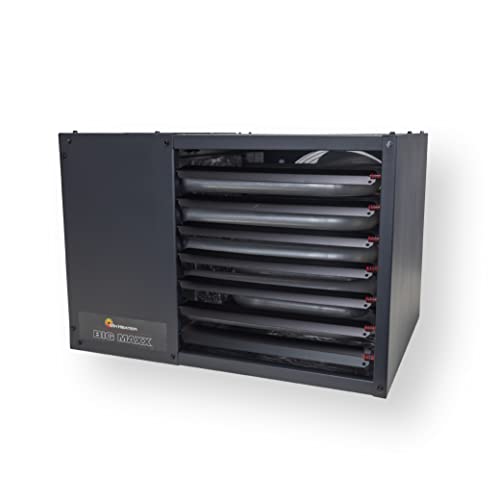
Output And Coverage: 80,000 BTU designed to heat up to approximately 2,000 sq. ft., making it suitable for large two-car or multi-bay garages and light workshops.
Included Items And Omission: Includes two angle brackets and an LP conversion kit. Thermostat, hose, and regulator are not included, so plan for ordering controls and gas connections separately.
Installation Notes: Unit dimensions are 29.33” L x 15.50” W x 26.37” H and it requires a minimum 8 ft. clearance from the floor to the base. Supports category 1 vertical and category 3 horizontal venting which increases mounting flexibility.
Electrical: Low electrical draw at 2.3 amps, 120 V operation suitable for standard garage circuits when only basic controls are used.
Call 888-896-7031 for Free Local HVAC Quotes – Compare and Save Today!
Modine HD45AS0111 Natural Gas Hot Dawg Garage Heater 45,000 BTU
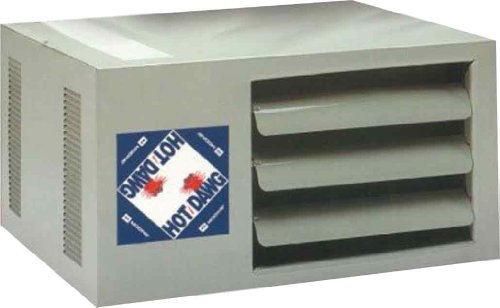
Quiet, Certified Operation: Modine lists this model as certified for residential, commercial and industrial use and highlights quiet operation, which is beneficial for attached garages or mixed-use spaces where noise matters.
Design And Mounting: Low profile, neutral grey finish for unobtrusive ceiling or wall mounting. This model’s compact footprint helps in garages with limited ceiling clearance.
Efficiency And Use: Often specified with high seasonal performance for unit-style heaters; designed to deliver dependable warm air without major ducting. Suitable for mid-sized garages where continuous, even airflow is needed.
Reznor 225,000 BTU Commercial Natural Gas Garage Heater UDXC-225

High Capacity, Industrial Use: Designed for large commercial garages, warehouses, and workshops. Rated outputs include multi-level fire capacities and a stated thermal efficiency around 83%.
Call 888-896-7031 for Free Local HVAC Quotes – Compare and Save Today!
Mounting Flexibility: Unit includes threaded-nut retainers for suspension points allowing ceiling or wall mounting depending on site needs. Mounting hardware may be sold separately, so account for installation accessories.
Performance Characteristics: Forced air distribution with a low static propeller fan for wide area heating. Best suited where very large volumes or open ceilings require high BTU delivery.
Mr. Heater F272800 40,000 BTU Natural Gas Garage Heater #MH40NG

Infrared Heat Approach: Uses efficient infrared radiant heating, which warms objects and people directly rather than solely heating air. Effective in garages with 12–15 ft ceilings where radiant heat reduces stratification losses.
Ceiling Height And Clearances: Engineered for buildings with 12-15 ft ceilings. Manufacturer clearances include top 36″, sides & back 30″, below 68″, and placement should respect these guidelines for safe operation.
Operational Use: Infrared models are often favored for intermittent use and workspaces where localized warmth is desired without running long ducted warm-air cycles.
Dyna-Glo IR30NMDG-1 30,000 BTU Natural Gas Infrared Wall Heater

Infrared Radiant Technology: Radiates heat to warm objects first, like sunlight, reducing the need to heat the entire air volume in the garage. Suitable for up to 1,000 sq. ft. depending on insulation and climate.
Fuel Compatibility: This model is natural gas ready and notes conversion restrictions. Confirm local fuel type and code compliance before installation.
Application Summary: Good for small-to-medium garages and workshops seeking cost-effective localized heating with a straightforward wall-mount installation.
Buying Guide: How To Choose A High Efficiency Natural Gas Garage Heater
Determine Heat Load And BTU Needs: Calculate garage square footage and ceiling height. For standard ceilings, a simple rule is 30–50 BTU per sq. ft., but cold climates, poor insulation, or tall ceilings require higher BTU ratings. Industrial spaces require far higher outputs and different distribution approaches.
Choose The Right Heat Delivery Type: Infrared (radiant) heaters warm objects and people directly and can be more efficient in high-ceiling or intermittently used garages. Forced-air unit heaters distribute warm air and are better for whole-space comfort and faster warm-up times. Wall furnaces can be suitable for attached garages with code-compliant venting.
Evaluate Efficiency Ratings: Look for stated thermal efficiency or manufacturer guidance (for example, some commercial units list efficiencies in the 80%+ range). Higher efficiency reduces fuel usage for the same heat output but consider installation and control strategy which influence real-world performance.
Venting And Installation Requirements: Unit heaters may be category 1 or 3 venting or require direct venting. Ensure you can meet clearance, venting, and combustion air requirements per local code. Ventless/vent-free units are not permitted in all jurisdictions and often not recommended for garages due to combustion byproducts and oxygen depletion concerns.
Safety Features And Certifications: Check for features like oxygen depletion sensors (ODS), flame failure devices, overheat switches, and self-diagnostics. Certification for residential and commercial use can indicate broader compliance with safety and performance standards.
Controls And Thermostat Compatibility: Built-in thermostats, programmable thermostats, or remote wall thermostats affect usability and efficiency. Some units require separate thermostats not included with the heater, so plan wiring and control placement accordingly.
Noise And Air Movement: Forced-air units use fans and can generate noise; consider quiet models for attached garages or spaces used as workshops. Infrared heaters are typically quieter but provide less air circulation.
Mounting And Space Constraints: Ceiling-hung units free floor and wall space and are often preferred in busy garages. Wall-mounted and floor units require proper clearances. Check manufacturer-recommended clearances and confirm you have adequate mounting structures.
Fuel Type And Conversion: Verify the unit is set up for natural gas or convertible with a kit (some include conversion kits). Some models are natural gas only and do not permit conversion to propane. Confirm local gas supply pressure and service compatibility.
Maintenance And Serviceability: Consider filter access, burner access, and whether replacement parts and service are readily available. Industrial units may require professional service agreements; consumer-grade units are often simpler to maintain.
Operating Costs And Long-Term Efficiency: Evaluate the unit’s efficiency alongside expected daily run hours and regional gas costs. A higher-efficiency unit may cost more up-front but can reduce fuel usage over time, especially with frequent operation.
Environmental And Ventilation Considerations: Combustion heaters introduce byproducts that need proper venting and make adequate fresh-air supply important. For enclosed attached garages, ensure ducting and venting prevent fumes entering living spaces.
Installation Permits And Local Codes: Always check local building and mechanical codes for garage heaters. Some jurisdictions restrict ventless units indoors or require specific vent types and clearances. Professional installation ensures code compliance and safe operation.
Comparison Perspectives: For small garages with occasional use, infrared wall heaters like the Dyna-Glo or Mr. Heater 40k provide localized economical heat. For whole-space comfort in mid-size garages, forced-air unit heaters like the Modine Hot Dawg offer balanced circulation. For large or commercial spaces, high-capacity units such as the Reznor UDXC series deliver required BTUs and distribution characteristics. The Mr. Heater Big Maxx fits large residential garages where a high single-unit output is needed with flexible venting options.
Final Practical Steps: Measure your space, assess insulation and typical operating hours, confirm fuel type, and consult a licensed HVAC or gas technician for sizing, venting, and permitting. Prioritize safety features and reliable controls to optimize efficiency and operation.
Tips for Getting the Best HVAC Prices
- Prioritize Quality Over Cost
The most critical factor in any HVAC project is the quality of the installation. Don’t compromise on contractor expertise just to save money. - Check for Rebates
Always research current rebates and incentives — they can significantly reduce your overall cost. - Compare Multiple Quotes
Request at least three estimates before making your choice. You can click here to get three free quotes from local professionals. These quotes include available rebates and tax credits and automatically exclude unqualified contractors. - Negotiate Smartly
Once you've chosen a contractor, use the proven strategies from our guide — How Homeowners Can Negotiate with HVAC Dealers — to get the best possible final price.