
Wall mounted gas heaters remain a reliable heating option for older homes looking to supplement or replace aging systems. Below is a concise comparison of relevant models selected for durability, mounting style, and heating capacity.
| Model | Type | BTU | Coverage |
|---|---|---|---|
| Comfort Glow 17,000 BTU Propane | Direct Vent Propane | 17,000 | Up To 570 Sq. Ft. |
| Comfort Glow 17,000 BTU Natural Gas | Direct Vent Natural Gas | 17,000 | Up To 570 Sq. Ft. |
| Comfort Glow 25,000 BTU Natural Gas | Direct Vent Natural Gas | 25,000 | Up To 825 Sq. Ft. |
| Mr. Heater 30,000 BTU Vent Free | Vent Free Natural Gas | 30,000 | Up To 1,000 Sq. Ft. |
| Dyna-Glo 10,000 BTU Vent Free Blue Flame | Vent Free Natural Gas | 5,000–10,000 | Up To 300 Sq. Ft. |
Content Navigation
- Comfort Glow 17,000 BTU Direct Vent Liquid Propane Gas Wall Heater, Gray, Large
- Comfort Glow 17,000 BTU Direct Vent Natural Gas Wall Heater, Gray, Large
- Comfort Glow 25,000 BTU Direct Vent Natural Gas Wall Heater, Gray, Large
- Mr. Heater MHVFBF30NGT 30,000 BTU Vent Free Blue Flame Natural Gas Heater
- Dyna-Glo 10,000 BTU Natural Gas Blue Flame Vent Free Wall Heater
- Buying Guide: Choosing A Wall Mounted Gas Heater For Older Homes
Comfort Glow 17,000 BTU Direct Vent Liquid Propane Gas Wall Heater, Gray, Large

This model is a direct vent propane wall heater rated at 17,000 BTU, designed to heat up to 570 sq. ft. The unit uses a sealed burn system and a Matchless Piezo Ignition, and includes a safety pilot with a built-in pressure regulator to stop gas flow if the pilot is extinguished. The compact, space-saving housing mounts to walls and measures 20″ H x 27.3″ W x 6.5″ D.
As a vented propane unit, it removes combustion products outdoors through a direct vent path, which can be preferable where indoor air quality or moisture concerns exist. Installation requires a proper venting run and a propane gas hookup following local codes.
Comfort Glow 17,000 BTU Direct Vent Natural Gas Wall Heater, Gray, Large

This Comfort Glow model shares the same 17,000 BTU rating and sealed burn safety features but is configured for natural gas. It lists heating capability up to 570 sq. ft. The design reduces indoor combustion by venting exhaust directly outside, maintaining indoor air quality.
Call 888-896-7031 for Free Local HVAC Quotes – Compare and Save Today!
Key features include the Matchless Piezo Ignition and a built-in pressure regulator on the safety pilot. The unit dimensions mirror the propane version and make it suitable for rooms where a wall-mounted direct vent solution is preferred over vent-free systems.
Comfort Glow 25,000 BTU Direct Vent Natural Gas Wall Heater, Gray, Large

This larger direct vent natural gas model delivers 25,000 BTU for spaces up to 825 sq. ft. It employs the same sealed burn system, Matchless Piezo Ignition, and safety pilot with pressure regulator as other Comfort Glow direct vent units.
The unit dimensions are 26.5″ H x 32.25″ W x 8.75″ D, offering increased heat output in a still wall-mounted profile. As with other direct vent heaters, installation requires an appropriate vent path and adherence to local gas and venting codes.
Mr. Heater MHVFBF30NGT 30,000 BTU Vent Free Blue Flame Natural Gas Heater
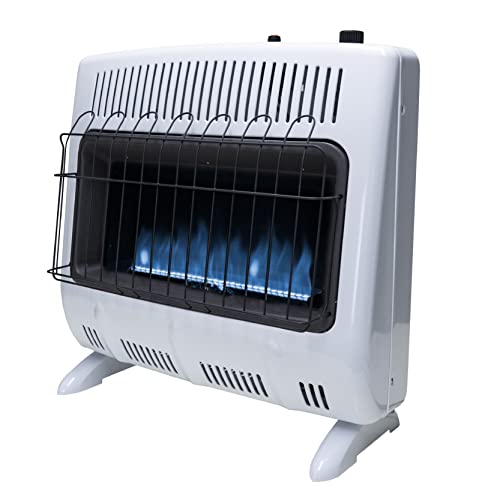
This vent-free blue flame heater supplies up to 30,000 BTU, intended for areas up to 1,000 sq. ft. The built-in thermostat enables precise temperature control, and an electric ignition is included with battery power provided. The blue flame design convects warmed air throughout the room.
Call 888-896-7031 for Free Local HVAC Quotes – Compare and Save Today!
Vent-free heaters do not exhaust combustion products outdoors, so they rely on indoor air exchange and may be subject to local restrictions or safety guidelines. The manufacturer notes performance up to higher altitudes and highlights fuel efficiency with blue flame combustion.
Dyna-Glo 10,000 BTU Natural Gas Blue Flame Vent Free Wall Heater

The Dyna-Glo vent-free blue flame model offers 5,000–10,000 BTU variable output and covers up to 300 sq. ft. Blue flame convection is intended to distribute heat similarly to central systems, with adjustable output to match smaller room loads.
As a vent-free unit, it provides simple installation and efficient energy use but requires attention to ventilation and adherence to regulatory limits on indoor combustion. It is suitable where modest heating is needed without a venting run.
Buying Guide: Choosing A Wall Mounted Gas Heater For Older Homes
When selecting a wall mounted gas heater for an older home, consider compatibility with existing utility services, venting requirements, safety features, and room size. The following factors will help evaluate models objectively.
Heat Output And Room Size
BTU rating determines coverage. Estimate square footage and use manufacturer coverage guidelines. For example, 10,000 BTU units commonly cover around 300 sq. ft., 17,000 BTU about 570 sq. ft., 25,000 BTU around 825 sq. ft., and 30,000 BTU near 1,000 sq. ft.
Vent Type: Direct Vent vs Vent-Free
- Direct Vent (Vented): Uses sealed combustion and vents exhaust outdoors. Better for indoor air quality and moisture control. Requires a proper vent run and more installation work.
- Vent-Free: No external vent; combustion products mix with indoor air. Easier to install and efficient but may be subject to local restrictions and requires adequate ventilation and CO/combustion monitoring.
Fuel Type And Availability
Confirm whether your home has natural gas or requires propane. Some units are model-specific and conversion may not be permitted. Choose a heater matched to your fuel source to avoid costly modifications.
Safety Features
Look for sealed burn systems, thermostats, safety pilot with pressure regulators, and reliable ignition systems. Vent-free units should be installed with carbon monoxide detection and follow local codes.
Installation And Local Codes
Older homes may have wall construction, clearances, or framing constraints. Verify clearance requirements, vent routing options for direct vent units, and any regional restrictions on vent-free appliances. Professional installation ensures compliance and safe operation.
Efficiency And Operating Costs
Vent-free units often report higher delivered heat efficiency because they do not lose warm air through a vent. Direct vent units vent combustion products but can preserve indoor air quality. Compare expected run times, thermostat control, and local fuel costs for long-term operating considerations.
Control Options And Comfort
Built-in thermostats and variable heat outputs support consistent comfort levels. Blue flame units provide convective heating, while infrared or radiant models focus heat on objects and occupants.
Maintenance And Durability
Consider ease of access for cleaning pilot assemblies, burners, and filters if applicable. Direct vent systems with sealed combustion chambers generally require less indoor maintenance related to combustion byproducts.
Comparison Perspectives
- Indoor Air Quality Focus: Prefer direct vent models with sealed combustion to minimize indoor pollutants.
- Ease Of Installation: Vent-free units are simpler to install where codes permit and no vent run exists.
- Large Space Heating: Higher BTU vent-free or vented models (25k–30k) suit larger rooms or open additions.
- Smaller Rooms Or Supplemental Heat: Low-output vent-free blue flame units deliver efficient local heating for bedrooms, bathrooms, or workshops.
Before purchase, measure the intended room, verify fuel compatibility, consult local code for vent-free appliance allowances, and plan for professional installation if venting or gas-line modifications are required.
Tips for Getting the Best HVAC Prices
- Prioritize Quality Over Cost
The most critical factor in any HVAC project is the quality of the installation. Don’t compromise on contractor expertise just to save money. - Check for Rebates
Always research current rebates and incentives — they can significantly reduce your overall cost. - Compare Multiple Quotes
Request at least three estimates before making your choice. You can click here to get three free quotes from local professionals. These quotes include available rebates and tax credits and automatically exclude unqualified contractors. - Negotiate Smartly
Once you've chosen a contractor, use the proven strategies from our guide — How Homeowners Can Negotiate with HVAC Dealers — to get the best possible final price.