
The guide below compares five notable flat panel radiant heaters for indoor use, offering specs, safety features, and ideal room applications. Each product entry includes the manufacturer’s listed features and the Amazon link for more details.
| Product | Brand | Key Feature |
|---|---|---|
| DeLonghi Mica Panel Space Heater | De’Longhi | Quiet 1500W mica panel, adjustable thermostat, safety shutoffs |
| Comfort Zone Oscillating Flat Panel Heater | Comfort Zone | 800W radiant/halogen, oscillation, slim profile for small rooms |
| Qmark 170W Electric Flat Panel | Qmark | 170W radiant panel, tip-over switch, compact dimensions |
| EconoHome Wall Heater Panel | EconoHome | 400W wall-mounted convector with thermostat and overheat protection |
| Floorheat Hydronic Radiant Heat Control Panel | Floorheat | Pre-assembled hydronic distribution panel for radiant floor systems |
Content Navigation
DeLonghi Mica Panel Space Heater

This De’Longhi unit is a 1500W mica panel space heater designed to deliver continuous, quiet heat for medium and large rooms. The manufacturer lists a fully adjustable thermostat and two heat settings to tailor comfort.
Key features from the product listing include: quiet operation that minimizes dust disturbance, 100% electrical-to-heat conversion for efficient output, and multiple built-in safety measures such as thermal shutoff, tip-over switch, and a standby mode that activates below approximately 41°F.
The design supports freestanding placement or easy wall mounting, providing installation flexibility for room layout and usage patterns.
Comfort Zone Oscillating Flat Panel Heater

Call 888-896-7031 for Free Local HVAC Quotes – Compare and Save Today!
The Comfort Zone model is described as an 800W radiant/halogen flat panel that targets occupants and objects with instant radiant heat. It is intended for small rooms, bedrooms, or office spaces where focused warmth is beneficial.
Manufacturer-listed features include radiant heating technology for direct warmth, a slim, space-saving profile, and an oscillation function that spans approximately 70 degrees to broaden coverage. Settings include multiple speeds for distribution control.
Safety features on the listing note an overheat sensor, tip-over switch, and a stay-cool exterior design, highlighting suitability for tight spaces where a compact footprin t is important.
Qmark 170W Electric Flat Panel
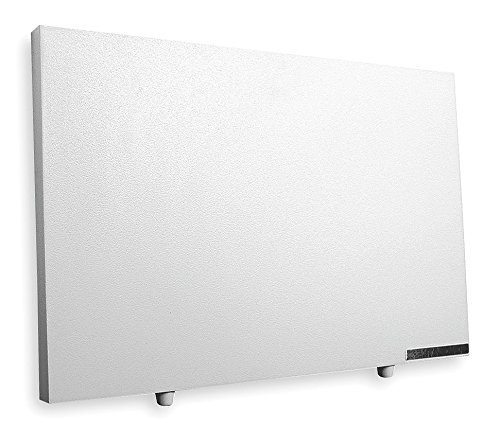
The Qmark 170W flat panel is a low-wattage radiant heater targeted at small area heating or supplemental use. The unit dimension and slim depth make it unobtrusive for narrow wall or floor placement.
Listed features include a 170W rated output, a three-prong grounded plug with a 72-inch cord, and built-in safety elements like an auto tip-over switch and power indicator light. The product listing states it is cETLus certified and includes a one-year warranty.
Call 888-896-7031 for Free Local HVAC Quotes – Compare and Save Today!
The entry-level wattage and single heat setting position this panel as suitable for targeted warming rather than whole-room climate control.
EconoHome Wall Heater Panel With Thermostat

The EconoHome flat panel is a 400W wall-mounted convector that blends convective and some radiant heat for consistent ambient temperatures in compact rooms up to approximately 120 sq ft.
Features from the listing highlight energy efficiency with a 0.6 kW/hr consumption claim, an adjustable thermostat with a temperature range around 41–86°F, cETL approval, and overheat protection. The unit can be hard-wired or used with standard electrical connection depending on installation preference.
The manufacturer notes the exterior will feel warm during operation, and that the device primarily uses convection with supplemental radiant output to distribute heat evenly in the target room size.
Hydronic Radiant Heat Control Panel

The Floorheat product is a pre-assembled hydronic distribution panel for radiant underfloor or space heating systems. This is a system component rather than a plug-in electric panel heater and is intended for integration with hydronic boilers or manifold systems.
Product features include a preassembled, space-saving design for easier installation and professional configuration for one-zone control. The listing requires a direct phone number for delivery logistics, indicating specialized handling.
As a hydronic solution, it emphasizes high efficiency for whole-floor radiant systems and is suited to installations where a circulation loop, manifolds, and boiler/generator are already or will be in place.
Buying Guide: How To Choose A Flat Panel Radiant Heater
Selecting the right flat panel radiant heater depends on application, power source, installation, and safety needs. The sections below outline considerations across multiple comparison perspectives.
Heat Type And Application
- Direct Radiant Panels: Provide focused warmth to people and objects in the panel’s line of sight. Best for supplemental heating, desks, seating areas, and spot warming.
- Convector Panels: Combine mild radiant output with convection currents for more even room warming. Better for continuous ambient heating in enclosed rooms.
- Hydronic Panels: Integrated with hot-water systems for whole-floor radiant heating. Suitable for central systems and new builds or major renovations.
Wattage And Coverage
- Higher wattage units (e.g., 1500W) can heat medium to larger rooms faster but require adequate circuit capacity.
- Lower wattage panels (100–400W) are effective for small rooms, bathrooms, or targeted supplemental warmth.
- Match panel wattage to room size and insulation: well-insulated spaces require less power for the same comfort level.
Installation And Placement
- Wall-Mounted vs Freestanding: Wall-mounted panels free floor space and are ideal for long-term placement. Freestanding units offer portability.
- Hydronic Integration: Hydronic panels need plumbing and a heat source; factor in installation complexity and contractor requirements.
- Clearances: Check manufacturer recommended clearances from furniture and combustible materials.
Controls And Thermostat Options
- Basic models offer simple on/off and fixed heat settings; units with adjustable thermostats maintain desired temperature more efficiently.
- Programmable thermostats, timers, and smart compatibility add energy savings by limiting runtime.
- For animal enclosures or specialized use, remote control and memory functions can be important for unattended operation.
Safety Features
- Look for overheat protection, tip-over switches, and certified safety marks (cETLus, UL). These features reduce risk in daily use.
- For units used near children, pets, or combustible materials, exterior surface temperature and stay-cool housings matter.
- Hydronic panels have different risk profiles but still require correct pressure and pump protection for safe operation.
Energy Efficiency And Operating Cost
- Efficiency claims: electric panels convert most input energy to heat, but overall operating cost depends on local electricity rates and usage patterns.
- Thermostat control, zoning (heating only the occupied area), and programmable schedules reduce energy consumption compared to continuous operation.
- Hydronic systems can be very efficient when paired with high-efficiency boilers or heat sources and are often preferred for whole-house radiant heating.
Durability, Warranty, And Certification
- Check manufacturer warranty lengths and what components are covered (elements, electronics).
- Certifications such as cETLus or UL indicate compliance with recognized safety standards.
- Consider element lifetime claims and serviceability for long-term installations.
Comparison Perspectives
- Room Size: Choose higher wattage and thermostatic control for larger rooms; smaller wattage panels are adequate for spot heating.
- Portability vs Permanence: Portable units offer flexibility; wall-mounted or hard-wired panels suit permanent installations and reduce trip hazards.
- System vs Supplemental: Hydronic panels are part of a whole-house strategy, while electric flat panels serve supplemental or targeted heating needs.
- Safety Priorities: For households with children, pets, or flammable materials, prioritize models with tip-over protection and stay-cool exteriors.
Use the above criteria to weigh trade-offs: higher power and automatic thermostats deliver faster, consistent heating, while lower-wattage or hydronic options offer longer-term efficiency depending on system design. Always verify installation requirements, electrical circuit capacity, and safety clearances before purchase or installation.
Tips for Getting the Best HVAC Prices
- Prioritize Quality Over Cost
The most critical factor in any HVAC project is the quality of the installation. Don’t compromise on contractor expertise just to save money. - Check for Rebates
Always research current rebates and incentives — they can significantly reduce your overall cost. - Compare Multiple Quotes
Request at least three estimates before making your choice. You can click here to get three free quotes from local professionals. These quotes include available rebates and tax credits and automatically exclude unqualified contractors. - Negotiate Smartly
Once you've chosen a contractor, use the proven strategies from our guide — How Homeowners Can Negotiate with HVAC Dealers — to get the best possible final price.