
Electric radiant floor heating adds comfort and efficient warmth to bathrooms, kitchens, and whole rooms. Below is a quick comparison of five in-floor heating kits and thermostats chosen for compatibility, installation options, and control features.
| Product | Type | Key Feature |
|---|---|---|
| LuxHeat 20sqft Floor Heating Mat Kit | Heating Mat Kit | Self-adhesive 3″ pre-spaced mat, includes thermostat & GFCI |
| LuxHeat 70sqft Floor Heating Mat Kit | Heating Mat Kit | 70 sq ft mat with UWG5 WiFi thermostat and alarm |
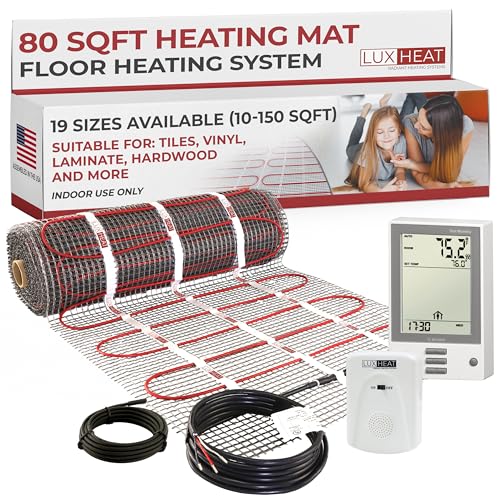
| LuxHeat 80sqft Floor Heating Mat Kit | Heating Mat Kit | 80 sq ft mat with UDG thermostat and built-in GFCI |
| LuxHeat 150sqft Floor Heating Cable Kit | Loose-Lay Cable Kit | Flexible cable for custom layouts, 150 sq ft total |
| Mysa Smart Thermostat For Electric In-Floor Heating | Smart Thermostat | WiFi app control, Class A GFCI, voice assistant support |
Content Navigation
- LuxHeat 20sqft Floor Heating Mat Kit – 120v In Floor Heating System
- 70sqft Floor Heating Mat Kit – 120v In Floor Heat Kit With WiFi Thermostat
- LuxHeat 80sqft Floor Heating Mat Kit – 120v Electric Radiant In Floor Heat
- LuxHeat 150sqft Floor Heating Cable Kit – 120v Vinyl Flooring Heating System
- Mysa Smart Thermostat For Electric In-Floor Heating 240V | Class A GFCI
- Buying Guide: How To Choose An In-Floor Heating System
LuxHeat 20sqft Floor Heating Mat Kit – 120v In Floor Heating System

This compact kit is designed for small rooms or targeted areas such as bathrooms. The package includes a 20 sqft self-adhesive heating mat, a cable monitor/alarm, and an OJ Microline UDG-4999 programmable thermostat with an integrated GFCI and floor sensor. The mat’s 3″ pre-spaced design can be cut and turned (but not cut through the heater wire) to fit irregular shapes. Installation requires embedding the heating wires in a self-leveling underlayment, thinset, or mortar, which is typical for tile and laminate installations. LuxHeat offers a 25-year limited warranty and positions this kit as an easy-to-install option for localized radiant heat.
70sqft Floor Heating Mat Kit – 120v In Floor Heat Kit With WiFi Thermostat

The 70 sqft kit expands coverage for larger rooms while maintaining the same installation approach as smaller mats. It includes a 70 sqft self-adhesive heating mat, cable monitor/alarm, floor sensor, and the UWG5-4999 programmable thermostat with WiFi capability and built-in GFCI. The pre-spaced mat adheres to subfloors with double-sided tape, and can be rotated or flipped to match the layout. The manufacturer notes that heater wires must be embedded in underlayment or mortar and warns against cutting the heater wire. This kit targets users who want remote control and scheduling features combined with an integrated safety GFCI.
LuxHeat 80sqft Floor Heating Mat Kit – 120v Electric Radiant In Floor Heat
Call 888-896-7031 for Free Local HVAC Quotes – Compare and Save Today!
The 80 sqft kit is intended for moderate-to-large rooms and includes an 80 sqft self-adhesive heating mat, alarm, floor sensor, and the OJ Microline UDG-4999 programmable thermostat with built-in GFCI. Like other LuxHeat mats, the 3″ spacing and adhesive mesh simplify positioning. The kit requires embedding wires in suitable underlayment and prohibits cutting the heating conductor. This option provides a balance between coverage and the convenience of a packaged thermostat and safety monitor.
LuxHeat 150sqft Floor Heating Cable Kit – 120v Vinyl Flooring Heating System

This kit uses loose-lay heating cable rather than a pre-spaced mat, providing more design flexibility for irregular rooms or partial coverage. The kit includes two 120V heating cables totaling 150 sqft, two cable monitors/alarms, a touchscreen programmable thermostat (UDG4-4999) with floor sensor and GFCI, plus cable guides and strapping for secure installation. Loose cables must be fastened to the subfloor with supplied strapping and embedded in self-leveling underlayment or mortar. The cable system is suitable where a mat cannot be routed around fixtures, or where custom spacing is required for heat distribution.
Mysa Smart Thermostat For Electric In-Floor Heating 240V | Class A GFCI

The Mysa thermostat is a high-voltage smart controller specifically designed for electric in-floor heating systems. It supports 120–240V systems with a built-in Class A GFCI. Mysa offers app-based scheduling, geofencing, energy reports, and voice control via Alexa, Google Assistant, and Siri. The product emphasizes remote monitoring without subscription fees. Mysa is not compatible with hydronic (water-based) systems; it targets users seeking smart-home integration and advanced energy-saving controls for electric radiant floors.
Buying Guide: How To Choose An In-Floor Heating System
Selecting the right in-floor heating system requires balancing room size, floor covering, installation method, control preferences, and safety features. Below are the primary factors to evaluate.
Call 888-896-7031 for Free Local HVAC Quotes – Compare and Save Today!
System Type: Mat Vs. Loose Cable
- Heating Mats — Pre-spaced mats are fastest to install for regular-shaped areas and tile or laminate floors. They offer predictable heat density and easy layout for full-room coverage.
- Loose Heating Cable — Cable systems are more flexible for irregular rooms, partial coverage, or installations around fixed fixtures. They require strapping to the subfloor and careful spacing documentation.
Flooring Compatibility
- Tile, stone, and concrete are excellent heat conductors and commonly used with electric mats and cables.
- Laminate and some vinyl floors work with radiant systems but often require a floor sensor and manufacturer-approved limits on surface temperature.
- Ensure the heater kit and thermostat provide a floor temperature sensor and limiting features for sensitive coverings.
Voltage And Electrical Requirements
- Confirm the kit voltage (commonly 120V or 240V) matches your circuit and electrical capacity.
- High-voltage systems may require dedicated circuits and electrician installation. Check local electrical codes and consult a licensed electrician for load calculations.
Thermostat Features And Controls
- Floor Sensor vs. Air Sensor: Floor sensors measure slab temperature to prevent overheating; air sensors add ambient control but may be less accurate for surface-heated floors.
- Programmable Schedules: Seven-day programming can reduce runtime and energy usage by matching occupancy patterns.
- Smart Controls: WiFi thermostats and apps allow remote management, energy reports, and integrations with voice assistants.
- GFCI Protection: Thermostats with integrated Class A GFCI add required ground fault protection for wet-area installations.
Installation Considerations
- Embedding Media: Most electric heaters must be embedded in a self-leveling underlayment, thinset, or mortar depending on the floor finish. Follow manufacturer instructions to ensure heat transfer and protect heater wiring.
- Cutting And Layout: Mats can usually be cut at mesh locations and turned, but heater conductors must never be cut. Loose cables are laid to custom spacing and secured with strapping or membrane channels.
- Underlayment And Membranes: Use compatible uncoupling or heat membranes where needed to provide crack isolation and waterproofing, especially over concrete or below-grade subfloors.
Safety And Warranty
- Look for products with built-in GFCI, cable alarms/monitors, and clear installation manuals. These reduce risk in damp spaces like bathrooms.
- Check warranty terms. Longer limited warranties indicate manufacturer confidence but read coverage details for labor and replacement terms.
Performance Metrics To Compare
- Watts Per Square Foot: Determines heat output and suitability for colder climates or rooms requiring rapid warm-up.
- Coverage Area: Choose a mat or cable length that matches room dimensions while allowing thermostat control zones as needed.
- Response Time: Floor heating has slower thermal response than forced-air; thermostats with scheduling and smart features mitigate this by preheating.
Cost Factors (Not Prices)
- Consider total installed cost: materials, underlayment, electrical work, and possible removal of existing flooring.
- Smart thermostats can reduce operating expense through optimized schedules and energy reporting, which can offset higher upfront costs over time.
Comparison Perspectives
- Best For Small Areas: Compact pre-spaced mats (e.g., 20 sqft kits) provide simple installation for single bathrooms or entryways.
- Best For Irregular Layouts: Loose-lay cable kits enable custom placement around fixtures and obstacles.
- Best For Smart Control: WiFi-enabled thermostats with GFCI and energy reporting suit homeowners who want remote control and usage insights.
- Best For Large Coverage: Larger mat kits (70–150 sqft or combined cable sets) reduce seams and simplify coverage planning for full rooms.
Before purchasing, verify compatibility between heating elements and chosen thermostat, review installation instructions, and consult a licensed electrician when in doubt. Proper planning of layout, sensor placement, and underlayment selection ensures reliable performance and longevity of electric in-floor heating systems.
Tips for Getting the Best HVAC Prices
- Prioritize Quality Over Cost
The most critical factor in any HVAC project is the quality of the installation. Don’t compromise on contractor expertise just to save money. - Check for Rebates
Always research current rebates and incentives — they can significantly reduce your overall cost. - Compare Multiple Quotes
Request at least three estimates before making your choice. You can click here to get three free quotes from local professionals. These quotes include available rebates and tax credits and automatically exclude unqualified contractors. - Negotiate Smartly
Once you've chosen a contractor, use the proven strategies from our guide — How Homeowners Can Negotiate with HVAC Dealers — to get the best possible final price.