
Choosing the right 50,000 BTU garage heater depends on fuel type, installation, and the space you need to heat. Below is a concise comparison of five relevant units covering hydronic, propane, electric, and multi-fuel options to match different workshop and garage setups.
| Product | Type | Key Feature | BTU Range |
|---|---|---|---|
| American Royal 50,000 Hot Water Hanging Heater | Hydronic / Water | Includes Remote Thermostat & 2-Speed Fan | 50,000 |
| American Royal 50,000 2-Speed Garage Heater | Hydronic / Water | Hanging Unit With Adjustable Fan Speed | 50,000 |
| Dura Heat LPC80 | Propane Convection | Variable Output 50,000–80,000 BTU; 360° Convection | 50,000–80,000 |
| Mr. Heater MH60QFAV | Propane Forced-Air | Variable 30,000–60,000 BTU; QBT Quieter Tech | 30,000–60,000 |
| Dyna-Glo Dual Power | Electric Forced-Air | Dual Power Settings Up To ~51,180 BTU Equivalent | ~51,180 (Electric) |
Content Navigation
- American Royal 50,000 BTU Hot Water Hanging Heater
- American Royal 50,000 BTU 2 Speed Garage Heater
- Dura Heat LPC80 50-80,000 BTU Propane Convection Heater
- Mr. Heater MH60QFAV 60,000 BTU Portable Propane Forced Air Heater
- Dyna-Glo Dual Power 15,000W Electric Garage Heater
- Buying Guide — Choosing A 50,000 BTU Garage Heater
American Royal 50,000 BTU Hot Water Hanging Heater

This 50,000 BTU hydronic hanging unit is designed for garages and workshops that already use hot water boilers or wood boilers. The unit lists a remote thermostat and an on/off/on switch, enabling basic control and two-speed fan operation. Hydronic heaters transfer heat via hot water flowing through the coil, which can be quieter and more even than direct-fired units.
Because it is a water-air handler, installation requires connection to a compatible boiler or hot water source. Hydronic systems are often chosen for compatibility with existing wood or gas boilers and for stable, long-duration heat delivery.
American Royal 50,000 BTU 2 Speed Garage Heater

This variant of the American Royal hydronic heater emphasizes a 2-speed fan and hanging configuration for garage ceilings or rafters. The product features specify suitability for hydronic (water) heat and note its compatibility with wood boilers, making it a practical choice where hot water heating is already present.
Call 888-896-7031 for Free Local HVAC Quotes – Compare and Save Today!
Hydronic heaters require plumbing and a water source but can offer efficient zone heating. The two-speed fan provides some flexibility in airflow and distribution, useful for balancing comfort and noise in a workspace.
Dura Heat LPC80 50-80,000 BTU Propane Convection Heater

The Dura Heat LPC80 is a propane convection heater with variable output between 50,000 and 80,000 BTU. Its 360-degree convection design is intended to promote even heat distribution without direct forced-air blasts. The feature set includes a piezo igniter and operation on large propane cylinders for extended runtime.
This heater operates without electricity, which can be an advantage in outbuildings or locations without reliable power. Convection-style units are generally quieter than forced-air heaters but may take longer to change room temperature. The manufacturer’s maximum room size guidance and runtime on specified cylinder sizes should be considered when planning installation and fuel supply.
Mr. Heater MH60QFAV 60,000 BTU Portable Propane Forced Air Heater

The Mr. Heater MH60QFAV provides variable output from 30,000 to 60,000 BTU and uses QBT technology for reduced noise relative to typical propane forced-air heaters. As a forced-air unit, it warms a space more quickly than convection units but requires ventilation considerations and safe clearances.
Call 888-896-7031 for Free Local HVAC Quotes – Compare and Save Today!
Being portable, this model offers flexibility for temporary workspace heating and can run on standard propane cylinders. Forced-air heaters create rapid temperature changes and are often used where speed of warm-up is a priority. Review clearances, hose/regulator requirements, and ventilation before use in enclosed spaces.
Dyna-Glo Dual Power 15,000W Electric Garage Heater
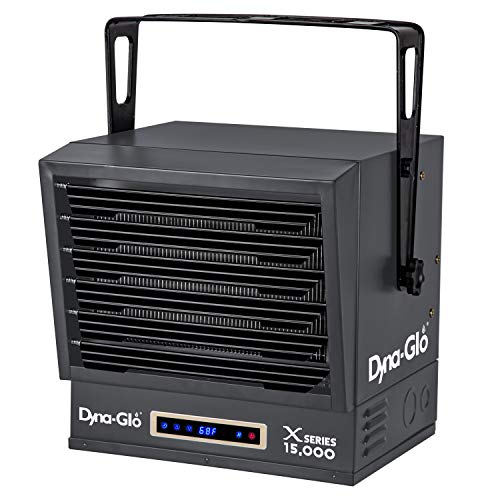
The Dyna-Glo Dual Power is an electric forced-air heater with dual power settings and up to 51,180 BTU-equivalent output on its highest setting. It offers multiple heat settings and the option to use the fan without heating during warmer months. Electric units eliminate on-site fuel storage and combustion emissions.
Electric heaters require appropriate 240V wiring and high-current breakers; verify electrical capacity before installation. They provide consistent heat and simplified control but may produce higher operating costs depending on local electricity rates and run times compared to gas or hydronic systems.
Buying Guide — Choosing A 50,000 BTU Garage Heater
Selecting the right heater involves matching BTU output, fuel availability, installation complexity, and safety requirements to your garage or workshop size and use patterns.
Heating Capacity And Coverage
- BTU Rating vs. Space: 50,000 BTU is suitable for medium to large garages or workshops; adjust for insulation, ceiling height, and open bays.
- Ceiling Height: Taller spaces require more output or better air circulation to maintain comfortable working levels at bench height.
Fuel Type And Infrastructure
- Hydronic (Hot Water): Requires a boiler or hot water source; provides even, quiet heat and integrates well with existing central systems.
- Propane/Natural Gas: Offers high output and fast warm-up. Consider fuel delivery, ventilation, and clearance requirements.
- Electric: Simplifies installation (no combustion), but needs appropriate 240V wiring and may have higher operating costs.
Heat Distribution Method
- Forced-Air: Rapid temperature changes and directional flow; good for quick warm-up but can be noisier.
- Convection: Quieter, more even heat spread; slower to change temperature but comfortable for steady-state heating.
- Hydronic Air Handler: Combines hydronic heat with a fan coil; efficient in systems already using hot water.
Installation And Mounting
- Hanging/Ceiling Mount: Saves floor space and provides good distribution for overhead units; ensure secure mounting to rafters or joists.
- Portable Units: Offer flexibility and no permanent installation but require careful placement and clearance for safety.
- Electrical/Plumbing Needs: Confirm circuit size for electric units and professional gas or hydronic connections for combustion or water-based systems.
Safety And Ventilation
- Clearances: Follow manufacturer minimum clearances from combustibles, ceilings, and floors.
- Ventilation: Combustion heaters need adequate ventilation and sometimes direct venting; enclosed garages may require CO monitoring.
- Certifications: Look for ETL, CSA, or other safety listings for installation compliance.
Operational Considerations
- Noise: Forced-air and portable combustion units can be louder; models with quieter tech may reduce disruption.
- Controls: Built-in thermostats, remote thermostats, and multi-speed fans improve comfort control and efficiency.
- Fuel Supply & Runtime: For propane models, consider cylinder size and how long the unit will run between refills.
Comparison Perspectives
- Cost-To-Operate: Compare local fuel costs—electric vs. propane vs. natural gas can shift operating economics substantially.
- Installation Complexity: Hydronic and hard-wired electric units often need professional installation; portable and propane forced-air may be simpler but require safety checks.
- Comfort Profile: If you need quick warm-up for intermittent use, forced-air units perform well. For steady, quieter heat, hydronic or convection units are preferable.
Use this guide to weigh fuel type, distribution method, installation needs, and safety when choosing a 50,000 BTU garage heater that matches your workshop layout and usage patterns.
Tips for Getting the Best HVAC Prices
- Prioritize Quality Over Cost
The most critical factor in any HVAC project is the quality of the installation. Don’t compromise on contractor expertise just to save money. - Check for Rebates
Always research current rebates and incentives — they can significantly reduce your overall cost. - Compare Multiple Quotes
Request at least three estimates before making your choice. You can click here to get three free quotes from local professionals. These quotes include available rebates and tax credits and automatically exclude unqualified contractors. - Negotiate Smartly
Once you've chosen a contractor, use the proven strategies from our guide — How Homeowners Can Negotiate with HVAC Dealers — to get the best possible final price.