
Find efficient, safe, and powerful heaters designed to warm large rooms with minimal energy waste. This guide compares top-rated electric space heaters, including infrared, oil-filled, and ceramic models, focusing on heating performance, safety features, and energy-saving modes.
| Model | Type | Key Feature |
|---|---|---|
| Heat Storm Phoenix HS-1500-PHX | Infrared | Infrared heat exchanger with attachable feet |
| Dreo Oil Filled Radiator | Oil-Filled Radiator | 7 fins, precise thermostat, 92.3% efficiency claim |
| Dreo 1500W Ceramic Space Heater | PTC Ceramic | Fast ceramic heating, 70° oscillation |
| Dr Infrared Heater Portable | Infrared + PTC | Dual heating system, infrared quartz + PTC |
| Pelonis 23” Oscillating Ceramic Tower | Ceramic Tower | Rapid ceramic heat, programmable thermostat |
Content Navigation
- Heat Storm Phoenix HS-1500-PHX Infrared Space Heater
- Dreo Oil Filled Radiator Electric Radiant Heater
- Dreo Space Heater 1500W Ceramic With Oscillation
- Dr Infrared Heater Portable Space Heater 1500W
- Pelonis 23” Oscillating Ceramic Tower Space Heater
- Buying Guide: Choosing An Energy Efficient Heater For Large Rooms
Heat Storm Phoenix HS-1500-PHX Infrared Space Heater

This infrared heater delivers 1500 watts with a dual power mode (750W / 1500W) and reports about 5200 BTU heat output. The unit’s patented heat exchanger with HMS Technology claims to combine with room humidity to provide soft, oxygen-preserving heat.
The design is compact and adaptable: removable feet allow floor placement or wall mounting. The front grill is described as safe to touch, and a remote control provides convenient operation from across the room.
Key considerations: infrared output favors targeted, radiant warmth and can be effective for living areas with people in the direct coverage zone. Two power settings let users scale energy use based on room conditions.
Dreo Oil Filled Radiator Electric Radiant Heater

Call 888-896-7031 for Free Local HVAC Quotes – Compare and Save Today!
The Dreo oil-filled radiator operates at 1500W with seven fins designed for 360° whole-room heat dispersion. Manufacturer testing claims improved heat dispersion and up to 92.3% efficiency relative to unspecified baselines.
Safety features include triple overheat protection, tilt protection, fire-resistant materials, and ETL listing. The radiator has a digital thermostat, eco mode, and a 24-hour timer for scheduled operation.
Oil-filled radiators provide steady, persistent heat and maintain warmth after shutdown due to stored heat in the fins. This model emphasizes even distribution and multi-layer safety checks for unattended operation.
Dreo Space Heater 1500W Ceramic With Oscillation

This compact 1500W PTC ceramic heater features a built-in thermostat, 70° oscillation, and multiple safety features including tip-over and overheat protection. The manufacturer specifies heating coverage around 200 sq. ft.
Quiet operation (about 34 dB) is highlighted, using optimized airflow to reduce noise and maintain room comfort for sleep or work. The unit supports 12-hour timer, multiple modes, and remote control.
Call 888-896-7031 for Free Local HVAC Quotes – Compare and Save Today!
Ceramic PTC elements heat rapidly and offer responsive temperature control. Oscillation improves air distribution, making this design suitable for open living spaces or large rooms where directional airflow is beneficial.
Dr Infrared Heater Portable Space Heater 1500W
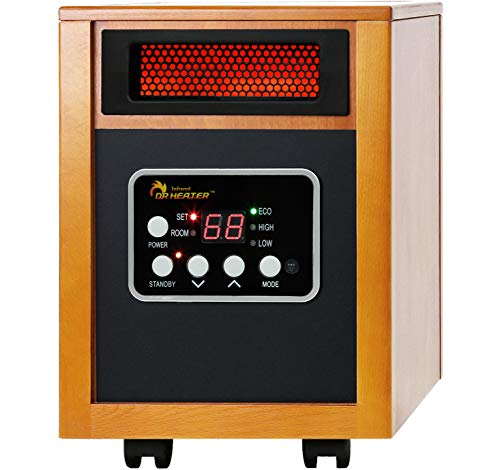
The Dr Infrared model uses a dual heating system: infrared quartz tubes plus PTC ceramic elements, intended to deliver broader, more consistent heat than a single-source unit. The manufacturer rates the output at around 5200 BTU.
Features include an auto energy-saving mode, tip-over and overheat protection, an IR remote, and a low-noise blower (~39 dB). A 12-hour automatic shut-off timer provides additional safety and scheduling control.
Dual systems aim to combine radiant warmth with convective circulation for more balanced large-room heating. The blower helps distribute heat beyond line-of-sight areas, potentially improving comfort in larger spaces.
Pelonis 23” Oscillating Ceramic Tower Space Heater

The Pelonis 23” ceramic tower heater emphasizes fast heating and constant temperature using ceramic PTC technology. It supports three heat options and an ECO mode for automatic energy-saving adjustments.
Safety features include flame-resistant materials, overheating and tip-over protection, and a programmable thermostat. The tower format uses oscillation to spread warm air across wider floor areas.
Ceramic tower heaters typically heat quickly and provide even convective flow. Programmable settings and ECO mode aim to reduce runtime and maintain setpoints, delivering potential energy savings for large-room use.
Buying Guide: Choosing An Energy Efficient Heater For Large Rooms
Heating Technology And Coverage
Infrared (radiant) heaters provide direct warmth to people and objects in their line of sight and can feel efficient in zones where occupants sit or stand. PTC ceramic and oil-filled radiators deliver convective heating that raises ambient air temperature for whole-room comfort.
Match heater type to room use: infrared for targeted spots and fast warmth; ceramic tower or fan-forced PTC for faster air circulation across the room; oil-filled radiators for steady, long-lasting background heat.
Power Ratings And Energy Use
Most consumer space heaters top out at 1500W due to household circuit limits. Higher wattage heats faster but uses more energy; look for eco modes, thermostats, and timers that reduce runtime and avoid unnecessary power use.
Thermostat accuracy and auto energy-saving modes can significantly reduce energy use by cycling the heater to maintain a set temperature rather than running continuously at full power.
Room Size And Placement
Estimate room size in square feet and choose a heater with specified coverage or multiple airflow features (oscillation, blower) to spread heat. Ceiling height, insulation, and open doorways affect effective coverage.
Placement matters: towers and fan heaters perform best centrally or where airflow is unobstructed. Radiant panels work well when aimed at frequently occupied areas; oil radiators are effective when placed near the center of the space.
Safety Features
Look for tip-over protection, overheat shutoff, and ETL/UL certification. Child lock, cool-touch exteriors, and burn-resistant materials add protection for households with children or pets.
Never use portable heaters on unstable surfaces, with extension cords, or unattended for prolonged periods unless specifically rated for such use.
Noise And Comfort
If the room is used for sleep or work, prioritize quieter models. Ceramic and oil-filled units often run quieter than fan-forced designs. Manufacturers commonly list decibel levels; under 35 dB is typically considered very quiet for home use.
Oscillation and blower speed affect air movement and perceived warmth. Adjustable fan speeds and oscillation help balance noise and distribution.
Controls, Scheduling, And Smart Features
Digital thermostats, remote controls, timers, and eco modes enable precise temperature management and can reduce energy consumption. Some models offer programmable schedules to heat rooms only when needed.
Evaluate the user interface and whether a remote or onboard controls suit your typical use cases. Lock features prevent accidental setting changes.
Durability And Maintenance
Oil-filled radiators require minimal maintenance but are heavier to move. Ceramic and infrared units are lighter and typically maintenance-free, but check airflow intakes for dust buildup.
Consider caster wheels or handles for portability, and verify warranty and manufacturer support for long-term reliability.
Comparison Perspectives
- Warm-Up Speed: Ceramic and infrared models heat up rapidly; oil-filled radiators heat slower but retain heat longer.
- Evenness Of Heat: Oil-filled and dual-system models provide stable ambient temperatures; oscillating towers increase distribution.
- Energy Savings: Thermostats, eco modes, and timers reduce runtime. Radiant heating can feel efficient for occupied zones, while convective heaters may be more efficient for whole-room comfort.
- Safety: All selected models include multiple safety features, but verify certifications and intended placement before use.
Use the above criteria to prioritize features most relevant to your room layout, occupancy patterns, and safety needs when selecting an energy-efficient heater for a large room.
Tips for Getting the Best HVAC Prices
- Prioritize Quality Over Cost
The most critical factor in any HVAC project is the quality of the installation. Don’t compromise on contractor expertise just to save money. - Check for Rebates
Always research current rebates and incentives — they can significantly reduce your overall cost. - Compare Multiple Quotes
Request at least three estimates before making your choice. You can click here to get three free quotes from local professionals. These quotes include available rebates and tax credits and automatically exclude unqualified contractors. - Negotiate Smartly
Once you've chosen a contractor, use the proven strategies from our guide — How Homeowners Can Negotiate with HVAC Dealers — to get the best possible final price.