
Natural gas (NG) garage heaters provide high output and efficient heating for attached garages, workshops, and commercial bays. This guide compares five heaters suitable for garages and similar spaces, summarizing key specs to help choose the right unit for your needs.
| Product | Type | BTU / Power | Best For |
|---|---|---|---|
| Mr. Heater Big Maxx MHU50NG | Natural Gas Unit Heater | 50,000 BTU | Small To Mid Garages (~1250 sq ft) |
| Mr. Heater Big Maxx MHU80NG | Natural Gas Unit Heater | 80,000 BTU | Larger Garages / Workshops (~2000 sq ft) |
| L.B. White Tradesman 170N | Portable Forced Air NG Heater | 125,000–170,000 BTU | Construction Sites, Very Large Spaces |
| Modine Hot Dawg HD | Natural Gas Unit Heater | 30,000 BTU | 1–1.5 Car Garages, Low-Ceiling Spaces |
| Comfort Zone Ceiling Heater | Electric Ceiling Unit (included for garage context) | 5,000 Watts (Electric) | Compact Garage Where NG Existing Supply Is Not Preferred |
Content Navigation
- Mr Heater F260550 Big Maxx MHU50NG
- Mr Heater F260560 Big Maxx MHU80NG
- L.B. White Tradesman 170N Portable Heater
- Modine Hot Dawg HD 30,000 BTU Unit Heater
- Comfort Zone Ceiling Garage Heater
- Buying Guide: How To Choose The Right NG Garage Heater
- Heating Capacity And Coverage
- Unit Type: Permanent Unit Heater vs. Portable
- Venting, Combustion Air, And Safety
- Installation And Mounting Considerations
- Controls, Thermostats, And Zoning
- Durability, Maintenance, And Duty Cycle
- Energy Efficiency And Operating Cost
- Comparison Perspectives
- Installation Costs And Professional Help
Mr Heater F260550 Big Maxx MHU50NG
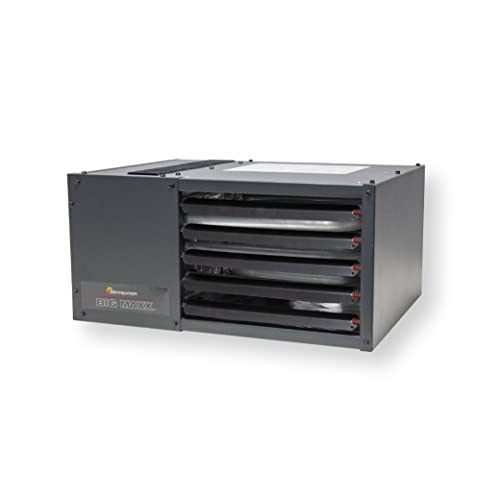
The Mr. Heater MHU50NG is a dedicated natural gas unit heater delivering 50,000 BTU per hour, with stated coverage up to approximately 1,250 square feet. It features a powered exhaust that allows vertical or horizontal venting, which increases installation flexibility in different garage layouts.
Key serviceable points—thermostat, A/C terminals and gas connection—offer easy outside access, simplifying maintenance. The unit is designed for permanent mounting and ties into an existing gas supply and electrical circuit for the fan and controls. It’s suitable where a mid-range, permanently installed NG heater is desired for consistent ambient heating.
Mr Heater F260560 Big Maxx MHU80NG
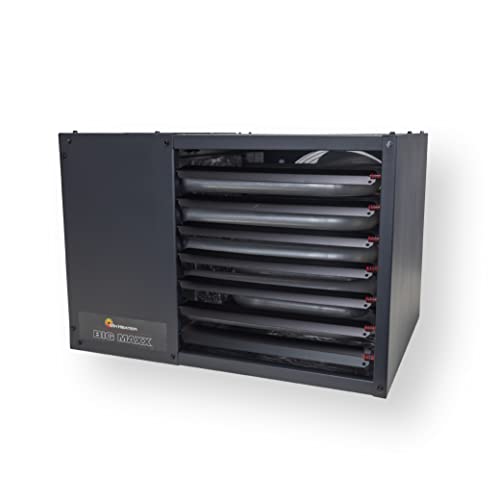
The MHU80NG ups the output to 80,000 BTU, aimed at larger garages and workshops—manufacturer specs note roughly coverage to 2,000 sq. ft. The package includes angle brackets and an LP conversion kit (though the unit is sold as NG), and it supports both Category 1 vertical and Category 3 horizontal venting.
Call 888-896-7031 for Free Local HVAC Quotes – Compare and Save Today!
Electrical specs are typical for unit heaters (120 V, low amperage). The manufacturer notes a minimum clearance requirement from floor to base and emphasizes that thermostat, hose and regulator are not included. Use cases include larger attached garages, commercial bays, or workshops where a permanent NG solution with higher output is needed.
L.B. White Tradesman 170N Portable Heater

The L.B. White Tradesman 170N is a high-output portable forced-air natural gas heater rated at 125,000–170,000 BTU/hr. It uses direct-fired technology with very high fuel utilization for maximum heat output, primarily intended for industrial, construction, and very large open spaces.
Notable features include an electronic spark ignition and a diagnostic light for startup and troubleshooting. Construction uses heavy-gauge combustion chamber materials and a tri-shield finish for corrosion resistance. This model functions as a portable worksite heater rather than a permanently mounted garage heater, making it suitable when mobility and raw heating capacity are priorities.
Modine Hot Dawg HD 30,000 BTU Unit Heater

The Modine Hot Dawg HD is a compact natural gas unit heater rated at 30,000 BTU, positioned for smaller garages or 1–1.5 car spaces. It uses an aluminized steel heat exchanger and is power vented, requiring a vent kit for proper installation.
Call 888-896-7031 for Free Local HVAC Quotes – Compare and Save Today!
This model emphasizes a compact footprint and suitability for low-to-moderate volume heating demands. It’s often selected where wall or ceiling space is limited and when a lower BTU output is sufficient to maintain comfortable temperatures in smaller garages or hobby shops.
Comfort Zone Ceiling Garage Heater

Although electric rather than natural gas, the Comfort Zone Ceiling Heater. It’s a hardwired, ceiling-mounted fan-forced unit useful where NG piping is unavailable or when a lower-install footprint is desired.
Constructed from heavy-gauge steel with louvers and adjustable angle mounting, it provides targeted heat distribution while preserving floor space. Electric heaters have different installation and operating considerations compared with NG units, including electrical load, runtime cost, and safety protections like overheat shutdown.
Buying Guide: How To Choose The Right NG Garage Heater
Selecting a natural gas garage heater involves evaluating capacity, installation constraints, ventilation, controls, and operating cost. Below are key considerations with comparison perspectives.
Heating Capacity And Coverage
- BTU Output vs. Space: Estimate garage volume (sq ft × average ceiling height). Small single-car garages may perform well with 30,000–50,000 BTU; larger workshops or attached bays often require 80,000 BTU or more.
- Heat Loss Factors: Insulation, door quality, and number of exterior walls change required BTUs. Poorly insulated spaces need higher output or more runtime.
Unit Type: Permanent Unit Heater vs. Portable
- Permanent Unit Heaters (ceiling or wall mounted): Examples include Modine and Mr. Heater Big Maxx models. These are good for continuous ambient heating and controlled distribution.
- Portable Forced-Air Heaters: L.B. White Tradesman is portable and high-output for temporary or multi-site use, but many direct-fired portable units require ventilation and are best in well-ventilated or outdoor work areas.
Venting, Combustion Air, And Safety
- Venting Category: Check if the heater supports vertical (Category I) or horizontal (Category III) venting and whether power venting is required.
- Combustion Air Requirements: Some direct-fired portable heaters pull room air for combustion and exhaust into the space; permanent NG unit heaters usually vent combustion products outdoors.
- Clearances And Codes: Verify manufacturer clearance requirements and local plumbing/mechanical codes for gas line sizing and venting.
Installation And Mounting Considerations
- Gas Supply And Line Sizing: Ensure sufficient gas pressure and proper pipe sizing for the selected BTU rating. Upgrading from a small gas line may be necessary for high-BTU units.
- Electrical Needs: Many NG unit heaters require a modest electrical connection for blower motors and controls—confirm voltage and breaker sizing.
- Mounting Space: Ceiling clearance, wall studs, and access for service should guide placement. Power-vented units need room for vent runs.
Controls, Thermostats, And Zoning
- Integrated Thermostat vs. External: Decide if a built-in thermostat is adequate or if you want remote or wall-mounted thermostatic control for precise temperature management.
- Zoning: Multiple smaller heaters or a zoned control strategy can be more efficient than a single oversized unit in segmented garages.
Durability, Maintenance, And Duty Cycle
- Material And Coatings: Look for aluminized or heavy-gauge steel heat exchangers and protective coatings if the garage is damp or sees heavy use.
- Service Access: Units with exterior access to thermostat and gas connections reduce downtime and simplify maintenance.
Energy Efficiency And Operating Cost
- Burner Efficiency: High-efficiency burners reduce fuel use but may increase upfront cost. Evaluate AFUE or manufacturer efficiency claims when available.
- Run-Time vs. Output: A higher output heater that cycles less may sometimes use less fuel than a low-output unit that must run constantly; match output to realistic use patterns.
Comparison Perspectives
- Small Garage Focus: Consider compact, lower-BTU units (e.g., Modine 30k or Mr. Heater 50k) for even heating and quicker warm-up of smaller volumes.
- Large Garage / Workshop: Higher-BTU fixed units (Mr. Heater 80k) or portable high-output models (L.B. White 170N) are better when space is large or frequently opened to the exterior.
- Mobility vs. Permanence: Portable NG heaters provide flexibility for temporary work sites; permanent unit heaters offer integrated installation and often safer combustion venting outdoors.
Installation Costs And Professional Help
- Permits and Code Compliance: Plan for permits, gas piping by a licensed plumber, and proper venting installed per code.
- Trade-Offs: Professional installation increases upfront costs but ensures safe operation and can reduce long-term risks and maintenance hassles.
Use the above considerations to match heater output, venting requirements, and installation realities with your garage size and usage patterns. Confirm compatibility with local gas supply, clearances, and codes before purchase and installation.
Tips for Getting the Best HVAC Prices
- Prioritize Quality Over Cost
The most critical factor in any HVAC project is the quality of the installation. Don’t compromise on contractor expertise just to save money. - Check for Rebates
Always research current rebates and incentives — they can significantly reduce your overall cost. - Compare Multiple Quotes
Request at least three estimates before making your choice. You can click here to get three free quotes from local professionals. These quotes include available rebates and tax credits and automatically exclude unqualified contractors. - Negotiate Smartly
Once you've chosen a contractor, use the proven strategies from our guide — How Homeowners Can Negotiate with HVAC Dealers — to get the best possible final price.