
Choosing the right ceiling heater for a shop or garage depends on coverage, mounting style, power, and safety features. Below is a quick comparison of five ceiling or wall/ceiling electric heaters selected for shop use, followed by detailed product sections and a practical buying guide.
| Product | Power / Type | Mounting | Notable Features |
|---|---|---|---|
| Comfort Zone CZ220BK | 5,000W / 240V | Ceiling hard-wired | Fan-forced, adjustable louvers, heavy-gauge steel |
| TEMPWARE 7500-Watt | 6,250–7,500W / 240V | Ceiling hard-wired | Digital controls, ECO mode, timer, remote |
| TEMPWARE 5000-Watt | 3,000 / 4,000 / 5,000W / 240V | Ceiling / wall / floor | 3 heat levels, adjustable louvers, ETL certified |
| VEVOR 10000-Watt | 10,000W / 240V | Wall or ceiling hard-wired | Digital controls, precise temp control, high coverage |
| DR. INFRARED DR-975 | 4,700W / 7,500W selectable / 240V | Wall or ceiling hard-wired | Remote thermostat, heavy-duty build, two power settings |
Content Navigation
- Comfort Zone Hard-Wired Ceiling Mount Garage Electric Space Heater, CZ220BK
- TEMPWARE Electric Garage Heater, 7500-Watt Digital Fan-Forced Ceiling Mount
- TEMPWARE Electric Garage Heater, 5000-Watt Ceiling Mount Shop Heater
- VEVOR Electric Garage Heater, 10000-Watt Digital Fan-Forced Shop Heater
- DR. INFRARED HEATER DR-975 7500-Watt Hardwired Shop Garage Heater
- Buying Guide: How To Choose A Shop Ceiling Heater
- Heat Output And Coverage
- Mounting Options And Space Constraints
- Power Supply And Electrical Requirements
- Control Features
- Air Distribution And Heat Type
- Safety And Certifications
- Durability And Build Material
- Noise And Fan Operation
- Energy Efficiency And Operating Cost
- Installation And Maintenance
- Comparison Perspectives
Comfort Zone Hard-Wired Ceiling Mount Garage Electric Space Heater, CZ220BK

This fan-forced ceiling heater is designed for overhead mounting to keep floors clear in garages, workshops, and small warehouses. It hard-wires to 240V circuits, which is common for high-capacity shop heaters.
Key features listed by the manufacturer include heavy-gauge steel construction for durability in fluctuating temperatures and adjustable louvers and mounting angle to direct airflow. The fan-forced design supports quicker heat distribution than purely radiant units.
Safety features include an overheat thermal cut-out switch. Installation requires appropriate electrical wiring and a secure ceiling mount to handle the unit’s weight and vibration during operation.
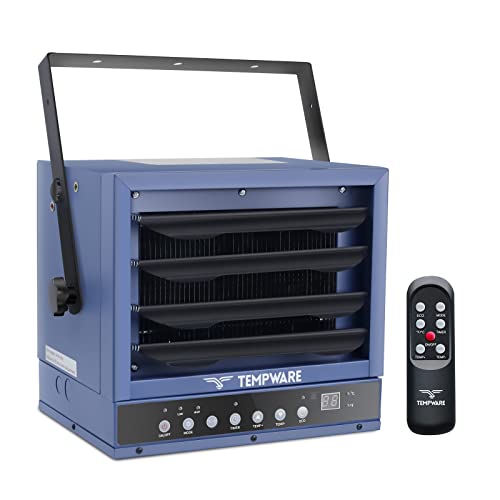
TEMPWARE Electric Garage Heater, 7500-Watt Digital Fan-Forced Ceiling Mount
Call 888-896-7031 for Free Local HVAC Quotes – Compare and Save Today!
This high-output 7,500W fan-forced heater targets larger shop spaces and lists a maximum coverage figure intended for performance planning. It installs as a hard-wired 240V ceiling unit.
Manufacturer features highlight an adjustable mounting angle and louvers, two heat settings, an integrated thermostat, and safety overheat protection. The unit also provides an ECO mode and a 1–12 hour timer for energy management.
A full-function remote and digital controls simplify operation when ceiling mounted. Proper circuit sizing and professional installation are necessary due to the high current draw at maximum output.
TEMPWARE Electric Garage Heater, 5000-Watt Ceiling Mount Shop Heater

This 5,000W adjustable heater offers three heat levels (3,000 / 4,000 / 5,000W) and modular mounting options: ceiling, wall, or floor placement. The flexibility helps when ceiling clearance or structural limitations exist.
Noted features include adjustable louvers and variable mounting angle, heavy-duty steel construction, and ETL certification for safety compliance. The listed coverage estimate is helpful when comparing against shop size and insulation quality.
Call 888-896-7031 for Free Local HVAC Quotes – Compare and Save Today!
Its compact footprint and multiple mounting options make it suitable for smaller shops or areas where space-saving is a priority. As with other hard-wired heaters, ensure correct wiring gauge and breaker size.
VEVOR Electric Garage Heater, 10000-Watt Digital Fan-Forced Shop Heater

VEVOR lists this unit as a 10,000W high-power heater intended for larger shop areas. It supports wall or ceiling mounting and emphasizes wide coverage and strong air circulation for even heating.
Product features include intelligent temperature control with tight tolerance, adjustable power levels, and an overheat automatic shutoff for safety. The housing is described as SPCC cold-rolled steel for long-term structural stability.
This heater is positioned for users who need higher capacity and precise temperature control. It will require appropriate circuit infrastructure and secure mounting to meet local electrical and building codes.
DR. INFRARED HEATER DR-975 7500-Watt Hardwired Shop Garage Heater

DR. INFRARED’s DR-975 is a heavy-duty 240V unit with selectable power settings including a 7,500W option. It is marketed for wall or ceiling mounting in garage and shop environments and includes a remote-controlled thermostat.
Manufacturer details note a remote thermostat with 50–85°F range and recommendation for specific wire gauge during installation. The heater’s build intent is industrial-strength operation with selectable output to match shop demands.
As with comparable hard-wired heaters, installation should follow the manufacturer wiring recommendations and local code requirements to ensure safe, reliable operation.
Buying Guide: How To Choose A Shop Ceiling Heater
Selecting the correct ceiling heater for a shop or garage requires assessing several technical and practical factors. This guide organizes key considerations to make an informed purchase.
Heat Output And Coverage
Match heater capacity to your shop’s volume and insulation. Manufacturers often list wattage and an estimated coverage area. Higher wattage (e.g., 7,500–10,000W) suits larger or poorly insulated shops. For smaller, insulated spaces, 3,000–5,000W may be adequate.
Mounting Options And Space Constraints
Ceiling-mounted units save floor space, but check ceiling height, joist layout, and mounting brackets. Some models are multi-mount (ceiling, wall, floor) which adds flexibility if shop layout changes.
Power Supply And Electrical Requirements
High-output electric heaters typically require 240V circuits and appropriate breaker sizing. Confirm available circuit capacity and follow recommended wire gauge (examples include 8 AWG for some models). Professional electrician installation is recommended.
Control Features
Digital thermostats, remote controls, timers, and ECO modes improve temperature management and energy efficiency. Consider a unit with a programmable timer or remote thermostat for ceiling installations where manual access is inconvenient.
Air Distribution And Heat Type
Fan-forced heaters provide convective airflow for quicker room warming and more even temperatures. Infrared units heat objects and people directly and can be effective in open or high-ceiling areas. Choose based on desired warming profile.
Safety And Certifications
Look for ETL, UL, or similar safety certifications and built-in protective features such as thermal cut-outs and overheat shutoff. Confirm minimum clearances and follow all installation guidelines to reduce fire risk.
Durability And Build Material
Heavy-gauge steel housings resist deformation and handle shop conditions better than thin-metal constructions. Consider corrosion resistance if the shop is humid or exposed to chemicals.
Noise And Fan Operation
Fan-forced models generate operational noise. If noise matters in your workspace, look for models with lower RPM fans or spec sheets indicating quieter operation, or consider radiant options for silent heat.
Energy Efficiency And Operating Cost
Higher wattage yields more heat but increases electrical consumption. Features like thermostats, ECO modes, and timers help reduce runtime and energy use. Calculate expected run hours to estimate operating impact on your power bill without relying on advertised price points.
Installation And Maintenance
Hard-wired heaters typically require professional installation. Check access for filter cleaning (if applicable), fan motor servicing, and clearance for safe airflow. Consider ease of servicing in the product design.
Comparison Perspectives
- For Maximum Coverage: Choose higher-wattage units (e.g., 7,500–10,000W) and ensure proper circuit capacity.
- For Flexibility: Multi-mount units (ceiling/wall/floor) adapt to changing shop layouts.
- For Precise Control: Models with digital thermostats and remote control simplify temperature management.
- For Quiet Operation: Consider infrared or lower-speed fan models if noise is a concern.
- For Durability: Favor heavy-gauge steel housings and proven safety certifications.
When comparing models, align the heater’s listed features—wattage, mounting, controls, and safety—with your shop’s size, ceiling structure, available electrical service, and operational priorities before making a selection.
Tips for Getting the Best HVAC Prices
- Prioritize Quality Over Cost
The most critical factor in any HVAC project is the quality of the installation. Don’t compromise on contractor expertise just to save money. - Check for Rebates
Always research current rebates and incentives — they can significantly reduce your overall cost. - Compare Multiple Quotes
Request at least three estimates before making your choice. You can click here to get three free quotes from local professionals. These quotes include available rebates and tax credits and automatically exclude unqualified contractors. - Negotiate Smartly
Once you've chosen a contractor, use the proven strategies from our guide — How Homeowners Can Negotiate with HVAC Dealers — to get the best possible final price.