
The following guide reviews the most efficient plug-in heaters designed for small rooms, offices, bathrooms, and RVs. Each model focuses on low-watt operation, safety features, and targeted heating to reduce energy consumption compared with whole-home heating. The summary table below highlights core specs at a glance.
| Product | Type | Power / Mode | Key Efficiency Feature |
|---|---|---|---|
| ENVI Plug-in Electric Panel Wall Heater | Wall-mounted panel (fan-less) | Low-watt continuous | Fan-less convection with low wattage |
| GiveBest Programmable Space Heater | Wall outlet plug-in | 450W | Programmable thermostat & timer |
| Brightown 800W Wall Outlet Space Heater | Wall outlet plug-in | 800W | ECO mode, LED temperature display |
| Eueiriup 1500W Electric Panel Heater | Freestanding / wall panel | 1500W (dual settings) | Aluminum convection; quick warm-up |
| QQT Electric Space Heater | Portable plug-in ceramic | 1200W (two-speed) | PTC ceramic efficiency; low-noise |
Content Navigation
- ENVI Plug-in Electric Panel Wall Heaters
- GiveBest Programmable Space Heater With LED Display
- Brightown 800W Wall Outlet Space Heater With Remote
- Eueiriup 1500W Electric Panel Heater With Thermostat
- QQT Electric Space Heater, Portable Energy Efficient Heater
- Buying Guide: How To Choose The Most Efficient Plug-In Heater
- 1. Match Wattage To Room Size
- 2. Type Of Heat Delivery
- 3. Controls And Thermostat Accuracy
- 4. Safety Features
- 5. Installation And Placement
- 6. Noise And Air Quality Considerations
- 7. Energy-Saving Modes And Features
- 8. Electrical Circuit And Outlet Considerations
- 9. Long-Term Operating Cost Perspective
- 10. Comparison Perspectives
ENVI Plug-in Electric Panel Wall Heaters
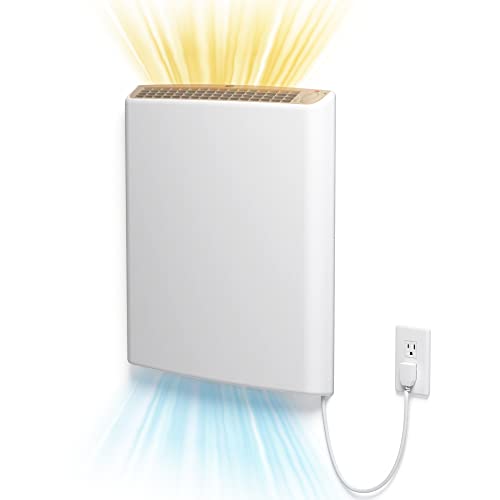
This wall-mounted unit is built for continuous, targeted warmth. The manufacturer highlights low-wattage operation for supplemental heating and a patented fan-less “Stack Convection” design that moves heat quietly. A wall-sense safety sensor disables power if the heater is removed from the mounting, and the unit operates at a surface temperature near 90°F, reducing contact-burn risk.
Key features include quiet operation (no fan to stir dust), an auto-dimming power light for night use, and a form factor intended for mounted, out-of-the-way installation. The fan-less convection approach supports steady, even heat without forced airflow, which can help reduce allergens being circulated. The unit is positioned as a supplement or partial replacement for central heat in specific rooms.
GiveBest Programmable Space Heater With LED Display

The GiveBest model is a 450W plug-in heater designed explicitly for low power consumption. It includes a digital LED display, adjustable thermostat (60°F–90°F), a timer, and remote control. The lower wattage makes it suitable for mild climates and situations where circuit load is a concern.
Call 888-896-7031 for Free Local HVAC Quotes – Compare and Save Today!
Notable design elements are the programming/timer functions and a 180° rotatable plug for flexible outlet orientation. Because it draws less current than higher-wattage space heaters, it minimizes the chance of tripping breakers on typical household circuits while enabling room-level temperature control to reduce HVAC runtime elsewhere in the home.
Brightown 800W Wall Outlet Space Heater With Remote

Brightown’s outlet heater targets small spaces with an 800W low-power mode and an ECO setting to prioritize efficiency. It has overheat protection, an LED display showing the current set temperature, and a remote control for convenient adjustments from across the room.
The ECO mode and built-in overheat protection are central to the unit’s energy and safety profile. The 180° rotatable plug and compact footprint are helpful for tight rooms, bathrooms, or RVs. The visible temperature readout supports precise setpoint control to avoid unnecessary run time.
Eueiriup 1500W Electric Panel Heater With Thermostat

This panel-style heater uses aluminum convection technology to deliver fast warm-up and nearly silent operation. It offers dual heat settings and an adjustable thermostat, with manufacturer notes about heating performance “within seconds” and low noise levels under 30 dB.
Call 888-896-7031 for Free Local HVAC Quotes – Compare and Save Today!
With a higher maximum power capability, this model is suited for larger rooms or situations where a stronger output is necessary. The convection approach (no fan) reduces airborne dust circulation and provides steady, breathable warmth. Dual settings allow you to match output to the room size and reduce energy use when full power isn’t required.
QQT Electric Space Heater, Portable Energy Efficient Heater

The QQT model is a PTC ceramic portable heater focused on efficiency and safety. It offers two heating settings up to 1200W, rapid heat response, overturn protection, and an insulating flame-retardant shell. Noise levels are cited below 30 dB, making it appropriate for bedrooms or offices.
PTC ceramic elements heat quickly and self-regulate as the element approaches set temperature, which can improve energy use compared with constant high-power resistive elements. Safety features such as tip-over shutoff and overheat protection are important for unattended use in occupied rooms.
Buying Guide: How To Choose The Most Efficient Plug-In Heater
Efficiency for plug-in heaters depends on matching heater type, wattage, and controls to your space and usage patterns. The right selection reduces overall energy use by limiting runtime while keeping occupants comfortable.
1. Match Wattage To Room Size
Lower-watt models (300–800W) work best for small rooms, bathrooms, or to warm personal zones at a desk. Higher-watt plug-in or panel heaters (1000–1500W) provide faster or whole-room heating but draw more electricity. Choose the lowest wattage that meets your comfort needs to minimize energy use.
2. Type Of Heat Delivery
- Convection (fan-less): Provides steady, quiet warmth. Good for bedrooms and allergy-sensitive users because there’s less air movement. Often more comfortable for long-term background heating.
- Forced Air (fan): Warms space faster but circulates dust and can be noisier. Useful when rapid temperature rise is needed for short periods.
- PTC Ceramic: Fast heat-up and partial self-regulation, improving efficiency compared with simple resistive elements.
- Oil-Filled Radiators: Slower to heat but retain heat longer after power-off, beneficial for maintaining temperatures with intermittent operation.
3. Controls And Thermostat Accuracy
Thermostatic control and programmable timers significantly improve energy efficiency by preventing overheating and unnecessary runtime. Digital displays and timers let you set occupied/unoccupied schedules to avoid wasted energy. Simple mechanical knobs are less precise but still useful when paired with external thermostats.
4. Safety Features
Look for overheat protection, tip-over shutoff, cool-touch surfaces, and any mounting or wall-sense features for fixed installations. Safety features reduce risk and allow confident use for extended periods, which influences practical efficiency by enabling safe, continuous use at lower setpoints.
5. Installation And Placement
Outlet-mounted or plug-in wall units free floor space and reduce tripping hazards. Panel heaters mounted higher on a wall distribute heat naturally through convection. For portable units, position for unobstructed airflow and avoid plugging into extension cords unless rated for heater loads.
6. Noise And Air Quality Considerations
Fan-less convection and oil-filled models are quieter and stir less dust, aiding those with allergies and enabling use in bedrooms. If noise is acceptable, fan-forced heaters provide quicker warmth but may require more frequent cleaning and filtering of the room environment.
7. Energy-Saving Modes And Features
Features to prioritize: ECO mode, programmable timers, accurate thermostats, and modular power settings. ECO modes typically cycle the heater in a way that maintains comfort while minimizing energy draw. Combining a low-watt heater with a thermostat often yields better energy outcomes than simply choosing the lowest wattage unit without controls.
8. Electrical Circuit And Outlet Considerations
Confirm the outlet and circuit capacity before selecting a high-watt model. Many plug-in heaters are designed to avoid overloading a single standard 15A circuit, but high-watt units near 1500W approach the upper safe limit of typical household circuits. Lower-watt plug-ins reduce the risk of tripped breakers and are better for multi-outlet circuits.
9. Long-Term Operating Cost Perspective
Energy-efficient models reduce runtime but not instantaneous electrical cost per watt. Savings come from targeted heating—warming only occupied areas and using thermostats to avoid overheating. Consider pairing a low-watt plug-in with proper insulation and zoned use to reduce whole-house heating demand.
10. Comparison Perspectives
- Small Personal Zone: Choose a 300–800W plug-in with precise thermostat and timer (e.g., models like GiveBest or Brightown).
- Quiet Background Heating: Prefer fan-less panel or oil-filled units for bedrooms (e.g., ENVI panel or oil heaters).
- Larger Rooms / Faster Heat: Higher wattage panel or portable (1000–1500W) with multiple settings, but monitor circuit load (e.g., Eueiriup).
- Safety-Conscious Households: Ensure tip-over and overheat protections, cool-touch surfaces, and wall-sense or mounting features.
Using this information will help you choose a plug-in heater that aligns with your room size, safety needs, electrical constraints, and desire for continuous efficient operation. Prioritize programmable control, appropriate wattage, and safety features to maximize energy savings while maintaining comfort.
Tips for Getting the Best HVAC Prices
- Prioritize Quality Over Cost
The most critical factor in any HVAC project is the quality of the installation. Don’t compromise on contractor expertise just to save money. - Check for Rebates
Always research current rebates and incentives — they can significantly reduce your overall cost. - Compare Multiple Quotes
Request at least three estimates before making your choice. You can click here to get three free quotes from local professionals. These quotes include available rebates and tax credits and automatically exclude unqualified contractors. - Negotiate Smartly
Once you've chosen a contractor, use the proven strategies from our guide — How Homeowners Can Negotiate with HVAC Dealers — to get the best possible final price.