
Choosing a propane unit heater for a garage requires balancing output, efficiency, installation, and safety. The table below summarizes five propane-ready heaters suited for garages, from compact portable units to ceiling-mount shop heaters. Each product section below includes key features and practical use notes to help match a heater to garage size and needs.
| Product | Type | BTU | Coverage | Mount |
|---|---|---|---|---|
| Mr. Heater Propane Unit Heater MHU80LP | Forced Air Unit Heater | 80,000 BTU/Hr | Up To ~1000 Sq Ft | Ceiling/Wall |
| Reznor UDXC-60 | Ceiling/Shop Unit | 60,000 BTU (multi-level) | Commercial/Workshop Areas | Ceiling Mount |
| Modine Hot Dawg Propane 75,000 BTU | Gas Fired Unit Heater | 75,000 BTU Input | Large Garages/Warehouses | Ceiling/Wall |
| Dyna-Glo 30,000 BTU Blue Flame Vent Free | Wall Convection Heater | 24,000–30,000 BTU | Up To 1,000 Sq Ft (optimally smaller) | Wall Mount |
| Mr. Heater Portable Buddy MH9BX | Portable Radiant Heater | 4,000–9,000 BTU | Up To ~225 Sq Ft | Portable/Spot Heat |
Content Navigation
- Mr. Heater Propane Unit Heater MHU80LP
- Reznor UDXC-60 Propane Garage Heater
- Modine Hot Dawg Propane 75,000 BTU
- Dyna-Glo 30,000 BTU Blue Flame Vent Free Wall Heater
- Mr. Heater Portable Buddy MH9BX
- Buying Guide: Choosing The Right Propane Unit Heater For Your Garage
- 1. Assess Required Heat Output (BTU)
- 2. Mounting And Installation Options
- 3. Venting Versus Vent-Free
- 4. Efficiency And Output Control
- 5. Safety Features And Indoor Use
- 6. Fuel Supply And Conversion
- 7. Noise, Air Movement, And Comfort Type
- 8. Installation Costs, Electrical Requirements, And Maintenance
- 9. Compliance With Local Codes
- 10. Comparison Perspectives
Mr. Heater Propane Unit Heater MHU80LP

This 80,000 BTU forced-air unit is designed for ceiling-mount installation to heat large garages and workshops. The product description highlights spark ignition with a self-diagnostic control module and includes angle brackets for mounting. Manufacturer notes indicate it can heat up to approximately 1,000 square feet, making it a fit for double-bay garages or small commercial bays.
Key considerations based on listed features: confirm compatibility with your propane supply and planned venting; spark ignition reduces manual lighting tasks; included mounting brackets simplify installation but check for clearance and local code requirements for gas appliances.
Reznor UDXC-60 Propane Garage Heater

The Reznor UDXC-60 is a propane-fueled, forced-air ceiling unit rated at 60,000 BTU with two output levels noted in the features: low fire and high fire outputs intended for mild to cold conditions. The listing cites an 83% thermal efficiency rating and describes threaded suspension points for ceiling mounting.
Call 888-896-7031 for Free Local HVAC Quotes – Compare and Save Today!
Its multi-level output provides flexible heat control for garages that experience varying winter temperatures. As a commercial-style unit, it is built for continuous operation and centralized airflow, but mounting hardware may be sold separately—check the mounting options and required clearance for safe installation.
Modine Hot Dawg Propane 75,000 BTU

The Modine Hot Dawg is presented as a gas-fired, power-vented unit with 75,000 BTU input and approximate 80% efficiency per the product detail. This style is common in garages and small warehouses, providing robust, consistent heat output with an emphasis on power venting to manage combustion gases.
Product features indicate suitability for larger garage spaces. Consider power vent requirements and ensure the electrical supply and venting path align with installation instructions. The unit’s combustion design aims to balance fuel input and output efficiency for extended service life in workshop environments.
Dyna-Glo 30,000 BTU Blue Flame Vent Free Wall Heater

The Dyna-Glo blue flame unit is a vent-free wall heater with variable output between 24,000 and 30,000 BTU and is labeled as Liquid Propane Ready. Its blue flame technology convects air to warm a space similarly to central heating systems, making it useful for moderate-sized garages when vent-free operation is permitted by local codes.
Call 888-896-7031 for Free Local HVAC Quotes – Compare and Save Today!
Vent-free models provide high efficiency since combustion products are released to the room; this can be advantageous for tight spaces but requires attention to indoor air quality and local regulations. The listing indicates up to 1,000 sq. ft. coverage under ideal conditions, but practical coverage depends on insulation, ceiling height, and ventilation.
Mr. Heater Portable Buddy MH9BX
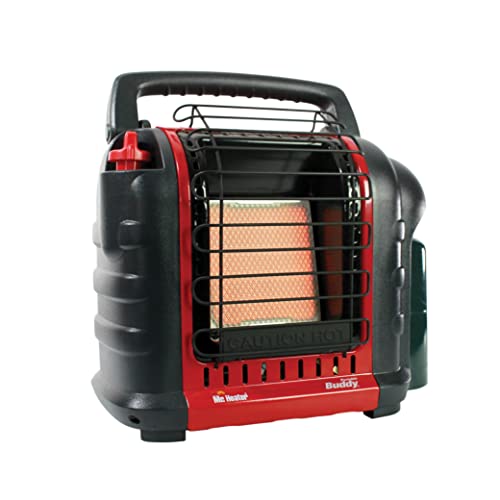
The Portable Buddy is an infrared radiant propane heater with adjustable output from 4,000 to 9,000 BTU. The product features highlight infrared heating that warms objects and people directly, an improved tip-over safety switch, and a Piezo igniter for matchless startup. It’s rated for spaces up to approximately 225 sq. ft.
This heater is best for localized spot heating inside garages—such as a workspace or during quick tasks—rather than whole-garage heating. The safety features and portability make it a practical supplement to a primary garage heating system, provided it’s used with appropriate ventilation and according to indoor-use guidelines listed by the manufacturer.
Buying Guide: Choosing The Right Propane Unit Heater For Your Garage
Selecting a propane heater for a garage requires reviewing heat output, mounting type, efficiency, venting, safety features, and local code. Consider the following elements to match a heater to your space and usage pattern.
1. Assess Required Heat Output (BTU)
Calculate garage volume (square feet times ceiling height) and insulation quality. As a rule of thumb, typical single-car garages may need 10,000–30,000 BTU, while two-car or larger insulated garages often require 40,000–80,000 BTU. Forced-air unit heaters in the 60,000–80,000 BTU range suit larger bays; smaller wall or radiant units are better for spot heating.
2. Mounting And Installation Options
Ceiling-mount forced-air units distribute warm air across the space and free floor area. Wall-mounted blue flame units use convection and are simpler to install if vent-free models are permitted. Portable radiant units provide spot heat without installation but are limited in coverage. Verify included mounting hardware and whether additional brackets or suspension kits are required.
3. Venting Versus Vent-Free
Power-vented and direct-vent heaters exhaust combustion gases outdoors, improving indoor air quality and often allowing higher continuous outputs. Vent-free models use indoor combustion and are highly efficient but can increase moisture and combustion byproducts in the garage. Check local codes and intended garage use before choosing vent-free units.
4. Efficiency And Output Control
Look for multi-stage or modulating output (low/high fire) for better temperature control and reduced fuel consumption. Efficiency ratings, like the Reznor’s listed 83% thermal efficiency, indicate how effectively fuel is converted to usable heat. Higher efficiency reduces fuel usage for comparable warmth.
5. Safety Features And Indoor Use
Essential safety elements include tip-over protection, oxygen depletion sensors (ODS), sealed combustion, and self-diagnostic ignition systems. For garages with vehicles or chemicals, ensure combustion products are vented or that the unit’s operation won’t compromise air quality. Portable heaters should include tip-over switches and protective guards.
6. Fuel Supply And Conversion
Confirm the unit’s compatibility with liquid propane and whether a conversion kit is required or included. Some manufacturers sell natural gas models that convert to propane with a kit; others are dedicated LP units. Ensure regulator, hose, and connectors meet local code and manufacturer requirements.
7. Noise, Air Movement, And Comfort Type
Forced-air heaters move more air and may produce noticeable fan noise, which is acceptable for workshops but could be disruptive for a quiet hobby space. Radiant and blue flame units provide gentler convection or object-focused heat. Choose based on whether you need whole-space warming or targeted warmth.
8. Installation Costs, Electrical Requirements, And Maintenance
Consider additional costs for professional installation, venting, gas line work, and electrical supply for ignition or power venting. Regular maintenance includes cleaning burners, checking ignition systems, and ensuring proper venting paths. Commercial-style units may require periodic service to maintain efficiency.
9. Compliance With Local Codes
Local building codes and fire regulations determine allowable indoor propane appliances and venting practices. Verify permits and code compliance before purchasing. Some jurisdictions restrict vent-free models or require specific clearances and combustion air provisions.
Tips for Getting the Best HVAC Prices
- Prioritize Quality Over Cost
The most critical factor in any HVAC project is the quality of the installation. Don’t compromise on contractor expertise just to save money. - Check for Rebates
Always research current rebates and incentives — they can significantly reduce your overall cost. - Compare Multiple Quotes
Request at least three estimates before making your choice. You can click here to get three free quotes from local professionals. These quotes include available rebates and tax credits and automatically exclude unqualified contractors. - Negotiate Smartly
Once you've chosen a contractor, use the proven strategies from our guide — How Homeowners Can Negotiate with HVAC Dealers — to get the best possible final price.
10. Comparison Perspectives
- Coverage VS Portability: Ceiling-mounted forced-air units deliver whole-garage heating; portable units supply targeted heat.
- Efficiency VS Venting Requirement: Vent-free models maximize usable heat but may carry air-quality trade-offs; vented units typically require more installation work but maintain indoor air quality.
- Initial Cost VS Long-Term Operation: Higher-BTU, power-vented units have higher initial and installation costs but can be more effective for large spaces and heavier use, possibly reducing runtime and fuel costs over time.
- Safety VS Convenience: Portable heaters are convenient for spot work but require close adherence to safety practices; permanently mounted heaters can incorporate advanced safety interlocks and professional installation safeguards.