
Electric baseboard heaters provide reliable, quiet heating for bedrooms, offices, and zoned spaces. Below is a quick comparison of five popular choices that balance power, safety, and controls. Read each product section for features, installation notes, and suitable room uses.
| Product | Type | Power / Voltage | Notable Features |
|---|---|---|---|
| Comfort Zone CZ600 | Convection Baseboard | 1500W / 120V | Adjustable thermostat, overheat protection, tip-over switch, stay-cool body |
| Cadet F Series 36″ (3F750-1W) | Hard-Wired Baseboard | 750W / 120V | All-metal construction, 25-gauge steel, requires external thermostat |
| Cadet F Series 24″ (2F350W) | Hard-Wired Baseboard | 350W / 240/208V | Steel construction, compact length for small spaces |
| KING 4K1210BW | Hard-Wired Baseboard | 1000W / 120V | Aluminum ribbon fin element, full-length safety cutout |
| Mysa Smart Thermostat | Smart Thermostat For High Voltage | Supports 120–240V baseboards | Wi‑Fi, HomeKit/Alexa/Google support, energy-saving scheduling |
Content Navigation
- Comfort Zone Electric Baseboard Space Heater CZ600
- Comfort Zone Baseboard Heater With Digital Thermostat CZ650B
- Cadet F Series 36″ Electric Baseboard Heater 3F750-1W
- KING 4K1210BW K Series Baseboard Heater 4′ 1000W
- Mysa Smart Thermostat For Electric Baseboard Heaters
- Buying Guide: How To Choose An Electric Baseboard Heater
- 1. Calculate Required Wattage
- 2. Voltage And Wiring Compatibility
- 3. Onboard Thermostat Vs. External Thermostat
- 4. Safety Features
- 5. Construction And Heat Distribution
- 6. Noise And Operation
- 7. Smart Features And Energy Savings
- 8. Installation And Maintenance
- 9. Room Placement And Size Considerations
- 10. Compatibility With Existing HVAC Strategy
Comfort Zone Electric Baseboard Space Heater CZ600

The Comfort Zone CZ600 is a convection-style electric baseboard heater rated at 1500 watts, designed for medium-sized rooms. It offers two heat settings and an adjustable thermostat to maintain desired temperature levels.
- Efficiency and Versatility: 1500W output with two heat settings for flexible room heating.
- Safety Features: Tip-over switch, overheat protection sensor, and a stay-cool body reduce burn and fire risks.
- Operation: Whisper-quiet convection heating suitable for bedrooms and offices where noise is a concern.
Installation typically requires hard-wiring by a qualified electrician unless the unit includes a corded model option. Consider room size and required wattage per square foot when sizing. The CZ600 is suited for users wanting a self-contained unit with basic onboard thermostat control and built-in safety interlocks.
Comfort Zone Baseboard Heater With Digital Thermostat CZ650B

The CZ650B builds on convection baseboard fundamentals by adding a digital thermostat and a clear temperature display. It is rated at 1500 watts and provides two heating levels.
Call 888-896-7031 for Free Local HVAC Quotes – Compare and Save Today!
- Power And Control: Digital adjustable thermostat allows precise temperature setting compared to manual dials.
- Quiet Operation: Designed for low-noise performance, making it suitable for living rooms and bedrooms.
- Safety: Tip-over switch, overheat protection, and dent-proof end panels for durability.
This model is appropriate when on-device precise temperature readout and control are preferred. For centralized or smart control, pair with compatible wiring or external thermostats if you want remote scheduling or integration.
Cadet F Series 36″ Electric Baseboard Heater 3F750-1W
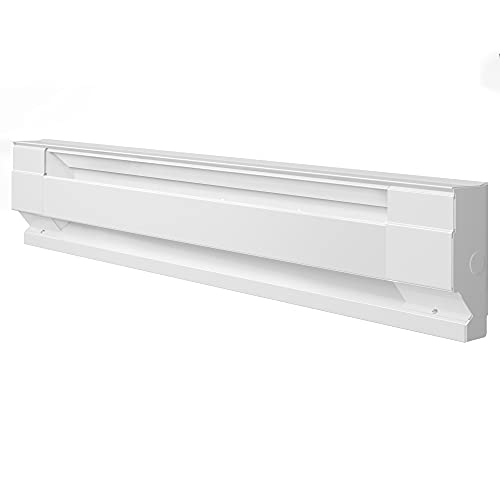
The Cadet F Series 36″ (3F750-1W) is a traditional hard-wired baseboard heater constructed from heavy-gauge steel. This model is typically paired with a separate wall thermostat.
- Construction: 25-gauge steel with a 20-gauge junction box and all-metal build for robustness.
- Controls: Requires an external thermostat; not a plug-in unit. This allows selection of line-voltage thermostats or smart retrofit thermostats.
- Use Case: Good for permanent installations where a wired thermostat or zoned control is preferred.
Because this unit lacks an onboard thermostat, plan for an appropriate thermostat type and circuit design. Its metal build suits long-term installations in living spaces and rentals that use conventional line-voltage control schemes.
KING 4K1210BW K Series Baseboard Heater 4′ 1000W

The KING 4K1210BW is a hard-wired 4-foot baseboard rated at 1000 watts and is designed for in-wall wiring. It uses an aluminum ribbon fin element for heat transfer and includes full-length safety cutout protection.
Call 888-896-7031 for Free Local HVAC Quotes – Compare and Save Today!
- Design: Not a plug-in model; intended for safe, permanent hard-wired installation.
- Safety: Full-length safety cutout protects against overheating along the entire element.
- Performance: Aluminum ribbon fins provide efficient heat distribution along the unit length.
This heater is appropriate for installations requiring a durable, hard-wired solution with a midrange wattage. Pair it with a compatible wall thermostat for centralized control or with a smart thermostat designed for line-voltage systems.
Mysa Smart Thermostat For Electric Baseboard Heaters

The Mysa Smart Thermostat is a line-voltage thermostat specifically designed for high-voltage electric baseboards and fan-forced heaters. It supports 120–240V systems and offers Wi‑Fi control with HomeKit, Alexa, and Google Home compatibility.
- Compatibility: Works only with high/line voltage systems; requires at least four wires including neutral or second live. Not compatible with two-wire low-voltage baseboards.
- Smart Features: Mobile app remote control, scheduling, adaptive display brightness, and energy-saving schedules to reduce electricity usage.
- Capacity: Supports high-load limits (check specific model for 1900W at 120V or 3800W at 240V capacities).
Mysa is a retrofit option for homeowners seeking smart control of existing baseboard circuits. Confirm wiring and load compatibility before purchase. Installation often requires electrician assistance if your current thermostat wiring lacks the necessary conductors.
Buying Guide: How To Choose An Electric Baseboard Heater
Selecting the right electric baseboard heater requires attention to room sizing, wiring, control options, and safety features. Below are key considerations to compare models effectively.
1. Calculate Required Wattage
Estimate wattage by room size. A common rule is 10 watts per square foot for average insulation. Multiply room square footage by 10 to approximate needed watts. For cold climates or poorly insulated rooms, increase wattage allowance.
2. Voltage And Wiring Compatibility
Check whether your home wiring is 120V or 240V. Many baseboards are hard-wired and require a dedicated circuit. If replacing an existing unit, confirm wire count and voltage before purchasing a smart thermostat like Mysa that requires four wires and neutral.
3. Onboard Thermostat Vs. External Thermostat
Some units include an onboard thermostat (digital or mechanical) for local control. Other models require a separate wall thermostat, allowing centralized or smart control and better zoning. Decide if you want local manual control or smart scheduling.
4. Safety Features
Look for overheat protection, thermal cutouts, tip-over switches (on portable units), and stay-cool exteriors. Full-length safety cutouts and metal construction improve longevity and reduce fire risk.
5. Construction And Heat Distribution
Materials such as steel cabinets and aluminum ribbon fins affect heat transfer and durability. Convection baseboards move warm air naturally, while finned elements can provide faster distribution. Consider the aesthetic and clearance requirements for baseboard placement.
6. Noise And Operation
Convection heaters are typically quiet, suitable for bedrooms. Fan-assisted models or infrared wall heaters may have different acoustic profiles. For quiet spaces prioritize units labeled whisper-quiet or convection-only designs.
7. Smart Features And Energy Savings
Smart thermostats provide scheduling, remote control, and adaptive algorithms to reduce energy use. If energy savings are a priority, choose a thermostat and heater pairing that supports scheduling and accurate temperature sensing.
8. Installation And Maintenance
Hard-wired models generally require professional installation to meet electrical codes. Check warranty and serviceability. Periodic cleaning of fins and ensuring clear airflow improves efficiency and lifespan.
9. Room Placement And Size Considerations
Baseboards should be installed along exterior walls, under windows when possible, to reduce cold drafts. Match heater length and wattage to wall runs and room layout. Shorter sections (e.g., 24″) suit bathrooms or small spaces; longer units cover larger walls for even heat.
10. Compatibility With Existing HVAC Strategy
Decide if baseboard heating will be the primary heat source, supplemental heat, or part of zoned heating. For whole-home control, integrate with line-voltage smart thermostats that support multi-room scheduling or use multiple thermostats for zoning.
Use the above criteria to compare the models reviewed. Select a heater with appropriate wattage, compatible voltage, and the control scheme that fits your comfort and energy goals. When in doubt about wiring or load capacity, consult a licensed electrician to confirm safe installation and thermostat compatibility.
Tips for Getting the Best HVAC Prices
- Prioritize Quality Over Cost
The most critical factor in any HVAC project is the quality of the installation. Don’t compromise on contractor expertise just to save money. - Check for Rebates
Always research current rebates and incentives — they can significantly reduce your overall cost. - Compare Multiple Quotes
Request at least three estimates before making your choice. You can click here to get three free quotes from local professionals. These quotes include available rebates and tax credits and automatically exclude unqualified contractors. - Negotiate Smartly
Once you've chosen a contractor, use the proven strategies from our guide — How Homeowners Can Negotiate with HVAC Dealers — to get the best possible final price.