
Choosing the right heater for a shop requires balancing power, fuel type, mounting options, and safety features. Below is a quick comparison of five well-matched heaters that cover electric and natural gas options, ceiling and wall mounting, and varying power outputs to suit different workshop sizes.
| Model | Type | Mounting | Power / Output |
|---|---|---|---|
| CTSC 10000W Electric Garage Heater | Electric | Wall/Ceiling Hardwired | 10000W / Digital Thermostat |
| Mr. Heater Big Maxx MHU80NG | Natural Gas Unit Heater | Hanging/Bracket | 80,000 BTU / 2000 sq. ft. Coverage |
| Comfort Zone CZ220BK 5000W | Electric | Ceiling Hardwired | 5000W / Fan-Forced |
| TEMPWARE 7500W Electric Garage Heater | Electric | Ceiling Hardwired | 6250–7500W / Timer & ECO Mode |
| VEVOR 10000W Electric Garage Heater | Electric | Wall/Ceiling Hardwired | 10000W / 2 Power Levels |
Content Navigation
CTSC 10000W Electric Garage Heater, 240v

Overview: Hardwired 240V electric heater with fan-forced output and digital controls. Designed for workshops and large garages where high wattage is required.
Key Features: Voltage display for quick troubleshooting; three heat settings (10000W, 7500W, Fan Only); digital thermostat, remote control, timer, ECO function; constructed from SPCC cold-rolled steel; ETL listed; overheating protection.
Use Case And Notes: Suited for larger garages or shops that have 240V supply and require powerful electric heating. The built-in voltage display helps identify installation issues. Requires hardwired installation by a qualified electrician. The multiple control options and ECO mode support energy management in variable climates.
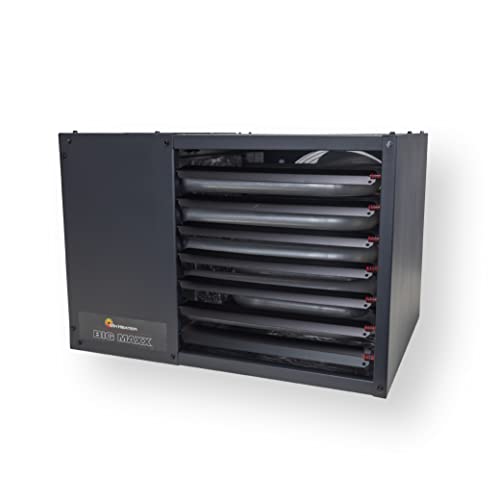
Mr. Heater F260560 Big Maxx MHU80NG 80,000 BTU
Call 888-896-7031 for Free Local HVAC Quotes – Compare and Save Today!
Overview: Natural gas unit heater offering high BTU output for commercial-size shops and garages. Intended for installations requiring extended coverage and continuous fuel supply.
Key Features: 80,000 BTU output with coverage up to 2000 sq. ft.; includes angle brackets and LP conversion kit; operates on natural gas (thermostat, hose, regulator not included); 120V electrical for controls; specified clearances (min 8 ft. from floor to base).
Use Case And Notes: Best for large or poorly insulated workshop spaces where gas supply is available. Installation requires appropriate venting category and professional setup. The high BTU output enables fast temperature recovery in large-volume areas but needs careful planning for clearances and ventilation.
Comfort Zone Hard-Wired Ceiling Mount 5000W Heater

Overview: Ceiling-mounted, fan-forced electric heater that saves floor space and provides directed airflow through adjustable louvers and mounting angle.
Key Features: Ceiling-mount hardwired design; heavy-gauge steel construction; louvers and adjustable mounting angle for precise heat distribution; thermal cut-out switch and overheat protection; ETL compliant.
Call 888-896-7031 for Free Local HVAC Quotes – Compare and Save Today!
Use Case And Notes: Ideal for workshops where floor space is at a premium. The ceiling placement promotes even heat circulation and minimizes obstruction. With a 5000W rating, it suits small-to-medium sized shops or localized heating zones within larger spaces. Requires professional electrical hardwiring.
TEMPWARE 7500W Electric Garage Heater With Timer
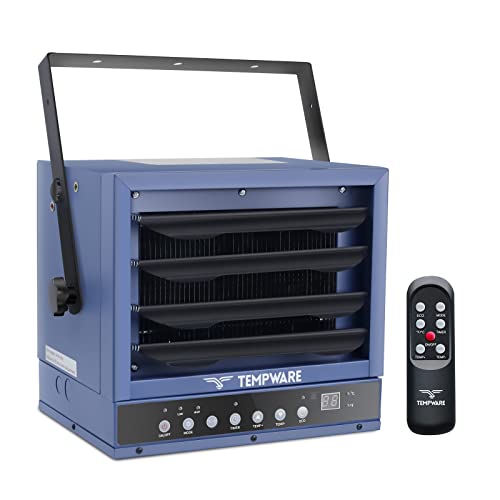
Overview: Ceiling-mount electric heater with digital controls, ECO mode, and a 12-hour timer to manage runtime and energy use in workshops and garages.
Key Features: Adjustable louvers and mounting angle; two heat settings (6250–7500W); max BTU equivalent of about 25,590; built-in thermostat adjustable from 45°F to 95°F; ECO mode and 1–12 hour auto-off timer; overheat protection and full-function remote.
Use Case And Notes: A flexible mid-power option for medium-sized shops. The ECO mode and timer can reduce energy consumption in intermittent-use scenarios. Ceiling mounting keeps the unit out of the way while delivering directed warm air. Professional hardwiring recommended.
VEVOR 10000W Electric Garage Heater Wall/Ceiling Mount

Overview: High-power electric heater designed for large workshops with options for wall or ceiling mounting and precise temperature control to maintain consistent warmth.
Key Features: 10000W output with two adjustable power levels; wide coverage (up to ~90 sq. m.); high air circulation for even convection; intelligent temperature control with 2°F stability; SPCC cold-rolled steel housing; automatic overheat power-off; ETL certified; remote and 9-hour timer.
Use Case And Notes: Suitable for larger garages and workshops that need strong, even heating and precise temperature regulation. The dual mounting and strong construction offer installation flexibility. Requires a 240V hardwired connection and adherence to electrical codes.
Buying Guide: How To Choose The Right Shop Heater
Selecting a heater for a shop involves matching heating capacity, fuel source, mounting, and safety to your workshop’s specific needs. Below are the core considerations and comparison perspectives to guide your decision.
Tips for Getting the Best HVAC Prices
- Prioritize Quality Over Cost
The most critical factor in any HVAC project is the quality of the installation. Don’t compromise on contractor expertise just to save money. - Check for Rebates
Always research current rebates and incentives — they can significantly reduce your overall cost. - Compare Multiple Quotes
Request at least three estimates before making your choice. You can click here to get three free quotes from local professionals. These quotes include available rebates and tax credits and automatically exclude unqualified contractors. - Negotiate Smartly
Once you've chosen a contractor, use the proven strategies from our guide — How Homeowners Can Negotiate with HVAC Dealers — to get the best possible final price.
Heating Capacity And Coverage
- BTU vs. Wattage: Gas heaters are rated in BTUs (e.g., 80,000 BTU), while electric heaters use watts (e.g., 5000W–10000W). Convert 1 watt ≈ 3.412 BTU to compare outputs.
- Room Size And Insulation: Calculate room volume (sq. ft. × ceiling height). Insulation quality greatly affects required capacity. Poorly insulated shops need more power to maintain set temperatures.
- Heat Distribution: Ceiling-mounted fan-forced units and high-circulation models provide more even warming than small portable heaters.
Fuel Type And Installation
- Electric Heaters: Simpler to install when a 240V circuit exists, no combustion byproducts, suitable for indoor enclosed spaces without venting.
- Gas Heaters: Higher output and lower operating cost in some markets, but need gas supply, proper venting/clearance, and professional installation.
- Portables vs. Hardwired: Portable electric units offer flexibility but lower capacity. Hardwired ceiling or wall units require electrician installation but deliver higher continuous power.
Mounting And Placement
- Ceiling Mount: Saves floor space and diffuses heat downwards; good for fixed zones and overhead clearance.
- Wall Mount: Useful when ceiling access is limited; direct air toward work areas.
- Clearances And Safety: Adhere to manufacturer-clearance specs to avoid fire hazards; maintain adequate airflow around fans and louvers.
Controls, Efficiency, And Runtime
- Thermostats And Timers: Digital thermostats and timers reduce wasted runtime and maintain stable temperatures.
- ECO Modes & Remote Control: Useful for workshops with intermittent use—programming or remote start reduces warm-up time and energy use.
- Power Levels: Multi-level power settings allow balancing heat output and electrical load to match demand.
Safety Features And Certifications
- Overheat Protection: Essential for continuous-operation units to prevent thermal failure.
- Certifications: Look for ETL or equivalent safety listings which indicate third-party testing.
- Construction Materials: Steel housings and robust internal components extend service life in shop environments.
Operational Costs And Efficiency
- Electricity Costs: High-watt electric heaters consume substantial power—estimate running costs using local kWh rates and typical runtime.
- Gas Costs: Natural gas or propane may be more economical for larger areas, but factor in venting and maintenance.
- Load Management: For multi-unit setups, ensure your shop’s electrical service can handle cumulative loads or stagger runtimes using timers.
Noise, Airflow, And Comfort
- Fan-Forced Noise: Fan-forced units move air effectively but generate noise; consider quieter models if noise is a concern.
- Air Direction: Adjustable louvers and pivoting mounts help target workbenches or vehicle bays for comfort and efficiency.
- Air Quality: Electric heaters do not produce combustion byproducts. If using gas, ensure adequate ventilation and CO monitoring where applicable.
Installation And Maintenance Perspectives
- Professional Installation: Hardwired electric units and gas heaters typically require licensed electricians or HVAC technicians.
- Accessibility For Service: Install with access for periodic inspection, cleaning of fans, and thermostat servicing.
- Replacement Parts And Support: Consider brands and models with available parts and documented support for long-term maintenance.
Comparison Summary
- High Output, Large Areas: Natural gas unit heaters (e.g., Mr. Heater Big Maxx) provide high BTU output and are suited for expansive, high-volume spaces.
- High-Power Electric: 10000W electric units (CTSC, VEVOR) deliver strong electric heating without combustion but require 240V circuits.
- Space-Saving Ceiling Options: Ceiling-mounted units (Comfort Zone, TEMPWARE) preserve floor space and provide targeted distribution for mid-sized shops.
- Energy Management: Models with ECO modes, timers, and thermostatic control improve efficiency and reduce runtime.