
Basements need targeted heating solutions that balance power, quiet operation, safety, and installation type. Below is a concise comparison of five well-suited heaters for basement use, including portable ceramic units, wall-mounted infrared options, and low-wattage panel heaters.
| Model | Type | Key Feature |
|---|---|---|
| Dreo 1500W Electric Heater | Portable Ceramic | Fast PTC heat, 70° Oscillation |
| Dreo 25″ Fast Electric Heater | Tall Oscillating Ceramic | Long-range airflow, low noise |
| Heat Storm HS-1500-PHX-WIFI | Wall-Mounted Infrared | Wi‑Fi control, space-saving mount |
| Dreo Smart Wall Heater WH719S | Smart Oscillating Wall | 120° Oscillation, app control |
| ENVI Plug-In Electric Panel | Low-Wattage Panel | Fan-less, 24/7 energy-efficient heat |
Content Navigation
- Dreo Space Heater, 1500W Electric Heaters For Indoor Use
- Dreo Space Heater For Indoor Use, 25″ Fast Electric Heater
- Heat Storm HS-1500-PHX-WIFI Infrared Heater, Wifi Wall Mounted
- Dreo Smart Wall Heater, Electric Space Heater For Bedroom
- Envi Plug-In Electric Panel Wall Heaters For Indoor Use
- Buying Guide: Choosing The Right Basement Heater
Dreo Space Heater, 1500W Electric Heaters For Indoor Use

This portable ceramic heater delivers 1500W PTC heating for quick warmth and is specified for coverage up to 200 sq. ft. It uses oblique airflow technology to reduce fan noise, producing around 34 dB, which is suitable for sleeping or working in quieter basement zones.
Safety features include ETL certification, multiple protections such as tip-over and overheat shutoffs, a V0 flame-retardant body, and a 12-hour timer with automatic power-off options. The product listing advises direct wall outlet use rather than an extension cord.
Control options include several heating modes, a thermostat for temperature control, and a remote. Performance is focused on fast warm-up, quiet operation, and integrated safety features that matter in basement settings where unattended operation is common.
Dreo Space Heater For Indoor Use, 25″ Fast Electric Heater

Call 888-896-7031 for Free Local HVAC Quotes – Compare and Save Today!
This 25″ tower-style ceramic heater emphasizes long-range airflow, using a hyperamics thermal design and extended impeller to reach farther across large rooms. It lists 11.5 ft/s fast heat output and aims to expand effective coverage compared with smaller portable units.
Safety and quiet operation are core features: built with V0 flame-retardant materials, ETL-certified tip-over and overheat protection, and a child lock. Noise levels are listed down to 32 dB, making it appropriate for basement recreation rooms or home theaters where low noise matters.
Operational modes and a remote provide convenient control. This model suits basements that need more directional range to move warm air from a corner or stairwell into wider open spaces.
Heat Storm HS-1500-PHX-WIFI Infrared Heater, Wifi Wall Mounted

The Heat Storm is a wifi-enabled wall-mounted infrared heater that conserves floor space — useful in basements with limited room or where floor placement is hazardous. Infrared heating warms objects and people directly, which can be efficient for localized comfort.
It offers a digital thermostat, touch screen, remote, and smartphone control for scheduling and remote adjustments. The wall-mounted form factor reduces trip hazards and keeps the unit out of reach of children or pets.
Call 888-896-7031 for Free Local HVAC Quotes – Compare and Save Today!
Safety features include tip-over shutoff and integrated controls. This heater is best when you need a mounted solution to target a finished basement area, workshop, or an area where silent, unobtrusive heating and remote control are priorities.
Dreo Smart Wall Heater, Electric Space Heater For Bedroom

This Dreo wall-mounted model blends smart control with a wide 120° vertical oscillation to distribute heat more evenly from top to bottom. The PTC ceramic element aims for quick steady heating with a wide temperature range.
It supports app control via the Dreo app and integrates with Alexa and Google Home, allowing scheduling and remote temperature adjustments. Temperature precision is noted to the nearest 1°F across a wide range, enabling tighter control in fluctuating basement conditions.
Installation is intended for indoor wall mounting to maximize floor space in finished basements. The combination of oscillation and smart scheduling makes it suitable for areas requiring evenly distributed heat and automated routines.
Envi Plug-In Electric Panel Wall Heaters For Indoor Use
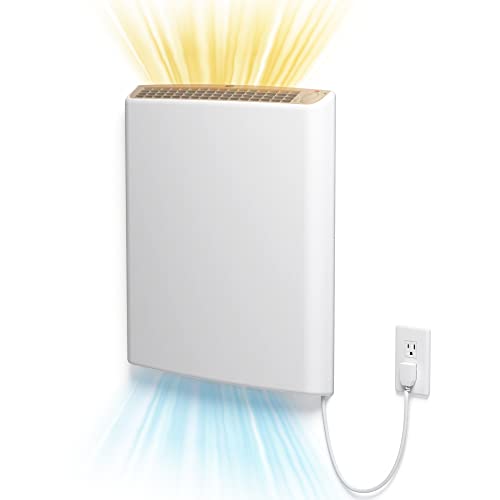
The ENVI plug-in panel heater is a low-wattage, fan-less wall heater designed for continuous operation and energy-efficient supplemental heating. It runs quietly using convection without blowing dust, making it attractive for basements used as hobby rooms or sleeping areas.
Operational features highlight a cool 90°F surface, a wall-sense safety sensor that cuts power if removed from the wall, and a design suitable for 24/7 use. The unit is positioned to reduce allergens and maintain relative humidity, which can be beneficial in damp basement environments.
This model is best for steady background warmth, especially in areas where silent operation and continuous low-level heating are preferred over rapid warm-up or oscillation.
Buying Guide: Choosing The Right Basement Heater
Selecting a heater for a basement depends on multiple factors: space size, insulation, installation constraints, noise tolerance, safety needs, and how you intend to use the space.
Heating Type And Coverage
- Portable Ceramic Heaters (like the Dreo 1500W models) provide fast warm-up with oscillation and are good for targeted zones up to a few hundred square feet.
- Tower Heaters are effective for longer throw and spreading warm air across open-plan basement areas.
- Infrared Wall Heaters warm people and objects directly and can be more efficient in poorly insulated basements or areas with intermittent occupancy.
- Panel Heaters (fan-less) are best for constant low-level heating, silent operation, and allergy-sensitive users.
Installation And Space Constraints
- Floor-placed portables require clear floor space and a grounded outlet; avoid using extension cords per many manufacturer warnings.
- Wall-mounted units save floor space but need mounting hardware and a safe nearby outlet or hardwired connection.
- Plug-in panel heaters offer simple installation and minimal footprint but require wall access and consideration of outlet position.
Noise And Comfort
- If the basement is used as an office, theater, or sleeping area, choose models rated at low dB levels (<35 dB) for quiet operation.
- Fan-less panel heaters provide silent warmth; ceramic fans produce airflow noise but often at reduced levels in newer designs.
Safety Features
- Look for ETL/UL certification, tip-over protection, overheat shutoffs, and flame-retardant construction for unattended use in basements.
- Wall heaters and panel units that remain cool to the touch or include sensors reduce burn and fire risks in tight spaces.
- Consider child lock and reinforced plugs when children or pets access the area.
Energy Use And Efficiency
- Most portable electric heaters operate at 1500W at max. For long-term use, compare thermostat accuracy and programmable timers to reduce energy waste.
- Low-wattage panel heaters may use less energy continuously and can be more cost-effective for maintaining mild temperatures 24/7.
- Infrared heaters can be efficient for spot heating since they directly warm occupants, reducing the need to raise ambient air temperature significantly.
Control And Smart Features
- Remote controls and programmable timers help manage runtime for intermittent basement use.
- Smart app and voice integration (Alexa/Google Home) enable remote scheduling, which is useful if you heat the basement only when occupied.
- Accurate thermostats with 1°F increments improve comfort and avoid cycling inefficiencies.
Durability And Environment
- Basements may be cooler and more humid; choose units with corrosion-resistant components and good seals.
- Metal-bodied forced-air heaters can withstand workshop use, while sleek wall panels are suited for finished living areas.
Comparison Perspectives
- Best For Quick Spot Heating: 1500W ceramic portables with oscillation provide rapid warmth for specific areas.
- Best For Large Open Basements: Tall tower models with extended impellers deliver longer-range airflow to distribute heat more evenly.
- Best For Space-Saving Installations: Wall-mounted infrared heaters free floor space and offer direct heating where people sit or work.
- Best For Continuous Low-Level Heat: Fan-less panel heaters give silent, even warmth for bedrooms, home offices, or areas used overnight.
- Best For Smart Control: Wi‑Fi and app-enabled models allow remote scheduling and integration into home automation systems for efficiency and convenience.
When selecting a basement heater, weigh targeted coverage needs against safety, noise tolerance, and whether you prefer quick bursts of heat or continuous background warmth. Matching heater type to your basement layout and use case will deliver the most efficient and comfortable results.
Tips for Getting the Best HVAC Prices
- Prioritize Quality Over Cost
The most critical factor in any HVAC project is the quality of the installation. Don’t compromise on contractor expertise just to save money. - Check for Rebates
Always research current rebates and incentives — they can significantly reduce your overall cost. - Compare Multiple Quotes
Request at least three estimates before making your choice. You can click here to get three free quotes from local professionals. These quotes include available rebates and tax credits and automatically exclude unqualified contractors. - Negotiate Smartly
Once you've chosen a contractor, use the proven strategies from our guide — How Homeowners Can Negotiate with HVAC Dealers — to get the best possible final price.