
Finding the right industrial electric heater means balancing power, mounting style, controls, and safety for large spaces. Below is a quick comparison table of the five selected units covered in this guide to help you scan core specs and intended use cases.
| Product | Power / Voltage | Mounting | Key Feature |
|---|---|---|---|
| Comfort Zone 10,000W Hard-Wired Garage Heater | 10,000W / 240V | Ceiling | Digital Thermostat, Remote, 2 Heat Settings |
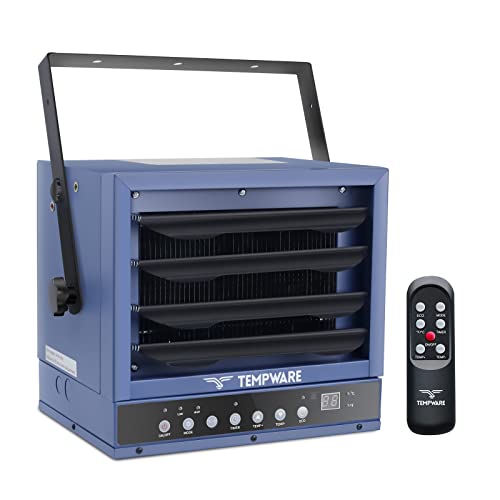
| TEMPWARE 7500W Electric Garage Heater | 6,250–7,500W / 240V | Ceiling | Adjustable Louvers, ECO Mode, Timer |
| Global Industrial Fan Forced Wall Heater | 4,000/3,000W / 240/208V | Wall (Recessed Option) | Enclosed Motor, Built-In Thermostat |
| Comfort Zone CZ290 4,800W NEMA 6-30P Industrial Heater | 4,800W / 240V | Portable / Floor | Carry Handle, Integrated Thermostat |
| Dr Infrared DR-988A Garage Shop Heater | 4,800/5,600W / 208–240V | Hardwired / Plug (NEMA 6-30) | High Wattage Option, 6-30R Plug Requirement |
Content Navigation
- Comfort Zone 10,000W Hard-Wired Garage Heater
- TEMPWARE 7500-Watt Digital Fan-Forced Ceiling Heater
- Global Industrial Fan Forced Wall Heater, Enclosed Motor
- Comfort Zone CZ290 NEMA 6-30P 4,800-Watt Industrial Heater
- Dr Infrared DR-988A Garage Shop 208/240-Volt Heater
- Buying Guide: How To Choose An Industrial Electric Heater
Comfort Zone 10,000W Hard-Wired Garage Heater

Intended Use: Large garages, commercial bays, workshops where ceiling mount and high wattage are required.
This is a ceiling-mounted, fan-forced heater with wide air distribution and adjustable directed airflow vents. It provides a high output suited for open spaces. The heater includes a digital thermostat, remote control, and a 12-hour timer for scheduled operation. Construction uses heavy-gauge steel and fully sheathed heating elements. The motor is enclosed to reduce dust intrusion in workshop environments. Overheat protection is integrated to meet basic safety needs for industrial settings.
Features Referenced: Efficient heat distribution via fan-forced system; precise temperature control with digital thermostat, timer, and remote; robust heavy-gauge steel body, enclosed motor, and overheat protection.
TEMPWARE 7500-Watt Digital Fan-Forced Ceiling Heater
Call 888-896-7031 for Free Local HVAC Quotes – Compare and Save Today!
Intended Use: Workshops and garages needing adjustable angle airflow and energy-saving modes.
The TEMPWARE unit is a fan-forced ceiling heater with adjustable louvers and mounting angle for directional air delivery. It offers two heat settings with power ranging from 6,250 to 7,500 watts and claims coverage up to about 1,250 square feet depending on insulation and ceiling height. The built-in thermostat supports an ECO mode that adapts output to ambient temperature and a 1–12 hour auto-off timer for scheduled savings. An overheat sensor provides an automatic safety shutdown.
Features Referenced: Adjustable angle and louvers; ECO mode and timer; built-in thermostat and overheat protection for safety and efficiency.
Global Industrial Fan Forced Wall Heater, Enclosed Motor

Intended Use: Areas where wall mounting or recessed installation is preferable to ceiling mounting.
This model is a fan-forced wall heater with an enclosed motor to reduce dust and debris exposure. It offers two selectable wattage levels (4,000W or 3,000W) and can operate on 240V or 208V circuits. The unit includes a built-in thermostat for temperature regulation and faster warm-up than passive convection heaters. The design supports recessed installation if a flush profile is required for space or aesthetic reasons.
Call 888-896-7031 for Free Local HVAC Quotes – Compare and Save Today!
Features Referenced: Faster heating than convection units; recessed installation option; built-in thermostat and enclosed motor for durability in dusty environments.
Comfort Zone CZ290 NEMA 6-30P 4,800-Watt Industrial Heater

Intended Use: Portable job-site heating, smaller workshops or supplemental zone heating in larger areas.
This Comfort Zone model is a portable fan-forced heater built from heavy-gauge steel with an integrated thermostat and overheat protection. It features a carry handle and rubber feet for stability. As a 4,800-watt unit it is suitable for targeted zone heating rather than whole large-bay heating. The fan design promotes even heat distribution across a workspace. It requires a compatible 240V supply and connector type for operation.
Features Referenced: Fan-forced heat distribution; integrated thermostat; heavy-gauge steel build, carry handle, and overheat protection.
Dr Infrared DR-988A Garage Shop 208/240-Volt Heater

Intended Use: Garages and shops that can accommodate a high-wattage hardwired or NEMA 6-30 plug connection for faster heating.
The DR-988A unit operates at 4,800 or 5,600 watts depending on wiring and is designed to connect to a NEMA 6-30R receptacle or be hardwired to a 240V line. The high wattage supports rapid warm-up in larger or poorly insulated spaces. The product listing highlights the requirement for a specific outlet (NEMA 6-30R) and matching plug (NEMA 6-30P) for portable plug-in operation. Proper electrical configuration is essential for safe use.
Features Referenced: High wattage options; requirement for 240V dedicated outlet or NEMA 6-30R receptacle; designed for garage/shop duty cycles.
Buying Guide: How To Choose An Industrial Electric Heater
Selecting the right industrial electric heater requires assessing space, power needs, mounting, controls, safety, and electrical capacity. The following factors provide a structured way to compare options.
1. Power And Coverage
Wattage Determines Heat Output: Higher wattage yields more heat but needs compatible electrical service. For large bays or poorly insulated workshops choose 5,000W–10,000W class units. For smaller zones, 3,000W–5,000W can be adequate.
Estimate Coverage vs. Conditions: Coverage claims vary; insulation, ceiling height, and open doors reduce effective coverage. Use wattage per square foot as a guideline: higher ceilings require substantially more power.
2. Mounting Style
Ceiling Mount: Good for broad distribution in large open spaces; keeps the heater out of the way of work activity.
Wall Mount / Recessed: Useful when ceiling installation is impractical. Recessed options can be more compact and protected.
Portable/Floor Units: Offer zone heating and mobility but have lower overall coverage compared to fixed high-wattage ceiling models.
3. Electrical Requirements And Installation
Circuit Capacity: Confirm available service (120V vs 208/240V) and circuit breaker capacity. Large units often require dedicated 240V circuits and specific plug types (e.g., NEMA 6-30).
Professional Wiring: Hard-wired or high-amp plug installations typically require an electrician to ensure code compliance and safe operation.
4. Controls And Energy Management
Thermostat Accuracy: Integrated digital thermostats with precise control reduce runtime and energy use by maintaining set temperature.
Timers and ECO Modes: Programmable timers and ECO functions help optimize energy consumption by reducing output when full heat is unnecessary.
5. Airflow, Distribution, And Directionality
Fan-Forced vs Convection: Fan-forced heaters distribute heat faster and more evenly, reducing cold spots. Convection units are quieter but slower and less effective in high-ceiling spaces.
Adjustable Louvers/Angle: Directional control is helpful to target work zones or avoid blowing directly on occupants or equipment.
6. Durability And Duty Cycle
Construction Materials: Heavy-gauge steel housings and enclosed motors suit dusty workshops and industrial environments.
Motor Enclosure And Dust Protection: Enclosed motors and sheathed heating elements extend service life in harsh conditions.
7. Safety Features
Overheat Protection And Thermal Cutoffs: Ensure the unit has built-in overheat shutoff and thermal protection for continuous duty use.
Mounting Clearance And Cool-Touch Surfaces: Observe manufacturer clearance and installation guidance. Portable units should have stable feet and cool-to-the-touch surfaces if used near personnel.
8. Maintenance And Serviceability
Filter And Fan Access: Consider how easy it is to access fans or internal components for cleaning in dusty environments.
Replacement Parts And Support: Verify availability of replacement parts such as fans, thermostats, or heating elements for long-term maintenance.
9. Noise And Workplace Comfort
Fan Noise: Fan-forced units produce audible noise. For environments where noise is a concern, compare decibel levels or consider intermittent operation schedules.
10. Comparison Perspectives
- High-Capacity Ceiling Units: Best for whole-bay heating where fixed installation is acceptable (e.g., Comfort Zone 10,000W, TEMPWARE).
- Wall/Recessed: Ideal where ceiling mounting is not possible or a lower profile is needed (e.g., Global Industrial).
- Portable Shop Heaters: Useful for targeted zone heating and temporary job-site use (e.g., Comfort Zone CZ290) but require matching outlet capacity.
- High-Wattage Plug/Hardwire Options: Provide flexible installation choices but require attention to outlet type and circuit capacity (e.g., Dr Infrared DR-988A).
When comparing models, match the heater’s electrical requirements to your facility’s capacity, evaluate mounting constraints, and prioritize safety and control features that align with your operational needs.
Tips for Getting the Best HVAC Prices
- Prioritize Quality Over Cost
The most critical factor in any HVAC project is the quality of the installation. Don’t compromise on contractor expertise just to save money. - Check for Rebates
Always research current rebates and incentives — they can significantly reduce your overall cost. - Compare Multiple Quotes
Request at least three estimates before making your choice. You can click here to get three free quotes from local professionals. These quotes include available rebates and tax credits and automatically exclude unqualified contractors. - Negotiate Smartly
Once you've chosen a contractor, use the proven strategies from our guide — How Homeowners Can Negotiate with HVAC Dealers — to get the best possible final price.