
Keeping a 100-gallon pond or stock tank at a stable temperature requires the right heater. Below is a concise comparison table of five well-suited pond and tank heaters followed by focused product sections and a detailed buying guide to help you choose the right unit for aeration, fish health, and freeze prevention.
| Product | Type | Key Feature |
|---|---|---|
| Zoo Med TURTLETHERM (300W) | Submersible Aquarium Heater | Preset 78°F, Digital Thermometer Display |
| Aqueon Pro 300 (300W) | Submersible Aquarium Heater | Adjustable 68–88°F, Electronic Thermostat ±1° |
| HITOP Outdoor Pond Heater (600W) | Floatable/Submersible Deicer | Designed To Melt Ice Holes, Constant 68–72°F Range |
| Engtesy 500W Pond Heater | Submersible Stock Tank Heater | Non-Conductive Casing, Automatic Thermostat |
| K&H Ultimate Stock Tank Deicer (750W) | Floating Or Submersible Deicer | Thermostatic Control, Full Cage Included |
Content Navigation
- Zoo Med TURTLETHERM Automatic Preset Aquatic Turtle Heater
- Aqueon Pro 300 Submersible Aquarium Fish Tank Heater
- HITOP Outdoor Pond Heater – 150W 300W 600W
- Engtesy 500W Pond Heater, Stock Tank Heater
- K&H Pet Products Stock Tank & Pond Heater – Ultimate Deicer (750W)
- Buying Guide: Choosing The Right Heater For A 100 Gallon Pond
Zoo Med TURTLETHERM Automatic Preset Aquatic Turtle Heater

Type: Submersible, Preset Aquarium Heater
This unit is specified to safely heat water up to 78°F (26°C) and includes a digital thermometer display with suction cup mounting for convenient position and readout. The heater is fully submersible and includes an automatic shut-off when removed from water for safety. At its rated wattage (300W), it is marketed for tanks up to 100 gallons under typical indoor conditions.
Relevant for small ponds or large indoor tanks, the TURTLETHERM is designed for stable preset heating rather than wide-range temperature adjustments. Its digital readout simplifies monitoring but note that outdoor exposure and heat loss in a pond environment can reduce effective coverage compared to indoor aquarium use.
Aqueon Pro 300 Submersible Aquarium Fish Tank Heater

Call 888-896-7031 for Free Local HVAC Quotes – Compare and Save Today!
Type: Submersible Adjustable Heater
The Aqueon Pro 300 offers an adjustable temperature range of 68–88°F with an electronic thermostat accurate to ±1°. It’s built to be shatterproof and fully submersible with an auto shut-off feature that resets when cooled. Its 300W output is specifically rated for tanks up to 100 gallons, which maps directly to the target pond size.
This heater’s adjustable control gives more flexibility for ponds where you may want different set points seasonally or to maintain a slightly higher temperature for sensitive fish. The accuracy and safety features make it appropriate for indoor or sheltered outdoor ponds where the heater can remain fully submerged and protected from direct freezing or debris.
HITOP Outdoor Pond Heater – 150W 300W 600W

Type: Floatable/Submersible Pond Deicer
Designed for outdoor ponds, the HITOP unit (available up to 600W) is intended to create melting holes in surface ice so fish can obtain oxygen rather than fully heating entire pond volume. The 600W model claims it will heat water near the heater and is effective at preventing surface freeze in cold conditions. It features a floatable foam body and automatic constant-temperature control targeting roughly 68–72°F around the device.
Call 888-896-7031 for Free Local HVAC Quotes – Compare and Save Today!
For a 100-gallon pond, this style functions primarily as a deicer and local warmer. Expect localized thawing and ice prevention rather than uniform water temperature. Performance will vary with ambient conditions and pond insulation.
Engtesy 500W Pond Heater, Stock Tank Heater

Type: Submersible Stock Tank/Pond Heater
The Engtesy 500W model highlights a non-conductive casing designed to reduce electrical risk, making it suitable for livestock waterers and ponds. It’s built from weather-resistant materials for outdoor use and includes an automatic thermostat controller. The design emphasizes safety for animals and durable operation in harsh environments.
At 500W, this heater provides more heating capacity than 300W units, offering stronger performance for a 100-gallon pond exposed to colder ambient temperatures. The non-conductive design can be an advantage in livestock settings or less-controlled outdoor installations.
K&H Pet Products Stock Tank & Pond Heater – Ultimate Deicer (750W)
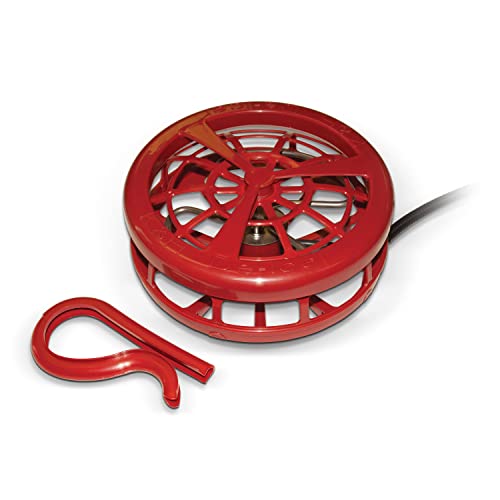
Type: Floating/Submersible Stock Tank Deicer
This K&H Ultimate Deicer includes a full protective cage and cord clip, and is thermostatically controlled to turn on and off as needed to prevent freezing. It’s offered in multiple wattages; the pictured 750W model provides substantial power for outdoor stock tanks and small ponds. It is safety-listed and intended for direct use in livestock and stock watering setups.
For a 100-gallon exposed pond, a higher-wattage, thermostatically controlled deicer such as this is useful for maintaining an open-water area in freezing conditions. The cage helps prevent contact with animals or debris.
Buying Guide: Choosing The Right Heater For A 100 Gallon Pond
Choosing the best heater depends on your pond location, insulation, aquatic life, and whether you need full-volume warming or just ice prevention.
1. Heater Type And Intended Use
- Submersible Aquarium Heaters (e.g., Aqueon, Zoo Med): Best for controlled, sheltered ponds or indoor tanks where maintaining an exact temperature is important.
- Floatable/Submersible Deicers (e.g., HITOP, K&H): Designed to keep an area of the surface ice-free; typically used outdoors to preserve oxygen exchange rather than to warm the entire pond.
- Stock Tank Heaters (e.g., Engtesy, K&H): Built for livestock and rugged outdoor use with safety features like cages and non-conductive casings.
2. Wattage And Heating Capacity
- As a general principle, more wattage equals more capacity to combat heat loss. A sheltered 100-gallon pond may be adequately served by 300W in mild cold, while exposed ponds in freezing climates benefit from 500–750W to maintain open water.
- Deicers do not aim to heat total pond volume — they create localized open water. If uniform temperature is required for sensitive species, choose a submersible heater sized for full-volume heating or combine devices.
3. Thermostatic Control And Accuracy
- Adjustable thermostats (Aqueon) offer setpoint flexibility, useful for different species or seasonal changes.
- Preset units (Zoo Med TURTLETHERM) simplify operation but limit temperature choices.
- Thermostat accuracy matters: a ±1°F electronic thermostat helps maintain stable conditions for sensitive fish.
4. Safety Features
- Look for auto shut-off when exposed to air or overheating, shatterproof materials, and protective cages for deicers in livestock settings.
- Non-conductive casings reduce risk of shock in drinking water or mixed-use installations.
5. Durability And Outdoor Rating
- Outdoor pond heaters should be weather-resistant and rated for submersion (IP68 where specified) or floatable operation with UV- and corrosion-resistant components.
- Consider cord length and cord clip options for stable installation and to keep connection points away from ice and mud.
6. Placement And Coverage Strategy
- For complete pond warming, center a submersible heater in deeper areas or use multiple lower-wattage heaters distributed around the pond to improve uniformity.
- For ice prevention, place a deicer in a sheltered spot near inflow or a location where open water is most helpful for circulation and animal breathing.
7. Animal And Fish Safety
- Ensure the heater design is safe for animals that might contact it. Protective cages and non-conductive housings reduce risk.
- Heaters intended for aquaria may be fragile outdoors; choose ruggedized models for livestock or outdoor ponds.
8. Energy Use And Efficiency
- Higher wattage units consume more power. Match wattage to actual need: deicers often use less total energy by only keeping an open hole, while full-volume heaters will draw more power continuously in extremely cold weather.
- Thermostatic control reduces runtime by cycling the heater only when needed.
9. Maintenance And Monitoring
- Regularly inspect for corrosion, debris, and secure mounting. Suction-cup displays should be checked for accuracy and repositioning.
- Consider adding a thermometer in another spot to verify uniform temperature and ensure setpoints meet your goals.
10. Comparison Perspectives
- Coverage vs. Localized Thawing: If you need evenly warm water for tropical species, choose an adjustable submersible heater sized for total volume. If your goal is winter survival and oxygen exchange, a deicer or floating heater may suffice.
- Indoor vs. Outdoor: Aquarium-style heaters excel indoors or in insulated ponds. Stock-tank and deicer models are built for outdoor exposure and animal contact.
- Safety vs. Power: Non-conductive and caged units prioritize safety in livestock settings; higher-wattage open elements or glass heaters emphasize heating efficiency but may require more careful installation.
Use the product sections above and this buying guide to match heater type, wattage, and features to your pond’s size, climate exposure, and the species you keep. Proper selection and placement will maximize heater performance and protect aquatic life through cold periods.
Tips for Getting the Best HVAC Prices
- Prioritize Quality Over Cost
The most critical factor in any HVAC project is the quality of the installation. Don’t compromise on contractor expertise just to save money. - Check for Rebates
Always research current rebates and incentives — they can significantly reduce your overall cost. - Compare Multiple Quotes
Request at least three estimates before making your choice. You can click here to get three free quotes from local professionals. These quotes include available rebates and tax credits and automatically exclude unqualified contractors. - Negotiate Smartly
Once you've chosen a contractor, use the proven strategies from our guide — How Homeowners Can Negotiate with HVAC Dealers — to get the best possible final price.