
Choosing the right 110V baseboard heater with thermostat means balancing room size, installation requirements, and control features. Below is a concise comparison of five relevant Amazon options, followed by focused product overviews and a practical buying guide to help you select the best fit for American homes.
| Product | Type | Voltage / Wattage | Thermostat |
|---|---|---|---|
| Cadet Com-Pak Electric Wall Heater Complete Unit | Wall Heater With Built-In Thermostat | 120V / 1500W | Built-In Mechanical |
| KING 4K1210BW K Series Baseboard Heater | Hard-Wire Baseboard Element | 120V / 1000W | Requires External Thermostat |
| Cadet F Series 36″ Electric Baseboard Heater | Baseboard Element | 120V / 750W | Requires External Thermostat |
| meross Smart Thermostat For Electric Baseboard | Smart Thermostat (120–240V) | 120–240V, 1920W@120V Max | Smart Wi‑Fi Thermostat (Requires 4 Wires) |
| YeloDeer Dual Voltage 4-Wire Manual Thermostat | Manual Electronic Thermostat | 110–265V, 2400W@120V Max | Digital Manual Control (4-Wire) |
Content Navigation
- Cadet Com-Pak Electric Wall Heater With Thermostat
- KING 4K1210BW K Series Baseboard Heater, 4′ / 1000W / 120V
- Cadet F Series 36″ Electric Baseboard Heater (750W)
- meross Smart Thermostat For Electric Baseboard Heaters
- YeloDeer Dual Voltage 4-Wire Manual Thermostat
- Buying Guide: Selecting A 110V Baseboard Heater With Thermostat
Cadet Com-Pak Electric Wall Heater With Thermostat

This Cadet Com-Pak is a complete 120V wall heater that integrates a thermostat and blower-less heating element. The listed model (CSC151TW) provides 1500W output suitable for medium rooms and installs directly into wall studs or a finished wall cavity.
Key listed features include a compact built-in thermostat configuration and a rated 5120 BTU output. As a complete unit, it simplifies installation for users who want an integrated solution rather than pairing a separate wall thermostat and baseboard element.
Installation considerations: the unit is intended for hard-wiring to a 120V circuit and requires proper electrical box and grounding. The integrated thermostat is mechanical in many Com-Pak variants, offering simple temperature control without smart features.
KING 4K1210BW K Series Baseboard Heater, 4′ / 1000W / 120V

Call 888-896-7031 for Free Local HVAC Quotes – Compare and Save Today!
The KING 4K1210BW is a 4-foot baseboard heater rated at 1000W for 120V circuits. It uses an aluminum ribbon fin element with full length safety cutout protection, designed for permanent hard-wired installation rather than plug-in use.
As a bare baseboard element, it requires a separate thermostat for zone control. That approach allows pairing with either an electronic or mechanical wall thermostat or a modern smart high-voltage thermostat for better scheduling and energy savings.
When selecting a thermostat for this unit, ensure compatibility with 120V line-voltage loads and check the thermostat’s maximum amp rating relative to the heater’s 1000W draw (approximately 8.3A at 120V).
Cadet F Series 36″ Electric Baseboard Heater (750W)
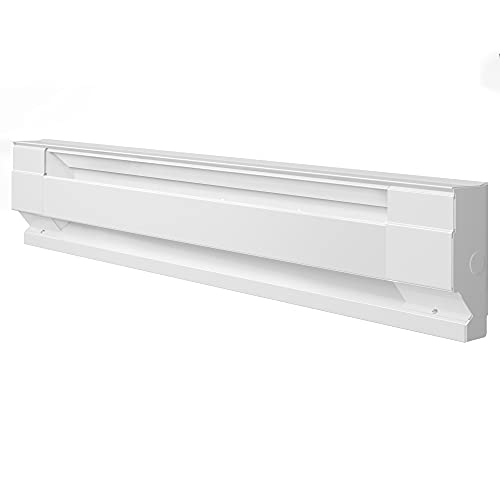
The Cadet F Series 36″ baseboard heater is a slim, all-metal unit designed for reliable convection heating. At 750W and 120V, this model suits smaller rooms, bathrooms, or supplemental heating where lower wattage is appropriate.
Manufacturer notes indicate the element requires an external thermostat. The heater includes a 20-gauge junction box with ground and powder-coated steel casing for durability. It’s a straightforward choice when matching with a compatible line-voltage thermostat.
Call 888-896-7031 for Free Local HVAC Quotes – Compare and Save Today!
Installers should confirm that the thermostat chosen supports the 750W load and that wiring follows local electrical code. For older two-wire systems, modern thermostats may not be compatible without additional wiring.
meross Smart Thermostat For Electric Baseboard Heaters

The meross Smart Thermostat is a Wi‑Fi programmable thermostat designed for high-voltage baseboard and fan-forced heaters, compatible with 120–240V systems. It supports integrations with Apple Home, Alexa, Google Home, and SmartThings for voice and app control.
Key listed capabilities: maximum output load of 16A (1920W@120V), easy install claims (under 30 minutes), and a requirement for four or more wires in the electrical box. The product notes emphasize compatibility with electric baseboard and convector heaters but not low-voltage systems.
Choose this smart thermostat when you want scheduling, remote control, and ecosystem integration. Confirm the wiring in older homes before purchase, as many smart high-voltage thermostats require a neutral or second live conductor.
YeloDeer Dual Voltage 4-Wire Manual Thermostat

The YeloDeer electronic thermostat is specified for dual-voltage operation (110–265V) and provides manual digital temperature control. It lists a maximum capacity of 20A (2400W@120V), a control range of 40°F to 80°F, and support for 4-wire installations.
Features from the listing highlight superior accuracy versus mechanical thermostats and a digital interface for consistent temperature hold. This thermostat is a practical choice when pairing with a 120V baseboard element that requires a separate controller.
Installation note: because it’s a 4-wire device, ensure the electrical box includes the required conductors. Confirm terminal wire size compatibility (max 12 AWG) and verify local code compliance for high-voltage thermostat installations.
Buying Guide: Selecting A 110V Baseboard Heater With Thermostat
When evaluating 110/120V baseboard heaters and thermostats, consider electrical compatibility, room heating needs, installation, and control features. Use the following sections to compare from technical and practical perspectives.
Tips for Getting the Best HVAC Prices
- Prioritize Quality Over Cost
The most critical factor in any HVAC project is the quality of the installation. Don’t compromise on contractor expertise just to save money. - Check for Rebates
Always research current rebates and incentives — they can significantly reduce your overall cost. - Compare Multiple Quotes
Request at least three estimates before making your choice. You can click here to get three free quotes from local professionals. These quotes include available rebates and tax credits and automatically exclude unqualified contractors. - Negotiate Smartly
Once you've chosen a contractor, use the proven strategies from our guide — How Homeowners Can Negotiate with HVAC Dealers — to get the best possible final price.
Voltage And Load Matching
- Confirm Voltage: Most US residential baseboards use 120V. Verify the heater and thermostat both support 120V operation.
- Check Wattage And Amps: Calculate current draw (amps = watts ÷ voltage). Ensure thermostat amperage rating exceeds heater current. For example, a 1500W heater at 120V draws ~12.5A.
- Safety Margin: Choose a thermostat rated at or above the heater’s continuous load; allow margin for continuous operation.
Thermostat Type And Features
- Mechanical vs Electronic: Mechanical thermostats are simple and robust; electronic thermostats offer finer control and energy-saving setpoints.
- Smart Thermostats: Provide remote control, scheduling, and voice integration. Confirm they are designed for high-voltage loads and require proper wiring (often 4 wires).
- Wiring Requirements: Many modern smart or electronic line-voltage thermostats need a neutral or second live conductor. Old two-wire baseboard circuits may require rewiring.
Room Size And Heater Sizing
- Calculate Required BTU/Watt: Estimate room heat load and select heater wattage accordingly. Small rooms often require 500–1000W; medium rooms 1000–1500W.
- Multiple Zones: For whole-house efficiency, consider separate thermostats for each zone or room to avoid overheating unused areas.
Installation And Code Considerations
- Professional Wiring: Hard-wired baseboard units commonly require circuit breakers and proper junction boxes. Consider licensed electricians for safe installation.
- Grounding & Junction Boxes: Ensure the heater includes a code-compliant junction box and ground, as noted for Cadet and KING models.
- Local Codes: Confirm local electrical codes regarding thermostat placement and circuit protection.
Safety Features
- Overheat Protection: Look for built-in overheat cutouts or safety thermal switches on heaters or thermostats.
- Tip-Over & Stay-Cool: For portable or wall-mounted alternatives, check for tip-over sensors and cool-touch bodies where applicable.
Control Flexibility And Energy Savings
- Programmable Schedules: Thermostats with scheduling can reduce running time and energy use.
- Adaptive Features: Some smart thermostats include adaptive or learning modes to optimize comfort and savings.
- Remote Access: Remote apps allow monitoring and adjustments when away from home; confirm there are no subscription requirements.
Compatibility Checklist Before Purchase
- Verify heater voltage and wattage match the thermostat rating.
- Confirm required wiring is present (two-wire vs four-wire).
- Check thermostat maximum amperage and continuous load rating.
- Ensure the thermostat supports the control type you want (manual, programmable, smart).
- Consider room size and whether multiple heaters or zones are needed.
Comparison Perspectives
- Integrated Unit vs Separate Thermostat: Integrated heaters (like Cadet Com-Pak) simplify installation but limit thermostat upgrade options. Separate elements plus thermostats (KING, Cadet F Series) offer flexibility to add smart controls.
- Mechanical vs Smart Controls: Mechanical controls are low-complexity; smart thermostats add convenience and potential energy savings but require compatible wiring.
- Warranty & Support: Review manufacturer support and documentation for installation guidance and warranty coverage.