
Quick Overview: This guide compares versatile 2‑in‑1 units that provide both cooling and heating for homes, apartments, RVs, and rooms where seasonal comfort matters. Below is a summary table of the five selected models reviewed in detail.
| Product | Type | Approx. Coverage |
|---|---|---|
| Uhome 12000 BTU Portable Air Conditioner With Heater | Portable A/C + Heater | Up To 400 Sq. Ft. |
| Midea 8000 BTU Smart Inverter Window Unit With Heat | Window Heat Pump Unit | Up To 350 Sq. Ft. |
| SereneLife 8000 BTU Portable Air Conditioner With Heat | Portable A/C + Heater | Up To 350 Sq. Ft. |
| COSTWAY 12000 BTU Mini Split Air Conditioner & Heater | Wall-Mounted Ductless Mini Split | Up To 750 Sq. Ft. |
| SereneLife 14000 BTU Portable Air Conditioner With Heating | Portable A/C + Heater (High Capacity) | Up To 500 Sq. Ft. |
Content Navigation
- Uhome 12000 BTU Portable Air Conditioner With Heater
- Midea 8,000 BTU Smart Inverter Air Conditioner Window Unit With Heat
- SereneLife 8000 BTU Portable Air Conditioner With Heat
- COSTWAY 12000BTU Mini Split Air Conditioner & Heater
- SereneLife 14000 BTU Portable Air Conditioner With Heating Function
- Buying Guide: How To Choose The Right 2‑In‑1 Air Conditioner And Heater
Uhome 12000 BTU Portable Air Conditioner With Heater

Type: 4‑in‑1 portable unit (cooling, heating, dehumidifier, fan). Coverage: Up to 400 sq. ft. Features emphasize a 12,000 BTU capacity for both cooling and heating, a self‑evaporating system that reduces water tray emptying, and a rated noise level near 52 dB.
Controls include an LED display and remote with programmable 24‑hour timer and three fan speeds. The unit lists an airflow of 360 m³/hr and moisture removal capacity at 91 pints/day. The product is positioned for medium rooms where portability and seasonal switching between AC and heat are priorities.
Midea 8,000 BTU Smart Inverter Air Conditioner Window Unit With Heat

Type: Window heat pump with inverter technology. Coverage: Up to 350 sq. ft. The unit uses variable‑speed inverter tech for improved efficiency and is Energy Star rated. It supports Heat, Cool, Dry, Fan, Auto modes and provides supplemental heating when outside temperature is above ~41°F (heat pump limitation).
Call 888-896-7031 for Free Local HVAC Quotes – Compare and Save Today!
Smart features include app control and voice assistant compatibility (Alexa, Google). The front‑access washable filter and 5 operation modes plus multiple fan speeds aim to balance comfort and energy use. This option suits rooms where a window installation and energy efficiency matter.
SereneLife 8000 BTU Portable Air Conditioner With Heat
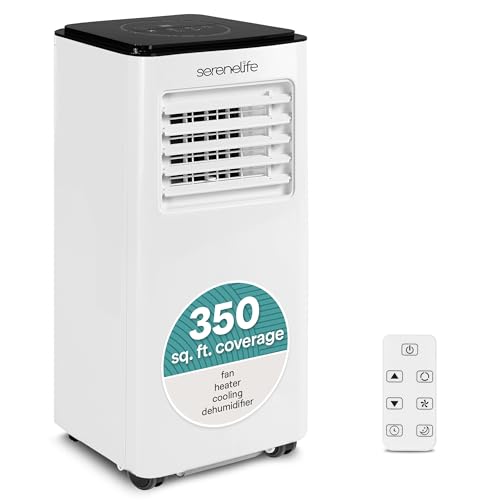
Type: Compact portable 4‑in‑1 unit (cool, heat, dehumidify, fan). Coverage: Approximately 300–350 sq. ft. Cooling capacity listed as 8000 BTU (ASHRAE) and 5000 BTU (DOE), with an airflow rate near 270 m³/hr.
Key features include auto, sleep, and power‑failure memory modes, R32 refrigerant, and a metal control box for added safety. The combination of dehumidifier and heater functions makes this model suited for smaller rooms and spaces where compact footprint and basic mobility are required.
COSTWAY 12000BTU Mini Split Air Conditioner & Heater

Type: Wall‑mounted ductless mini split with inverter heat pump. Coverage: Up to 750 sq. ft. The unit is AHRI certified, uses inverter tech for continuous modulation, and includes a 1‑ton heat pump rated to provide both heating and cooling.
Call 888-896-7031 for Free Local HVAC Quotes – Compare and Save Today!
Operational modes include Auto, Cool, Dry, Heat, and Fan and four fan speeds plus ECO, sleep, turbo, and iFEEL functions. The remote control, low‑noise operation, and higher coverage area make this option appropriate for whole‑room comfort where a permanent wall mount is acceptable and higher efficiency is desired.
SereneLife 14000 BTU Portable Air Conditioner With Heating Function
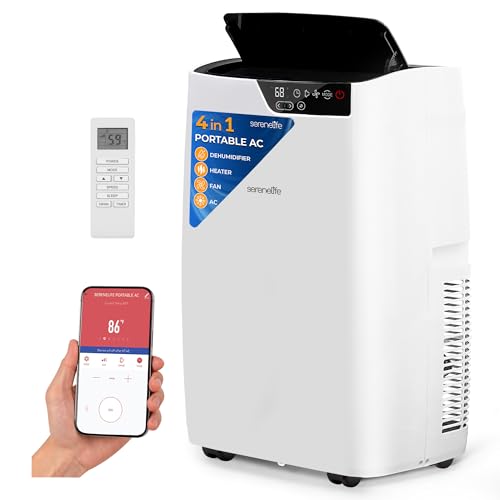
Type: High‑capacity portable 4‑in‑1 unit with Wi‑Fi. Coverage: Up to 500 sq. ft. The unit lists 14,000 BTU cooling and integrated heating with a GMCC compressor and self‑evaporative system for reduced condensate management.
Features include Wi‑Fi control, automatic and sleep modes, R32 refrigerant, CEER efficiency rating, and low‑noise operation. This model targets users needing higher cooling capacity in larger rooms while retaining portable heater functionality for shoulder‑season use.
Buying Guide: How To Choose The Right 2‑In‑1 Air Conditioner And Heater
Selecting a dual‑function unit depends on several technical and practical factors. Below are objective considerations to compare models across multiple perspectives: performance, installation, efficiency, noise, and maintenance.
Room Size And BTU Capacity
- Match BTU To Room Area: Use manufacturer coverage guidelines as a baseline—smaller rooms often work with 8,000–12,000 BTU portable or window units; mini splits scale to larger areas (12,000+ BTU).
- Account For Insulation And Ceiling Height: Poorly insulated spaces or high ceilings require higher capacities; tight, insulated rooms may allow smaller units to perform adequately.
Type And Installation
- Portable Units: Offer mobility and no permanent installation but require a window kit and exhaust hose; they can be noisier and slightly less efficient.
- Window Heat Pump Units: Install in a window opening, usually more efficient than portable units and offer better sealing if installed correctly.
- Mini Splits: Require professional or semi‑professional installation but provide the best efficiency, quieter operation, and flexible wall‑mounted placement.
Heating Technology
- Resistive Electric Heat vs. Heat Pump: Heat pumps transfer heat and are more efficient above their operating minimum outdoor temperature. Resistive heaters can work at any temperature but consume more electricity.
- Cold Climate Performance: Check manufacturer notes—some heat pump window units may stop heating below certain outdoor temperatures.
Energy Efficiency And Operating Costs
- Look For Energy Certifications: Energy Star rated models and inverter compressors can reduce power draw and running costs.
- Variable‑Speed Inverter Compressors: Provide smoother temperature control and lower cycling losses versus single‑speed compressors.
Noise And Comfort Features
- Noise Ratings: Compare dB ratings for indoor quietness. Portable units typically list noise levels around mid‑50s dB; mini splits and window units often run quieter.
- Controls And Automation: Remote, programmable timers, sleep modes, Wi‑Fi, and voice control can improve usability and energy management.
Dehumidification And Air Quality
- Integrated Dehumidifiers: Useful in humid regions—units list pints/day removal rates. Higher dehumidification can increase comfort without over‑cooling.
- Filters And Air Cleaning: Check for washable filters or additional air‑cleaning (e.g., UV‑C) if indoor air quality is important.
Maintenance And Durability
- Service Access: Front‑access filters and simple condensate management reduce upkeep time. Self‑evaporative systems decrease manual emptying.
- Refrigerant Type: R32 vs. older refrigerants—R32 offers efficiency benefits but may have different servicing requirements.
Portability Versus Permanence
- Portable Units: Best for renters or for moving between rooms. Consider weight, caster design, and window kit compatibility.
- Window/Mini Split Units: Best for fixed installations where higher efficiency, quieter operation, or larger capacity is required.
Safety And Certifications
- Look For Safety Features: Overheat protection, metal control enclosures, and certified components can reduce risk and improve longevity.
- Check Certifications: AHRI, Energy Star, or other regional certifications indicate tested performance standards.
Comparison Perspectives To Weigh
- Upfront Cost vs. Lifetime Cost: Mini splits may cost more to install but often save more over time through higher efficiency.
- Flexibility vs. Performance: Portable units provide flexibility; window and split systems typically deliver better steady‑state performance and efficiency.
- Climate Considerations: In cold climates, verify heat pump low‑temperature ratings; for mild climates, heat pump units are usually more efficient.
Use the above criteria to compare the units reviewed: portable models prioritize mobility and quick seasonal switching, window inverter units balance efficiency and installation simplicity, and mini splits deliver higher efficiency and capacity for permanent installations.
Tips for Getting the Best HVAC Prices
- Prioritize Quality Over Cost
The most critical factor in any HVAC project is the quality of the installation. Don’t compromise on contractor expertise just to save money. - Check for Rebates
Always research current rebates and incentives — they can significantly reduce your overall cost. - Compare Multiple Quotes
Request at least three estimates before making your choice. You can click here to get three free quotes from local professionals. These quotes include available rebates and tax credits and automatically exclude unqualified contractors. - Negotiate Smartly
Once you've chosen a contractor, use the proven strategies from our guide — How Homeowners Can Negotiate with HVAC Dealers — to get the best possible final price.