
The following guide compares reliable 220–240V shop heaters suitable for garages, workshops, and commercial spaces. Each selected model supports higher-voltage circuits or hardwired installation and offers robust heating performance, safety features, and installation flexibility.
| Model | Type | Power (Watts) | Key Feature |
|---|---|---|---|
| Comfort Zone CZ220 | Ceiling Mount, Hardwired | 5,000W | Space-Saving Ceiling Mount |
| DR. INFRARED DR-988A | Plug-In (NEMA 6-30P) | 4,800 / 5,600W | Requires NEMA 6-30R Outlet |
| TEMPWARE 7500W | Ceiling Mount, Hardwired | 6,250–7,500W | Digital Controls, ECO Mode |
| VEVOR 10000W | Wall/Ceiling Mount, Hardwired | 10,000W | Large Coverage, Precise Temp Control |
| CTSC 10000W | Hardwired Fan-Forced | 10,000W | Voltage Display, Digital Thermostat |
Content Navigation
Comfort Zone Hard-Wired Ceiling Mount Garage Heater

This hard-wired ceiling-mount heater is designed for garages and workshops where floor space is limited. The fan-forced design pushes heat downward and across the workspace.
Key listed features include efficient ceiling mounting that frees up floor area, heavy-gauge steel construction for durability in harsher environments, and adjustable louvers and mounting angle for targeted heat distribution.
Safety elements noted include an overheat protection thermal cut-out switch. The unit is ETL compliant, indicating it meets recognized safety standards for indoor commercial use.
Dr Infrared Heater DR-988A Garage Shop 208/240-Volt

Call 888-896-7031 for Free Local HVAC Quotes – Compare and Save Today!
The DR-988A is a higher-voltage model intended for 240-Volt circuits. It lists 5600 watts power consumption at full capacity and provides substantial heating for medium to large work spaces.
The model is delivered with a NEMA 6-30P power cord and requires a NEMA 6-30R receptacle (250V, 30A). Proper outlet and circuit compatibility are essential for safe operation.
Feature notes emphasize the need for a dedicated 240V feed and the correct special outlet. Installers should verify wiring and breaker sizing to match the unit’s amperage requirements.
TEMPWARE 7500W Digital Fan-Forced Ceiling Mount Heater
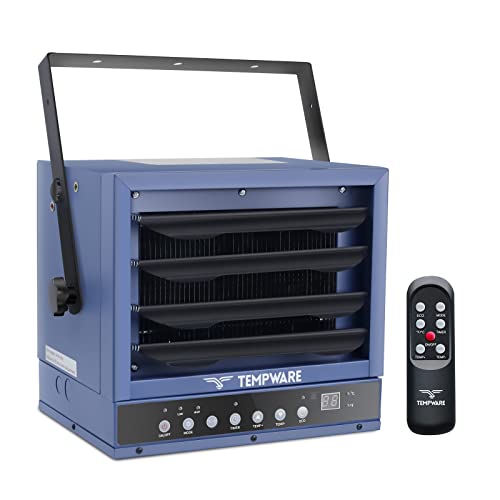
This model is a high-output 7500W hardwired ceiling heater with digital controls and remote operation. It targets large garages and workshops, claiming coverage up to 1,250 sq ft under optimal conditions.
Highlighted features include adjustable louvers, two heat settings (6,250W low and 7,500W high), a built-in thermostat, ECO mode, and a 12-hour timer. Thermal and overheat sensors provide automatic shutdown in unsafe conditions.
Call 888-896-7031 for Free Local HVAC Quotes – Compare and Save Today!
The digital interface and remote control aim to simplify temperature management. For proper performance, installation on a suitable 240V circuit and appropriate breaker rating are required.
VEVOR 10000W Electric Garage Heater

The VEVOR model is a heavy-duty 10,000W unit suitable for larger commercial or high-volume garage spaces, offering both ceiling and wall mounting options.
Key features include wide coverage with two power levels, high air circulation for even convection heating, and precise temperature control claiming ±2°F stability. The housing uses SPCC cold-rolled steel for structural durability.
Safety protection includes automatic overheat shutoff and ETL certification. Users must ensure the electrical supply and breaker capacity match the stated 10,000W load for safe operation.
CTSC 10000W Electric Garage Heater With Voltage Display

The CTSC 10000W unit is a high-output hardwired fan-forced heater offering a digital thermostat, remote control, and an innovative voltage display to aid troubleshooting during installation.
Its features list includes 3 heat settings (10000W, 7500W, Fan Only), ECO function, an LED voltage readout to detect insufficient line voltage, and ETL listing for safety compliance.
Constructed from cold-rolled steel with overheat protection, the model is positioned for demanding workshop environments where monitoring supply voltage and reliable control are priorities.
Buying Guide For 220 Shop Heaters
This section covers the primary considerations for selecting a 220–240V shop heater for garages or workshops. Compare capacity, installation, controls, safety, and long-term operation before choosing.
1. Power And Coverage
Match heater wattage to the volume and insulation level of the space. Higher wattage (7,500–10,000W) suits larger or poorly insulated shops. Use watt-per-square-foot estimates but consult a professional for precise sizing in extreme conditions.
2. Voltage And Circuit Requirements
Confirm your electrical supply is 220–240V and that breakers, wiring gauge, and receptacles (if applicable) meet the heater’s amperage. Models like the DR-988A require a NEMA 6-30R outlet, whereas many hardwired units need a dedicated circuit and breaker sized for full load.
3. Mounting And Space Utilization
Ceiling-mounted heaters save floor space and spread heat from above. Wall-mounted models can direct warm air at work areas. Consider obstructions, ceiling height, and airflow patterns when choosing mount type.
4. Controls And Features
Digital thermostats, timers, ECO modes, and remotes enhance convenience and energy management. For busy workshops, remote control and programmable timers help maintain comfort without manual adjustments.
5. Safety Features
Prioritize models with overheat protection, ETL or UL listing, and thermal cut-offs. Hardwired installations should be performed by licensed electricians to ensure grounding, correct breaker sizing, and compliance with local codes.
6. Build Quality And Durability
Steel housings and robust fans extend service life in dusty or demanding environments. Look for corrosion-resistant finishes and motor protection for long-term reliability.
7. Noise And Air Movement
Fan-forced units produce airflow noise that could impact work environments. If quiet operation is critical, evaluate fan speed options or consider infrared models that provide more silent operation but different heat distribution characteristics.
8. Energy Efficiency And Operating Cost
Higher wattage heaters deliver heat faster but consume more power. Use thermostats and timers to reduce runtime. Consider ECO modes and zoning strategies (heating only occupied areas) to lower energy use.
9. Installation And Maintenance
Hardwired heaters require professional installation; plug-in models require appropriate outlet types. Plan for periodic cleaning of intake and fan components in dusty shops and check thermal sensors and wiring annually.
10. Comparison Perspectives
- Output vs. Coverage: 5,000W–7,500W units suit medium garages; 10,000W better for large or poorly insulated shops.
- Mounting Choice: Ceiling mounts save floor space; wall mounts allow directional heating of workbenches.
- Control Options: Digital thermostats and remotes improve precision and reduce wasted runtime compared to basic on/off units.
- Safety & Certification: ETL/UL listings and overheat cutoff increase suitability for commercial use.
- Installation Complexity: Plug-in units with a NEMA 6-30 plug may be simpler for some installs, but verify outlet and breaker adequacy.
Use this guide to weigh each heater’s listed features—such as overheat protection, voltage requirements, mounting style, and control options—against your shop’s size, electrical setup, and operational preferences before purchasing.
Tips for Getting the Best HVAC Prices
- Prioritize Quality Over Cost
The most critical factor in any HVAC project is the quality of the installation. Don’t compromise on contractor expertise just to save money. - Check for Rebates
Always research current rebates and incentives — they can significantly reduce your overall cost. - Compare Multiple Quotes
Request at least three estimates before making your choice. You can click here to get three free quotes from local professionals. These quotes include available rebates and tax credits and automatically exclude unqualified contractors. - Negotiate Smartly
Once you've chosen a contractor, use the proven strategies from our guide — How Homeowners Can Negotiate with HVAC Dealers — to get the best possible final price.