
The following guide surveys long-length baseboard heaters and compatible covers, focusing on 96-inch wireways and common long-run solutions for American homes. Below is a quick comparison table of the five selected products covered in detail, followed by objective product summaries and a comprehensive buying guide.
| Product | Type | Key Feature | Use Case |
|---|---|---|---|
| TPI 3900WW96 Wireway Cover | 96″ Wireway Cover | 96″ Length For hydronic/architectural electric | Long runs, continuous aesthetic covers |
| KING 4K1210BW K Series Baseboard Heater | Electric Baseboard Heater | 4′ / 1000W Hard-wire, aluminum ribbon fin | Wall-mounted convection heater for rooms |
| Cadet F Series 36″ Electric Baseboard (120V) | Electric Baseboard Heater | 36″ / 750W All metal construction | Short runs or combined with multiples for longer coverage |
| Cadet F Series 36″ Electric Baseboard (240/208V) | Electric Baseboard Heater | Multi-watt / Multi-voltage Convection heating | 240V systems, flexible wattage for electrical setups |
| EZ-HEAT 1500W Baseboard Space Heater | Portable / Convection Baseboard | 1500W Adjustable thermostat, safety features | Supplemental heat, portable or temporary installs |
Content Navigation
- TPI 3900WW96 Wireway Cover For Hydronic And Electric Baseboard
- KING 4K1210BW K Series Baseboard Heater — 4′ / 1000W
- Cadet F Series 36″ Electric Baseboard Heater 3F750-1W (120V)
- Cadet F Series 36″ Electric Baseboard 3F750W (240/208V)
- EZ-HEAT 1,500 Watt Baseboard Space Heater (CZ600)
- Buying Guide — How To Choose The Best 96-Inch Or Long-Run Baseboard Solution
TPI 3900WW96 Wireway Cover For Hydronic And Electric Baseboard

The TPI 3900WW96 is a 96-inch wireway cover designed for hydronic and architectural electric baseboard systems. It provides an elongated cover option for continuous runs where a single long piece is preferred for aesthetics and wiring simplicity.
Features listed: White finish. Application includes covering hydronic sections and protecting wiring while delivering a uniform look along long walls. The 96″ length reduces seams compared to multiple shorter covers and can be used where building codes and system types match the cover specification.
Installation notes: Ensure the cover dimensions align with your heater’s profile and that mounting supports and end treatments are compatible. For hydronic systems, check manufacturer guidance on using covers designed specifically for water-based baseboards versus electric fin-tube systems.
KING 4K1210BW K Series Baseboard Heater — 4′ / 1000W

Call 888-896-7031 for Free Local HVAC Quotes – Compare and Save Today!
The KING 4K1210BW K Series is a hard-wired, non-plug-in baseboard heater rated at 1000W / 120V and 4 feet in length. It uses an aluminum ribbon fin element, a common design for convection heat distribution.
Listed features: Not a plug-in model (hard-wires for safety), Aluminum Ribbon Fin Element, and a Full Length Safety Cutout. The full-length safety cutout provides overheat protection across the unit.
Use considerations: The 4′ length makes it suitable for room segments or for installing multiple units in sequence to cover longer wall runs. Because it is hard-wired, installation must comply with local electrical codes and typically requires a qualified electrician for connection.
Cadet F Series 36″ Electric Baseboard Heater 3F750-1W (120V)
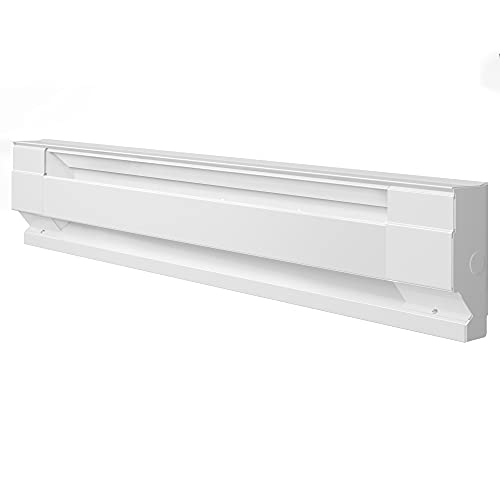
The Cadet F Series 36″ electric baseboard heater model 3F750-1W is a 36-inch unit rated at 750W, 120V. It is constructed of 25 gauge steel with a 20 gauge junction box with ground and comes in a powder-coated white finish.
Listed features: Requires a thermostat, All metal construction, and powder-coated finish for durability. The requirement for an external thermostat gives control flexibility, especially when integrating multiple units into a zoned setup.
Call 888-896-7031 for Free Local HVAC Quotes – Compare and Save Today!
Installation and usage: These 36″ sections are often combined to create longer heating runs. Ensure compatibility of wiring and thermostat control when connecting multiple heaters in a continuous layout. Verify the junction box placement and grounding for safe wiring practices.
Cadet F Series 36″ Electric Baseboard 3F750W (240/208V)
This Cadet F Series 36″ model supports multi-watt capabilities (750/563W) and is rated for 240/208V
Listed features: Powerful multi-watt deliverance, Universal wiring and pre-punched knockouts for simplified installation, and convection heating which circulates warm air throughout the room. The pre-punched knockouts ease conduit routing and splicing.
Application: Use this model where 240V circuits are available and when higher heating output per linear foot is required. Multi-watt flexibility allows installers to match output to circuit capacity or local heating load requirements.
EZ-HEAT 1,500 Watt Baseboard Space Heater (CZ600)

The EZ-HEAT CZ600 is a 1500W convection baseboard-style space heater with an adjustable thermostat. It offers two heat settings, overheat protection, a tip-over switch, dent-proof end panels, and a stay-cool body.
Listed features: Adjustable thermostat, Whisper-quiet operation, and multiple safety features including tip-over and overheat protection. The stay-cool exterior reduces burn risk during operation.
Use cases: This model is a supplemental or portable option rather than a hard-wired permanent baseboard. It can be used to augment heat in specific rooms or as a temporary solution where wired baseboards are impractical.
Buying Guide — How To Choose The Best 96-Inch Or Long-Run Baseboard Solution
Choosing the right long baseboard heater or cover requires matching physical dimensions, electrical characteristics, heating load, safety features, and local code requirements. The following considerations cover multiple comparison perspectives to help decision-making.
Length And Fit
- Measure Precisely: Confirm the wall run you need to cover. A 96-inch cover or wireway minimizes seams but requires matching heater depth and mounting points.
- Cover Versus Heater Length: A 96″ wireway cover is primarily for hydronic and architectural electric systems; electric baseboard heaters are often sold in 3’–8′ sections that can be combined.
Heating Capacity And Wattage
- Calculate Heat Load: Baseboard wattage per linear foot varies. Determine required BTU or watts for the room size and insulation levels.
- Voltage Considerations: 120V units (common for small rooms) differ from 240V units that provide higher output per foot. Match unit voltage to available circuits.
System Type: Electric vs Hydronic
- Electric Fin-Tube Baseboards: Use ribbon or tubular elements with convection air flow; require electrical wiring and appropriate thermostatic control.
- Hydronic Baseboards: Use hot water; covers like long wireways are designed to conceal fins and piping. Do not use hydronic covers on electric units unless explicitly rated.
Installation And Wiring
- Hard-Wired Units: Many baseboard heaters require hard-wiring (e.g., KING 4K1210BW). Use licensed electricians for connections and to ensure compliance with local electrical codes.
- Pre-Punched Knockouts: Look for pre-punched knockouts on junction boxes for easier conduit or cable entry in multi-section installs.
- Thermostat Integration: Some models require a separate thermostat. Plan for room-based or multi-zone thermostats when combining units over long runs.
Safety Features
- Overheat Protection / Cutouts: Look for full-length safety cutouts or overheat sensors to reduce risk in obstructed installations.
- Tip-Over Switch (Portable models): Portable convectors may include tip-over protection; this does not apply to fixed wall-mounted baseboards.
- Materials And Grilles: Use covers that maintain airflow and prevent direct contact with hot elements, especially around children and pets.
Material, Finish, And Durability
- Steel Gauge And Coating: Thicker gauge steel and quality powder-coating improve longevity and resist rust in humid environments.
- Galvanized Options: Galvanized steel covers offer rust resistance for hydronic systems; confirm suitability with your heater type.
Aesthetics And Continuous Runs
- Long Single-Piece Covers: A 96″ cover reduces visible seams and can match baseboard height for a cleaner look. Confirm end-cap availability and trim options.
- Retractable Or Slip-On Designs: Slip-on covers can simplify replacement of older covers and provide consistent airflow patterns when sized correctly.
Multiple Comparison Perspectives
- Performance vs. Installation Complexity: Higher-voltage, multi-watt units can deliver more heat but may require different circuit capacity and professional wiring.
- Fixed vs. Portable: Portable 1500W convection units provide temporary flexibility but are not a substitute for distributed hard-wired baseboard systems for whole-room heating.
- Hydronic Cover Compatibility: Use hydronic-specific covers (e.g., products with hydronic designation) for wet systems. Electric fin-tube systems require covers rated for electric use to avoid heat restriction or safety issues.
Code, Warranty, And Manufacturer Guidance
- Local Codes: Verify local building and electrical codes for baseboard heater installation, especially for long continuous runs and junction boxes.
- Manufacturer Instructions: Follow installation manuals for clearance, mounting, and electrical connections. Warranty coverage may depend on compliant installation.
- Lifetime Rust Policies: Some covers advertise lifetime protection against rust for hydronic use; verify conditions and exclusions.
Practical Tips For Long Runs
- Segmented Heaters: When continuous long electric runs are required, combine multiple matched units with proper wiring and thermostatic control zones rather than relying on one oversized piece.
- End Caps and Trim: Ensure end caps are available for the chosen cover length; some kits come with end caps and screws, others are sold separately.
- Airflow Clearance: Maintain recommended clearances from furniture and drapery to preserve convection flow and avoid overheating.
Use this information to compare form factor, electrical requirements, heat output, safety features, and installation needs. For long continuous runs in halls or living rooms, a 96-inch wireway or a sequence of compatible electric baseboards matched to a thermostat strategy will often provide the best balance of appearance and performance.
Tips for Getting the Best HVAC Prices
- Prioritize Quality Over Cost
The most critical factor in any HVAC project is the quality of the installation. Don’t compromise on contractor expertise just to save money. - Check for Rebates
Always research current rebates and incentives — they can significantly reduce your overall cost. - Compare Multiple Quotes
Request at least three estimates before making your choice. You can click here to get three free quotes from local professionals. These quotes include available rebates and tax credits and automatically exclude unqualified contractors. - Negotiate Smartly
Once you've chosen a contractor, use the proven strategies from our guide — How Homeowners Can Negotiate with HVAC Dealers — to get the best possible final price.