
Choosing the right heater for a large garage means balancing power, fuel type, mounting, and safety. Below is a concise comparison of five high-capacity garage heaters tailored for big workshops, commercial bays, and home garages.
| Product | Fuel / Type | Output / Coverage | Key Feature |
|---|---|---|---|
| Mr. Heater Big Maxx MHU80NG | Natural Gas Unit Heater | 80,000 BTU · ~2000 sq. ft. | High BTU, venting options |
| CTSC 10000W Electric Garage Heater | Electric · Hardwired | 10,000 W · Large garages | Voltage display, 3 heat settings |
| Comfort Zone Ceiling Mount CZ230ER | Electric · Ceiling | 7,500 W · Up to 1,250 sq. ft. | Ceiling-mounted, louvers |
| VEVOR 10000W Electric Heater | Electric · Wall/Ceiling | 10,000 W · ~90 m² coverage | Precise temp control, ETL |
| TEMPWARE 7,500W Electric Heater | Electric · Ceiling | 7,500 W · Up to 1,250 sq. ft. | ECO mode, built-in thermostat |
Content Navigation
Mr. Heater F260560 Big Maxx MHU80NG Natural Gas Unit Heater
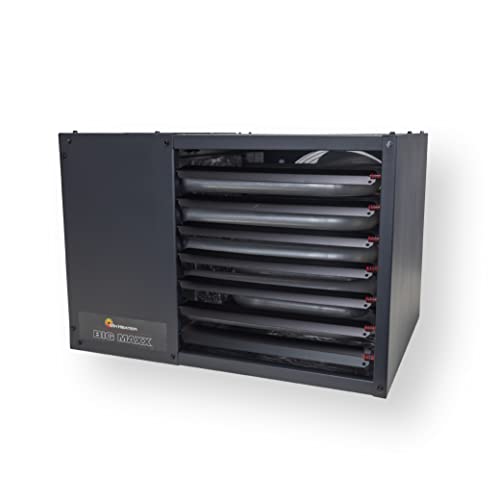
Brand: Mr. Heater. This unit is designed for large, well-ventilated garages and commercial spaces. It offers 80,000 BTU performance with natural gas operation and covers around 2,000 sq. ft.
- Includes two angle brackets and a LP conversion kit (thermostat, hose, regulator not included).
- Heater dimensions: 29.33” L x 15.50” W x 26.37” H; requires minimum 8 ft. clearance from floor to base.
- Electrical: 120 V, 2.3 amps; venting: category 1 vertical or category 3 horizontal.
- Best suited for large garages where high BTU natural gas provides sustained heat across open space.
CTSC 10000W Electric Garage Heater With Thermostat

Brand: CTSC. A hardwired, high-power electric heater aimed at commercial and large residential garages. It emphasizes installation diagnostics and safety.
- Power display shows input voltage to help identify incorrect voltage installations, reducing common failures.
- Construction: SPCC cold-rolled steel for durability and ETL-listed safety with overheating protection.
- Controls: digital thermostat, remote, timer, and three heat settings (10000W / 7500W / fan).
- Suitable where high electrical power is available and precise control with remote access is desired.
Comfort Zone Ceiling Mount CZ230ER 7,500W Heater

Call 888-896-7031 for Free Local HVAC Quotes – Compare and Save Today!
Brand: Comfort Zone. This ceiling-mounted, fan-forced heater is designed to free up floor space while heating large garage areas up to 1,250 sq. ft.
- Space-saving mount: hard-wired installation for permanent ceiling placement and maximum floor use.
- Durable heavy gauge steel body built for poorly insulated or variable-temperature spaces.
- Adjustable louvers and mounting angle provide targeted airflow control to focus warmth where needed.
- Ideal for workshops or garages where ceiling mounting improves safety and circulation.
VEVOR 10000W Digital Fan-Forced Garage Heater

Brand: VEVOR. A high-power electric heater offering wide coverage and precise temperature management for large garages or light commercial spaces.
- 10,000W power with two adjustable power levels to match varying cold conditions.
- Intelligent temperature control maintains a narrow 2°F differential for consistent comfort and energy efficiency.
- Built from SPCC cold-rolled steel, with overheat auto power-off and ETL certification for added safety.
- Designed for both ceiling and wall mounting to optimize placement in large garages.
TEMPWARE 7,500W Digital Ceiling Garage Heater
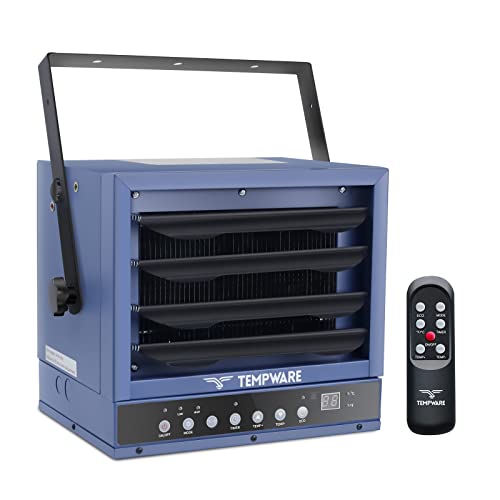
Brand: TEMPWARE. A ceiling-mounted fan-forced heater emphasizing energy savings and flexible control for medium-to-large garages.
- Power range: 6,250 W to 7,500 W with adjustable louvers and mounting angle for directed airflow.
- Smart ECO mode and a precise built-in thermostat (45°F–95°F) help conserve energy.
- 12-hour timer and overheat protection offer operational convenience and safety.
- Good choice where thermostat regulation and ECO operation are priorities for ongoing energy management.
Buying Guide: Choosing A Big Garage Heater
Selecting the right heater depends on several practical factors. The main areas to evaluate are fuel type, heating capacity, mounting and placement, electrical requirements, safety features, and control options.
Call 888-896-7031 for Free Local HVAC Quotes – Compare and Save Today!
Fuel Type: Gas vs Electric
Natural Gas / Propane heaters (like the Mr. Heater Big Maxx) deliver very high BTU output and are cost-effective for continuous heating of large, open garages. They often require venting, gas lines, and clearance rules.
Electric heaters are easier to install when adequate electrical service exists. Hardwired high-watt models (7,500–10,000W) provide strong performance without venting but need correct circuit capacity and professional wiring.
Heating Capacity And Coverage
Match heater output to garage size and insulation. For big garages or commercial bays, prioritize high BTU or high wattage units and note manufacturer square-foot estimates. Open-bay or poorly insulated spaces typically need more power for effective warmth.
Mounting And Air Distribution
Ceiling or wall-mounted
Electrical And Installation Needs
High-power electric heaters require specific voltage and breaker sizing. The CTSC model’s voltage display highlights the importance of correct supply. Always verify voltage compatibility, breaker size, and professional hardwiring requirements before purchase.
Safety Features And Certifications
Key safety features include overheat protection, ETL certification, automatic shut-off, and adequate clearance/venting specs. Gas heaters may need category venting and minimum clearance from combustible surfaces.
Controls, Thermostats, And Efficiency
Digital thermostats, remote controls, timers, and ECO modes enhance control and reduce operating costs. Precision temperature control (small differential) maintains comfort while limiting energy use.
Durability And Build
Look for heavy-gauge steel construction and corrosion-resistant finishes for garage environments. Robust housings withstand dust, tool impacts, and temperature swings common in workshops.
Comparison Perspectives
- Cost Of Operation: Natural gas can be less expensive per BTU for long runtime; electric units cost depend on local electricity rates and usage hours.
- Installation Complexity: Electric hardwired units require sufficient circuit capacity and possibly an electrician; gas units need gas line hookups and proper venting.
- Placement Flexibility: Portable plug-in heaters offer mobility but generally lack the sustained output for very large spaces; hardwired ceiling/wall units provide permanent, consistent heat.
- Maintenance: Electric heaters typically have lower maintenance needs; gas heaters require periodic inspection of burners, venting, and gas lines.
Practical Steps To Choose
- Measure garage volume and note insulation level to estimate required BTU/W output.
- Decide whether gas or electric best fits available utilities and operational costs.
- Confirm electrical service (voltage and breaker capacity) before selecting high-watt electric models.
- Check clearance, venting, and mounting requirements for safe installation.
- Prioritize models with safety certifications (ETL/UL) and built-in overheat protection.
This guide highlights the primary considerations when selecting a big garage heater. Refer to local codes and a licensed professional for installation and fuel connections to ensure compliance and safe operation.
Tips for Getting the Best HVAC Prices
- Prioritize Quality Over Cost
The most critical factor in any HVAC project is the quality of the installation. Don’t compromise on contractor expertise just to save money. - Check for Rebates
Always research current rebates and incentives — they can significantly reduce your overall cost. - Compare Multiple Quotes
Request at least three estimates before making your choice. You can click here to get three free quotes from local professionals. These quotes include available rebates and tax credits and automatically exclude unqualified contractors. - Negotiate Smartly
Once you've chosen a contractor, use the proven strategies from our guide — How Homeowners Can Negotiate with HVAC Dealers — to get the best possible final price.