
Blue flame propane heaters offer efficient, convection-style warmth for garages, cabins, additions, and sunrooms. Below is a quick comparison of selected models to help you match capacity, coverage, and features to your space.
| Model | BTU | Coverage | Key Feature |
|---|---|---|---|
| Mr. Heater MHVFBF20LPT | 20,000 | Up to 700 sq. ft. | Thermostat + ODS |
| Mr. Heater MHVFB30LPT (Bundle) | 30,000 | Up to 1,000 sq. ft. | Blue Flame Burner + Thermostat |
| Mr. Heater F299730 | 30,000 | Up to 1,000 sq. ft. | Thermostat + CSA Certified |
| Dyna-Glo 30,000 BTU | 24,000–30,000 | Up to 1,000 sq. ft. | Blue Flame Convection |
| ProCom ML100TBA-B | 10,000 | Up to 500 sq. ft. | Compact, Thermostat Control |
Content Navigation
- Mr. Heater MHVFBF20LPT 20,000 BTU Blue Flame Vent Free Propane Heater
- Mr. Heater 30,000 BTU Vent Free Blue Flame Propane Heater (MHVFB30LPT Bundle)
- Mr. Heater F299730 30,000 BTU Blue Flame Vent Free Propane Heater
- Dyna-Glo 30,000 BTU Liquid Propane Blue Flame Vent Free Wall Heater
- ProCom ML100TBA-B Ventless Propane Gas Blue Flame Space Heater
- Buying Guide: How To Choose A Blue Flame Propane Heater
Mr. Heater MHVFBF20LPT 20,000 BTU Blue Flame Vent Free Propane Heater
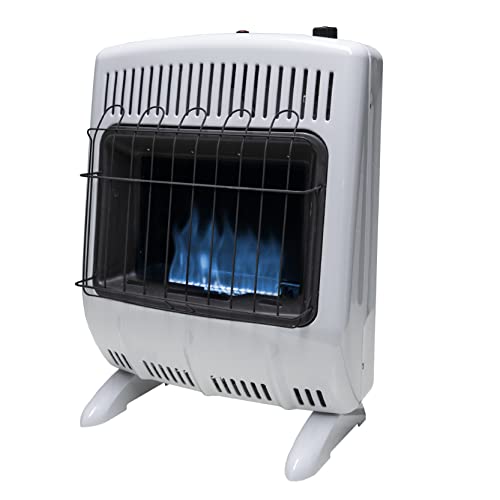
This 20,000 BTU vent-free heater is designed for indoor use in cold rooms, sunrooms, cabins, garages, and additions. It offers steady convection heat suitable for areas up to about 700 sq. ft.
Key specs and features include a built-in thermostat for automatic temperature control and a battery-powered electronic ignition for quick starts (battery included). Fuel consumption is listed at approximately 0.926 lbs per hour. The unit includes an Oxygen Depletion Sensor (ODS) that automatically shuts off the heater if oxygen levels fall below safe thresholds, supporting indoor safety compliance.
Installation options include wall placement; the unit is designed to perform at elevations up to 4,500 ft. The combination of moderate capacity, thermostat control, and built-in safety systems makes this model appropriate for many mid-sized enclosed spaces.
Mr. Heater 30,000 BTU Vent Free Blue Flame Propane Heater (MHVFB30LPT Bundle)

Call 888-896-7031 for Free Local HVAC Quotes – Compare and Save Today!
This 30,000 BTU vent-free model delivers convection-style heat intended for larger rooms or spaces up to 1,000 sq. ft. The product listing indicates the presence of a blue flame burner for even heat distribution and a thermostat for automatic temperature control (thermostat not present on smaller 10,000 BTU variant).
Safety features include an automatic low oxygen shutoff system (ODS). The bundle typically includes wall mounting hardware and legs for flexible installation. The unit is CSA certified and designed for reliable operation when venting is not desired or possible.
For spaces requiring higher output, the 30,000 BTU rating supports rapid warm-up and sustained convection heating while maintaining the features expected in vent-free blue flame appliances.
Mr. Heater F299730 30,000 BTU Blue Flame Vent Free Propane Heater

The F299730 model is another 30,000 BTU option from Mr. Heater with coverage stated up to 1,000 sq. ft. It features a thermostat and battery-powered electronic ignition for convenient operation, plus CSA certification in support of safety and manufacturing standards.
An automatic low oxygen shut-off system (ODS) is included to halt operation if oxygen levels become unsafe. The unit is specified to work reliably at elevations up to 4,500 ft., and it is designed for typical vent-free installation scenarios such as wall mounting in garages, workshops, or larger interior rooms.
Call 888-896-7031 for Free Local HVAC Quotes – Compare and Save Today!
This model emphasizes consistent heat output and integrated safety controls, matching common needs for larger enclosed areas that require convection heating without ductwork.
Dyna-Glo 30,000 BTU Liquid Propane Blue Flame Vent Free Wall Heater

Dyna-Glo’s vent-free wall heater uses blue flame technology to convect heat through the air similar to central heating. The variable heat output ranges from 24,000 to 30,000 BTU, with stated coverage up to 1,000 sq. ft.
This unit is marked as liquid propane ready, and installation is via wall mounting. The blue flame burner design focuses on efficient convection heat, producing even room temperatures without a forced-air blower. The product listing specifies that fuel conversion is not permitted, meaning it is dedicated to liquid propane as shipped.
For applications desiring straightforward convection heating with high BTU output and a wall-mount footprint, this model provides a common feature set used in garages, large rooms, and workshops.
ProCom ML100TBA-B Ventless Propane Gas Blue Flame Space Heater

The ProCom ML100TBA-B is a compact 10,000 BTU ventless blue flame heater aimed at smaller spaces up to 500 sq. ft. It offers three thermostat settings (High/Medium/Low) and includes both wall-mount hardware and base feet for floor placement.
Designed for residential rooms, offices, and bedrooms, the unit emphasizes compact footprint and flexible installation. The thermostat control supports steady temperature management, and the unit includes an oxygen depletion sensor for automatic shutoff if needed.
This model is suited for smaller zones where a lower BTU, economical convection heater is adequate and where portability or optional floor placement is desired.
Buying Guide: How To Choose A Blue Flame Propane Heater
This buying guide covers the main considerations when selecting a vent-free blue flame propane heater to ensure safety, performance, and suitability for your space.
Heat Output (BTU) And Room Size
- Match BTU To Square Footage: Estimate your space’s heating requirement. Rough rule: 10,000 BTU heats about 300–500 sq. ft., 20,000 BTU about 600–700 sq. ft., and 30,000 BTU approaches 1,000 sq. ft., depending on insulation and ceiling height.
- Insulation And Ceiling Height: Poorly insulated rooms or high ceilings require higher BTU capacity for the same floor area.
Vent-Free vs. Venting Considerations
- Vent-Free Advantages: Higher efficiency for direct room heating and simpler installation since no flue is required.
- Indoor Air Quality: Vent-free appliances release combustion products into the room; ensure the area meets local codes and ventilation recommendations.
Safety Features
- Oxygen Depletion Sensor (ODS): Essential for indoor vent-free heaters; shuts down unit if oxygen drops below safe levels.
- Automatic Shutoff And Certification: Look for CSA or equivalent certification and automatic safety shutdown features for reliability.
Control Options
- Thermostat: Built-in thermostats provide automatic temperature control and more efficient fuel use versus manual-only models.
- Ignition Type: Battery-powered electronic ignition is convenient; manual/piezo ignition may be found on simpler units.
Fuel Type And Conversion
- Liquid Propane vs. Natural Gas: Confirm the heater’s fuel type. Some models are dedicated to propane and do not permit conversion.
- Supply Considerations: Ensure you have proper propane supply and regulator capacity for the BTU rating.
Installation And Placement
- Wall Mount Vs. Floor Placement: Some units include legs/base feet; others are wall-only. Consider room layout and clearance requirements.
- Clearances And Local Codes: Follow manufacturer-specified clearances and local building codes, especially for indoor vent-free appliances.
Elevation And Performance
- High-Elevation Operation: Some manufacturers specify maximum elevation (e.g., 4,500 ft.). Verify unit performance ratings if you live at high altitude.
Noise And Blower Options
- Convective Blue Flame: Heats by convection with minimal noise; good for quiet spaces.
- Built-In Blower: Some models offer a blower to circulate air for faster distribution but may add noise and require electricity.
Maintenance And Longevity
- Regular Checks: Inspect burners, pilot or ignition systems, and the ODS sensor periodically per the manual.
- Professional Service: Consider annual inspection by a qualified technician for safe indoor fuel appliance operation.
Comparison Perspectives
- Performance vs. Coverage: Higher BTU models heat larger areas but consume more fuel; match capacity to actual room needs.
- Control vs. Simplicity: Thermostatic models offer comfort and efficiency; manual models reduce upfront cost and complexity.
- Safety vs. Installation Flexibility: Vent-free units are efficient but require attention to indoor air and code compliance; sealed or vented units change the safety and ventilation equation.
Use the above considerations to compare features like BTU output, thermostat presence, ODS safety, installation flexibility, and certification. Measure your space, check local codes, and pick a model whose capacity and safety features align with your room and usage pattern.
Tips for Getting the Best HVAC Prices
- Prioritize Quality Over Cost
The most critical factor in any HVAC project is the quality of the installation. Don’t compromise on contractor expertise just to save money. - Check for Rebates
Always research current rebates and incentives — they can significantly reduce your overall cost. - Compare Multiple Quotes
Request at least three estimates before making your choice. You can click here to get three free quotes from local professionals. These quotes include available rebates and tax credits and automatically exclude unqualified contractors. - Negotiate Smartly
Once you've chosen a contractor, use the proven strategies from our guide — How Homeowners Can Negotiate with HVAC Dealers — to get the best possible final price.