
Finding the right ceiling-mounted garage heater means balancing power, installation, coverage, and safety. Below is a concise comparison of five highly relevant models to help you evaluate options at a glance, followed by detailed product sections and a practical buying guide.
| Model | Type | Power | Mounting | Key Controls |
|---|---|---|---|---|
| Comfort Zone 10,000W Hard-Wired | Fan-Forced Convection | 10,000W (240V) | Ceiling Hardwired | Digital Thermostat, Remote, Timer |
| TEMPWARE 7500-Watt | Fan-Forced Convection | 6,250–7,500W (240V) | Ceiling Hardwired | Full-Function Remote, Timer, ECO Mode |
| TEMPWARE 5000-Watt | Fan-Forced Convection | 3,000 / 4,000 / 5,000W (240V) | Ceiling/Wall/Ground | 3 Heat Levels, Adjustable Louvers |
| VEVOR 10000-Watt | Fan-Forced Convection | 10,000W (240V) | Wall/Ceiling Hardwired | Digital Control, Remote, Timer |
| Dr. Infrared DR-966 3000/6000W | Electric Hardwired | 3,000 / 6,000W (240V) | Ceiling Or Wall Hardwired | Two Power Levels, Commercial Duty |
Content Navigation
- Comfort Zone 10,000W Hard-Wired Ceiling Heater
- TEMPWARE 7500-Watt Digital Fan-Forced Ceiling Heater
- TEMPWARE 5000-Watt Ceiling Shop Heater
- VEVOR 10,000-Watt Digital Fan-Forced Heater
- Dr. Infrared DR-966 3000/6000W Hardwired Heater
- Buying Guide: Choose The Right Ceiling Mount Garage Heater
- 1. Determine Required Power And Coverage
- 2. Fan-Forced Convection Vs. Infrared
- 3. Hardwired Installation And Electrical Requirements
- 4. Mounting Flexibility And Directional Control
- 5. Controls, Thermostats, And Timers
- 6. Safety Features And Certifications
- 7. Durability And Build Quality
- 8. Noise And Air Movement
- 9. Maintenance And Serviceability
- 10. Installation Cost And Ongoing Energy Use
- Comparison Perspectives
Comfort Zone 10,000W Hard-Wired Ceiling Heater

Type: Fan-forced convection heater designed for industrial and commercial ceilings. Key Features: wide air distribution, adjustable directed airflow vents, digital thermostat, 12-hour timer, remote control, fan-forced system, overheat protection, heavy-gauge steel body, fully sheathed heating elements, enclosed motor.
This unit emphasizes even heat distribution through a fan-forced design and adjustable vents, aimed at reducing cold spots in larger garages or workshops. The integration of a digital thermostat and remote control enables precise temperature settings and scheduled operation via the 12-hour timer. Built with heavy-gauge steel and enclosed motor components, it targets durability for dusty or industrial environments. Overheat protection and sheathed elements contribute to safety in continuous-use scenarios.
TEMPWARE 7500-Watt Digital Fan-Forced Ceiling Heater
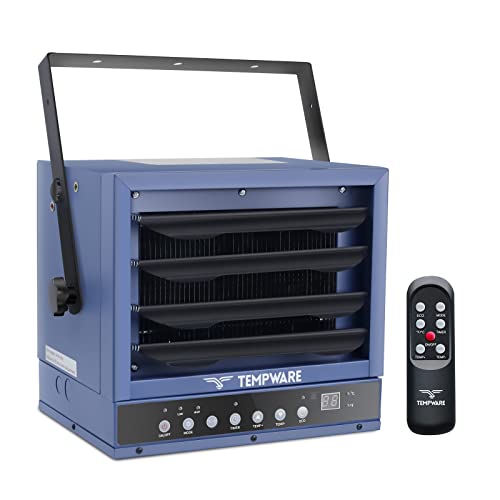
Type: Hardwired fan-forced electric heater with ECO Mode. Key Features: adjustable louvers and mounting angle, two heat settings (6,250–7,500W), up to 25,590 BTU, built-in temperature sensor, ECO mode, 1–12 hour timer, built-in thermostat, overheat protection.
Call 888-896-7031 for Free Local HVAC Quotes – Compare and Save Today!
This model focuses on directional control and energy efficiency. Adjustable louvers and angle let users aim warm air where needed. The ECO mode and built-in sensor adjust output based on ambient temperature to reduce energy use. The heater supports timed operation and includes overheat protection for safer continuous use. It’s positioned for larger workshops where adjustable coverage and moderate-high output are priorities.
TEMPWARE 5000-Watt Ceiling Shop Heater

Type: Compact fan-forced heater suitable for ceilings, walls, or floor placement. Key Features: 3 heat levels (3,000/4,000/5,000W), adjustable louvers, variable mounting angle, ETL certification, heavy-duty steel construction, rated coverage up to ~592 sq ft, multiple mounting options.
The space-saving design of this TEMPWARE model is useful for garages with limited clearance or multi-use rooms. With three power levels it adapts to smaller to mid-size spaces and can be freestanding or ceiling-mounted. ETL certification and a sturdy steel build underline safety and durability. Adjustable output and louvers provide control over coverage and distribution.
VEVOR 10,000-Watt Digital Fan-Forced Heater

Type: High-power fan-forced ceiling/wall heater. Key Features: 10,000W output, two adjustable power levels, wide coverage up to 90 m², high air circulation for even convection, intelligent temperature control (±2°F), remote control, 9-hour timer, SPCC cold-rolled steel shell, ETL certified, overheat automatic shutoff.
Call 888-896-7031 for Free Local HVAC Quotes – Compare and Save Today!
This VEVOR model emphasizes large-area coverage and temperature stability. Intelligent control maintains tight temperature tolerances and the unit’s construction uses cold-rolled steel for structural durability. High airflow aims to limit cold pockets. Safety features include overheat shutoff and ETL certification, making it suitable for demanding shop or garage environments that require steady temperature regulation.
Dr. Infrared DR-966 3000/6000W Hardwired Heater

Type: Commercial-grade electric hardwired heater with selectable power levels. Key Features: 3,000/6,000W settings, 240V single-phase, UL/CUL listed, heavy-duty design, bracket included for wall or ceiling mounting, designed for shop/garage use, power cord not included.
As a commercial-style unit, the DR-966 offers selectable capacity and rugged certification. UL/CUL listing supports code-compliant installations. Its two power levels enable scaling output to space size and insulation quality. With heavy-duty construction and included mounting bracket, it is oriented to commercial shops or larger residential garages that need a straightforward, hardwired electric heating solution.
Buying Guide: Choose The Right Ceiling Mount Garage Heater
1. Determine Required Power And Coverage
Estimate your garage volume (square footage × ceiling height) and insulation quality. Higher wattage (5,000–10,000W+) covers larger or poorly insulated spaces. Use manufacturer coverage estimates as a baseline, then allow extra capacity for high ceilings or cold climates.
2. Fan-Forced Convection Vs. Infrared
Fan-Forced Convection moves heated air quickly to reduce cold spots and warm the whole volume. Best for general garage/workshop use. Infrared heats objects and people directly, producing immediate warmth but less ambient air heating—useful for workstations or semi-outdoor areas.
3. Hardwired Installation And Electrical Requirements
Most high-power ceiling heaters require 240V hardwiring and dedicated circuits. Confirm your panel capacity and whether a licensed electrician is needed. Lower-power plug-and-play models exist for 120V but provide far less heat.
4. Mounting Flexibility And Directional Control
Look for adjustable louvers, variable mounting brackets, or angled mounts to direct airflow toward work areas. Units that can also be wall-mounted offer flexibility for different garage layouts.
5. Controls, Thermostats, And Timers
Digital thermostats, remote controls, and timers improve convenience and energy efficiency. Smart ECO modes or built-in sensors can reduce runtime by adapting to ambient temperature.
6. Safety Features And Certifications
Prioritize units with overheat protection, enclosed motors, fully sheathed heating elements, and certifications (ETL, UL/CUL). These features support compliance with local codes and safer continuous operation.
7. Durability And Build Quality
Heavy-gauge or cold-rolled steel enclosures resist deformation and protect internal components from dust and debris common in garages. Enclosed motors and sealed elements extend service life in dusty environments.
8. Noise And Air Movement
Fan-forced models produce mechanical noise. Consider quieter units if the garage is adjacent to living space. Louvers and fan speed settings can affect perceived airflow and comfort.
9. Maintenance And Serviceability
Check ease of access for cleaning filters or fan areas, and whether replacement parts (motors, thermostats) are readily available. Regular dust removal preserves airflow and heater efficiency.
10. Installation Cost And Ongoing Energy Use
Factor in electrician labor for hardwired 240V units. Compare running costs based on wattage and expected daily hours. Timers and thermostats can reduce energy use by avoiding unnecessary runtime.
Tips for Getting the Best HVAC Prices
- Prioritize Quality Over Cost
The most critical factor in any HVAC project is the quality of the installation. Don’t compromise on contractor expertise just to save money. - Check for Rebates
Always research current rebates and incentives — they can significantly reduce your overall cost. - Compare Multiple Quotes
Request at least three estimates before making your choice. You can click here to get three free quotes from local professionals. These quotes include available rebates and tax credits and automatically exclude unqualified contractors. - Negotiate Smartly
Once you've chosen a contractor, use the proven strategies from our guide — How Homeowners Can Negotiate with HVAC Dealers — to get the best possible final price.
Comparison Perspectives
- High Output Needs: Choose 10,000W-class fan-forced heaters for large, poorly insulated garages or commercial shops.
- Mid-Size Garages: 5,000–7,500W units balance capacity and lower circuit demands.
- Spot Heating: Infrared models or directional fan heaters are effective when warming people or a specific workbench.
- Budget & Installation: Factor initial installation (hardwiring) vs. long-term efficiency; lower wattage plug-in options reduce wiring cost but limit coverage.
- Safety-Focused: Prioritize ETL/UL listings, overheat shutoff, and enclosed components for dusty or industrial environments.