
Quick Summary: This guide compares five commercial-grade space heaters suited for indoor and outdoor commercial settings — hardwired electric units for workshops and warehouses, portable forced-air heaters for job sites, and high-BTU patio heaters for outdoor dining or events.
| Product | Type | Best For |
|---|---|---|
| Dura Heat EWH5510 | Hard-Wired Electric | Large Garages, Workshops |
| Dr. Infrared Heater DR-966 | Hard-Wired Electric | Wall/Ceiling Mounted Commercial Spaces |
| Comfort Zone CZ230ER | Ceiling-Mount Electric | Warehouses, Garages With Limited Floor Space |
| L.B. White Volt 3 | Portable Forced Air Electric | Job Sites, Tents, Small Industrial Areas |
| Amazon Basics 46,000 BTU Patio Heater | Propane Outdoor Heater | Outdoor Patios, Restaurants, Event Areas |
Content Navigation
- Dura Heat EWH5510 Electric Forced Air Heater With Remote
- Dr. Infrared Heater DR-966 240-Volt Hardwired Shop Garage Heater
- Comfort Zone Hard-Wired Ceiling Mount Garage Heater CZ230ER
- L.B. White Volt 3 Electric Forced Air Portable Heater
- Amazon Basics 46,000 BTU Outdoor Propane Patio Heater With Wheels
- Buying Guide: How To Choose A Commercial Space Heater
Dura Heat EWH5510 Electric Forced Air Heater With Remote

Type: Hard-wired 240V / 5,000W commercial electric forced-air heater requiring professional installation.
Key Features: 17,060 BTU output covering up to 750 sq. ft., remote control with adjustable thermostat and LED display, designed for garage or workshop heating.
This unit Is engineered for larger indoor areas where permanent, high-capacity heating is needed. The hard-wired design provides continuous high wattage without relying on cords, and the remote thermostat allows centralized temperature control. Installation requires proper electrical wiring and is intended for professional installers to meet code and safety standards. The heater’s airflow design focuses on delivering warm air across a workspace, and the remote/LED controls provide setpoint adjustments between 45–99 degrees.
Dr. Infrared Heater DR-966 240-Volt Hardwired Shop Garage Heater

Call 888-896-7031 for Free Local HVAC Quotes – Compare and Save Today!
Type: Heavy-duty 240V single-phase hardwired electric heater, wall or ceiling mountable.
Key Features: 3000/6000W selectable heating, UL/CUL listing, included mounting bracket, designed for commercial installation. Power cord not included.
Designed for flexibility in mounting, this heater is suitable for both wall and ceiling installations in commercial spaces. The selectable wattage allows installers and facility managers to adapt to power availability and heating load requirements. UL/CUL listing indicates rigorous testing for safety and performance. As a hardwired unit, it avoids extension cords and minimizes tripping hazards, making it appropriate for service bays, small warehouses, and workshop environments where reliable, ceiling- or wall-mounted heat distribution is required.
Comfort Zone Hard-Wired Ceiling Mount Garage Heater CZ230ER

Type: Fan-forced, hard-wired ceiling-mounted electric heater with digital thermostat and remote.
Key Features: 7,500W 240V capacity, variable airflow louvers, overheat protection, 12-hour timer, designed to heat up to ~1,250 sq. ft.
Call 888-896-7031 for Free Local HVAC Quotes – Compare and Save Today!
This ceiling-mounted heater is optimized for facilities where floor space is at a premium. The adjustable louvers provide directional airflow to target specific zones or distribute heat broadly across a workspace. With a digital thermostat, timer, and remote control, the unit supports scheduled operation and temperature management suitable for commercial needs. Heavy gauge steel construction enhances durability in poorly insulated or variable-temperature environments. Hard-wiring secures continuous power and reduces onsite cord clutter.
L.B. White Volt 3 Electric Forced Air Portable Heater
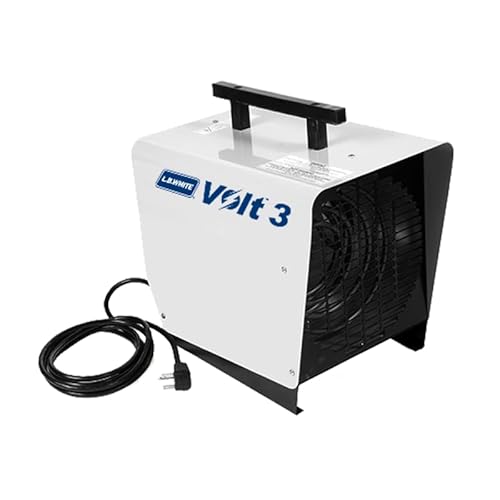
Type: Portable electric forced-air heater with ambient thermostat and overheat protection.
Key Features: Stainless-jacketed heating coils, powder-coated steel housing, ambient thermostat 32°F–100°F, compact footprint and sealed motor for combustion-free operation.
The Volt 3 is targeted at mobile jobsite and industrial applications where portability and quick heat-up are priorities. Its compact size and integrated thermostat allow localized temperature control for tents, curing areas, or small workshop zones. The sealed motor and combustion-free electric design make it suitable for indoor use where fumes or fuel handling are not acceptable. Overheat protection provides an added layer of safety for unattended or continuous applications.
Amazon Basics 46,000 BTU Outdoor Propane Patio Heater With Wheels

Type: Propane-fueled outdoor patio heater designed for commercial and residential use.
Key Features: 46,000 BTU output with up to a 9-foot radius, one-touch ignition, wheels for mobility, integrated water tank base option for stability.
This propane patio heater is designed for outdoor dining areas, cafes, and event spaces where radiant heat and mobility are important. The high BTU output supports localized warmth for seating clusters, and the one-touch ignition facilitates quick start-up during service periods. Wheels and a stabilizable base help reposition and secure the unit on outdoor surfaces. As an outdoor fuel-burning device, placement, ventilation, and fuel management are essential operational considerations for safety and regulatory compliance.
Buying Guide: How To Choose A Commercial Space Heater
Heating Capacity And BTU/Watt Rating: Match the heater’s BTU (for gas) or wattage (for electric) to the volume and insulation level of the space. Larger, poorly insulated areas require higher output. For electric hard-wired units, verify circuit capacity and breaker requirements.
Installation Type: Consider ceiling-mounted hard-wired heaters for floor-space savings, wall-mounted for directional warmth, and portable forced-air units when mobility is required. Hard-wired systems typically need licensed electrician installation to meet code.
Fuel Source And Location: Electric heaters offer combustion-free heating suitable for indoor environments. Propane or natural gas patio heaters are effective outdoors but require fuel handling, ventilation, and adherence to local codes. For indoor commercial use, prioritize electric models unless space and ventilation meet gas appliance requirements.
Safety Features: Look for overheat protection, tip-over/shutoff safety (especially for portable and propane units), UL/ETL or CUL listings, and thermal cutoffs. For mounted units verify clearances to combustible materials and any built-in guards.
Thermostat And Controls: Digital thermostats, remote controls, and timers increase energy efficiency by preventing overheating and allowing scheduled operation. Consider units with adjustable louvers or directional airflow for zoned heating.
Durability And Construction: Heavy-gauge steel housings, powder-coat finishes, and stainless components resist industrial wear. Corrosion-resistant materials are important for outdoor or humid environments.
Noise And Motor Type: Forced-air heaters use fans and can generate noise; sealed motors and low-noise designs reduce disruption in customer-facing environments. For quiet zones, consider radiant or ducted heating solutions.
Mobility And Footprint: Portable units with wheels are useful for temporary setups; ceiling- or wall-mounted heaters preserve floor space in busy commercial areas. Evaluate mounting hardware, access for maintenance, and clearance needs.
Energy Efficiency And Operating Cost: Higher wattage or BTU ratings increase capacity but also operating cost. Compare runtime, thermostat control accuracy, and available power sources to estimate operational expenses across shifts or event duration.
Compliance And Certifications: Check UL, ETL, or CSA markings and local building/electrical codes for commercial installations. Verify whether the unit requires professional installation or special permits for gas appliances.
Application-Specific Considerations: For warehouses and garages, focus on directional hard-wired units with high output and protective housings. For job sites and temporary indoor workspaces, prefer portable forced-air electric heaters. For outdoor dining or events, choose high-BTU propane heaters with stable bases and ignition safety features.
Comparison Perspectives: Compare fixed vs portable options by installation complexity, upfront vs operational cost, and site flexibility. Electric hard-wired heaters reduce fuel logistics but may need upgraded electrical infrastructure. Propane offers high instantaneous radiant heat outdoors but introduces refueling and storage needs. Forced-air units deliver rapid warm-up for localized zones but may be less efficient for very large volumes.
Tips for Getting the Best HVAC Prices
- Prioritize Quality Over Cost
The most critical factor in any HVAC project is the quality of the installation. Don’t compromise on contractor expertise just to save money. - Check for Rebates
Always research current rebates and incentives — they can significantly reduce your overall cost. - Compare Multiple Quotes
Request at least three estimates before making your choice. You can click here to get three free quotes from local professionals. These quotes include available rebates and tax credits and automatically exclude unqualified contractors. - Negotiate Smartly
Once you've chosen a contractor, use the proven strategies from our guide — How Homeowners Can Negotiate with HVAC Dealers — to get the best possible final price.