
Choosing The Right Commercial Wall Heater depends on installation voltage, heating capacity, indoor vs outdoor use, and control features. Below is a quick comparison of five well-matched commercial wall heaters selected for reliability, capacity, and commercial-grade features.
| Product | Type / Use | Key Feature |
|---|---|---|
| Qmark SSHO4007 | Recessed Electric Wall Heater (277V) | Programmable Thermostat, Remote |
| Qmark SSHO4008 | Recessed Electric Wall Heater (208V) | Smart Series Large Unit |
| QMark CWH3404F | Fan-Forced Wall Heater | Fan-Only Option, Overheat Protector |
| Broan-NuTone 198 | High Capacity Wall Heater | 4000W With 2000W Conversion, Adjustable Thermostat |
| EAST OAK Patio Heater | Outdoor Infrared Wall Heater (240V) | Instant Infrared Heat, IP65 Weatherproof |
Content Navigation
- Qmark 1800-4000W @ 277V Smart Series Commercial Wall Heater – White SSHO4007
- Qmark 1800-4000W @ 208V Smart Series Commercial Wall Heater – White SSHO4008
- QMark CWH3404F Electric Wall Heater For Home And Commercial Use
- Broan-NuTone White 198 High Capacity Wall Heater, Painted Grille
- EAST OAK Patio Heater For Commercial Use, 3000W Wall Mounted Infrared Heater
- Buying Guide: How To Choose A Commercial Wall Heater
- 1. Voltage And Electrical Compatibility
- 2. Heating Type: Fan-Forced vs Infrared vs Convection
- 3. Controls And Programmability
- 4. Installation And Mounting
- 5. Safety Features And Certifications
- 6. Durability And Environmental Rating
- 7. Coverage And Layout Considerations
- 8. Maintenance And Serviceability
- Comparison Perspectives
Qmark 1800-4000W @ 277V Smart Series Commercial Wall Heater – White SSHO4007

This recessed electric wall heater is built for larger commercial spaces requiring a higher-voltage solution. The unit features a programmable thermostat for scheduling or holding temperatures, enabling energy savings by heating only when needed. A useful remote control allows adjustments from across the room, improving convenience in hotel rooms, conference areas, or offices.
The Smart Series design is larger than compact register heaters and intended for spaces like bedrooms, hotel rooms, and light commercial rooms. For facilities using 277V distribution, this model provides a scalable 1800–4000W range to match load and coverage needs.
Qmark 1800-4000W @ 208V Smart Series Commercial Wall Heater – White SSHO4008
The SSHO4008 provides the Smart Series recessed form factor for facilities supplied with 208V. It matches the SSHO4007 in application but is specified for a different supply voltage commonly found in commercial electrical panels.
Call 888-896-7031 for Free Local HVAC Quotes – Compare and Save Today!
Package information notes substantial unit weight and dimensions suitable for a permanent wall or recessed installation. Use this model where 208V service exists and a large-capacity recessed heater is preferred to minimize wall protrusion while delivering robust output.
QMark CWH3404F Electric Wall Heater For Home And Commercial Use

The CWH3404F is a fan-forced wall heater with commercial-grade steel construction and a low-profile appearance for mixed-use spaces. It includes a fan-only option to circulate air in warm months and a manual reset thermal overheat protector to disconnect power if obstruction causes overtemperature.
This model suits locations requiring flexible year-round air movement and robust safety features. The fan-forced design provides faster heat distribution than convection-only units, useful in service rooms, small offices, or utility spaces.
Broan-NuTone White 198 High Capacity Wall Heater, Painted Grille
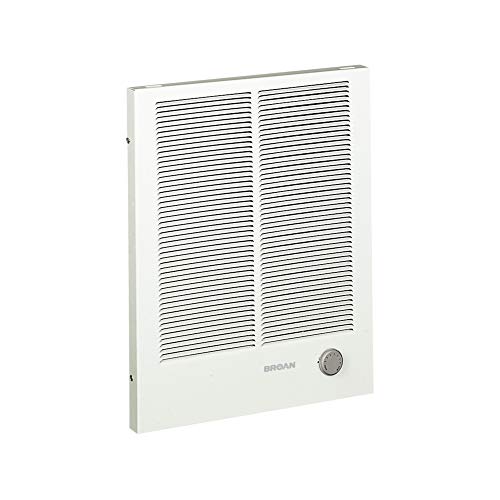
The Broan-NuTone 198 is a high-capacity wall heater operating at 4000W at 240VAC, convertible to 2000W at 120V. It offers an adjustable front-mounted thermostat for simple heat control and a heavy-duty 18-gauge steel grille with downflow louvers to direct warm air toward the floor.
Call 888-896-7031 for Free Local HVAC Quotes – Compare and Save Today!
Its durable one-piece painted grille provides corrosion resistance for long-term use in corridors, apartments, or commercial rooms. This unit is useful where a straightforward, high-output wall-mounted solution and easy thermostat access are priorities.
EAST OAK Patio Heater For Commercial Use, 3000W Wall Mounted Infrared Heater

Designed for outdoor commercial spaces, this 240V infrared heater uses a gold-coated heating element and infrared technology to provide near-instant warmth. The manufacturer claims up to 1-second perceived warmth at startup and high energy transfer efficiency.
With an IP65 waterproof and dustproof rating, a 45° heat angle, and coverage suitable for roughly 97–129 sq ft, it is positioned for restaurants, patios, or semi-outdoor commercial zones. The unit is ETL/UL certified and uses durable aluminum with nano-ceramic coating for corrosion resistance.
Buying Guide: How To Choose A Commercial Wall Heater
Selecting the right commercial wall heater requires weighing installation electrical characteristics, heating method, coverage, controls, and safety features. Below are the primary considerations and comparison perspectives to guide procurement.
Tips for Getting the Best HVAC Prices
- Prioritize Quality Over Cost
The most critical factor in any HVAC project is the quality of the installation. Don’t compromise on contractor expertise just to save money. - Check for Rebates
Always research current rebates and incentives — they can significantly reduce your overall cost. - Compare Multiple Quotes
Request at least three estimates before making your choice. You can click here to get three free quotes from local professionals. These quotes include available rebates and tax credits and automatically exclude unqualified contractors. - Negotiate Smartly
Once you've chosen a contractor, use the proven strategies from our guide — How Homeowners Can Negotiate with HVAC Dealers — to get the best possible final price.
1. Voltage And Electrical Compatibility
- Match Supply Voltage: Confirm facility voltage—common commercial options include 208V, 240V, and 277V. Buying the correct unit avoids rewiring or transformer costs.
- Power Capacity: Evaluate wattage needs (e.g., 1000–4000W) to determine coverage and thermostat behavior under load.
2. Heating Type: Fan-Forced vs Infrared vs Convection
- Fan-Forced: Provides rapid heat distribution and airflow (good for enclosed rooms). Look for fan-only mode if seasonal air circulation is desired.
- Infrared: Heats people and surfaces directly without warming the entire air volume—ideal for outdoor patios, warehouses, or areas with drafts.
- Convection/Recessed: Works quietly and evenly for bedrooms, hotel rooms, or conference spaces; recessed designs reduce visual profile.
3. Controls And Programmability
- Programmable Thermostats: Enable schedules to reduce runtime and energy cost in intermittently used spaces.
- Remote Control & Front-Mounted Thermostats: Improve convenience and accessibility for tenants or staff.
4. Installation And Mounting
- Recessed vs Surface Mount: Recessed units offer lower visual impact; surface-mounted or wall-mounted infrared units often require stronger brackets for outdoor exposure.
- Hardwired vs Plug-In: Commercial installations often use hardwired units to meet area code and load distribution requirements.
5. Safety Features And Certifications
- Overheat Protection: Manual reset or auto-thermal safeguards prevent unsafe operation if airflow is blocked.
- Certifications: UL, ETL, or CUL listings indicate third-party safety testing suitable for commercial settings.
6. Durability And Environmental Rating
- Outdoor Ratings: For patios or semi-exposed areas, seek IP ratings (e.g., IP55/IP65) and corrosion-resistant finishes.
- Material Quality: Commercial-grade steel or thick aluminum bodies resist wear in high-traffic environments.
7. Coverage And Layout Considerations
- BTU/Watt Equivalency: Translate wattage to coverage expectations; higher wattage equals greater potential coverage but depends on insulation and ceiling height.
- Distribution Pattern: Use infrared for directional heat across seating zones; use fan-forced or recessed units for even room heating.
8. Maintenance And Serviceability
- Filter And Fan Access: Choose units with accessible service panels for cleaning fans or replacing components.
- Replacement Parts: Prefer brands with available thermostats, grilles, and element replacements to extend service life.
Comparison Perspectives
- Operational Cost: Infrared units often feel warmer faster, reducing run-time in open areas; programmable thermostats reduce idle runtime indoors.
- Installation Complexity: Recessed and hardwired large units may require electricians and wall modifications; surface-mounted options are often quicker to deploy.
- User Experience: Remote controls and front-mounted thermostats influence perceived convenience and adjustment frequency for staff or guests.