
Choosing the best corner gas heater means balancing room size, venting, fuel type, and installation style. Below is a concise summary of five corner-friendly gas heaters selected for residential use, each suited for small to mid-size rooms or corner placement.
| Product | Type | Recommended Coverage | Fuel |
|---|---|---|---|
| ProCom Dual Fuel Ventless Gas Fireplace System With Mantle | Ventless Fireplace Insert + Mantle | Up To 500 Sq. Ft. | Natural Gas Or Liquid Propane |
| Duluth Forge Dual Fuel Ventless Gas Fireplace System With Mantle | Ventless Fireplace Insert + Mantle | Up To 1500 Sq. Ft. | Natural Gas Or Liquid Propane |
| ProCom MN300TPA-B Ventless Natural Gas Infrared Space Heater | Infrared Ventless Wall Or Floor Heater | Up To 1400 Sq. Ft. | Natural Gas |
| ProCom MN300HBA-B Ventless Blue Flame Heater | Blue Flame Ventless Wall/Stand Heater | Up To 1400 Sq. Ft. | Natural Gas |
| Mr. Heater MHVFBF30NGT Vent Free Blue Flame Natural Gas Heater | Wall-Mount Vent-Free Blue Flame Heater | Up To 1000 Sq. Ft. | Natural Gas |
Content Navigation
- ProCom Dual Fuel Ventless Gas Fireplace System With Mantle
- Duluth Forge Dual Fuel Ventless Gas Fireplace System With Mantle
- ProCom MN300TPA-B Ventless Natural Gas Infrared Space Heater
- ProCom Ventless Blue Flame Heater Model MN300HBA-B
- Mr. Heater MHVFBF30NGT Vent Free Blue Flame Natural Gas Heater
- Buying Guide: Choosing A Corner Gas Heater
- 1. Venting Type: Ventless vs. Vented
- 2. Fuel Type: Natural Gas vs. Liquid Propane
- 3. Heater Style: Fireplace Mantle, Blue Flame, Infrared
- 4. BTU Output And Coverage
- 5. Controls And Convenience
- 6. Safety Features And Code Compliance
- 7. Installation Considerations For Corner Placement
- 8. Energy Efficiency And Operating Considerations
- 9. Aesthetics And Noise
- 10. Comparison Perspectives
- 11. Maintenance And Longevity
- 12. Final Selection Checklist
ProCom Dual Fuel Ventless Gas Fireplace System With Mantle

Type: Ventless dual fuel fireplace system with mantle. BTU: 10000. Coverage: Up to 500 sq. ft.
This system provides a fireplace-style heat source designed for corner placement or against a wall where a traditional chimney is not available. The unit uses ventless dual fuel technology, allowing operation on either natural gas or liquid propane. The package includes a furniture-grade mantle and four hand-painted ceramic fiber logs for a realistic look.
The built-in thermostat control cycles the unit to maintain a set temperature, improving efficiency compared with manual operation. As a ventless heater, it provides near-complete heat output to the room but requires adherence to local codes and proper room ventilation. This model is targeted at small living rooms or spaces where a decorative heater is preferred alongside functional warmth.
Duluth Forge Dual Fuel Ventless Gas Fireplace System With Mantle

Call 888-896-7031 for Free Local HVAC Quotes – Compare and Save Today!
Type: Ventless dual fuel fireplace with mantle and remote. BTU: 32000. Coverage: Up to 1500 sq. ft.
This larger ventless fireplace is suitable for corner installs in larger open-plan rooms. It features dual fuel capability and a remote with LCD for on/off and thermostat control, allowing either manual or automatic temperature regulation. The aesthetic includes six ceramic fiber logs, double doors, and a sprayed brick liner for a traditional fireplace appearance.
Because the unit is ventless and high output, it is designed to maximize room heat without ducting. The higher BTU rating increases coverage area, but ventless operation necessitates attention to oxygen depletion sensor requirements and safety clearances. This model aims to combine strong heating capacity with mantel-style presentation for focal corner installations.
ProCom MN300TPA-B Ventless Natural Gas Infrared Space Heater

Type: Infrared ventless space heater. BTU: 30000. Coverage: Up to 1400 sq. ft.
This compact infrared heater is designed for flexible placement, including corner mounting or floor standing with included hardware and base feet. Infrared heat warms objects and occupants directly rather than relying solely on air convection, which can be advantageous in rooms with drafts or high ceilings.
Call 888-896-7031 for Free Local HVAC Quotes – Compare and Save Today!
The unit offers thermostat control with multiple heat settings and a slim profile for unobtrusive corner installation. As with other ventless devices, the infrared design provides efficient room heat output but requires compliance with ventless heater safety standards, such as oxygen depletion sensor (ODS) and local installation codes.
ProCom Ventless Blue Flame Heater Model MN300HBA-B

Type: Ventless blue flame heater. BTU: 30000. Coverage: Up to 1400 sq. ft.
This model provides convection-style heating with a visible blue flame burner. It operates on natural gas only and does not require electricity, which can be beneficial in power-outage scenarios. The unit includes three manual heat settings and an oxygen depletion sensor for automatic shut-off if oxygen levels drop.
The blue flame design offers steady, distributed warmth suitable for corner placement in a living area or sunroom. Installation should conform to manufacturer clearances and local codes. The manual control setup suits users who prefer straightforward operation without remote or digital interfaces.
Mr. Heater MHVFBF30NGT Vent Free Blue Flame Natural Gas Heater
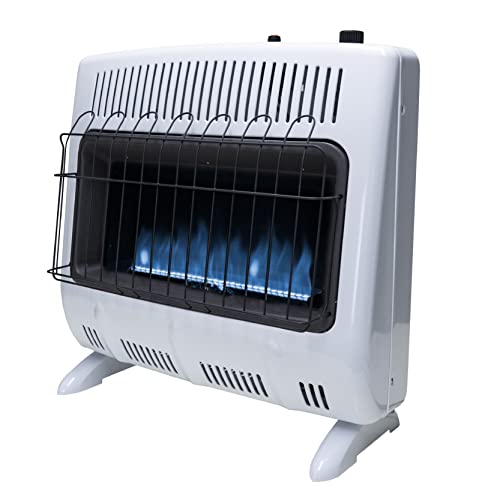
Type: Wall-mount vent-free blue flame heater. BTU: 30000. Coverage: Up to 1000 sq. ft.
This wall-mounted blue flame heater emphasizes fuel efficiency and thermostat precision. It offers convection heating with a thermostat for accurate temperature control and includes electric ignition powered by a supplied battery. The unit is rated to operate at moderate altitudes and is intended for room-specific heating goals.
Designed for straightforward wall installation, the model is commonly chosen for bedroom additions, cold rooms, and enclosed porches that meet local ventless heater code allowances. As a vent-free device, it provides efficient heat output but requires correct placement and ventilation awareness.
Buying Guide: Choosing A Corner Gas Heater
Selecting the right corner gas heater requires comparing room size, venting requirements, fuel type, heater style, and safety features. This guide breaks down essential considerations and compares options to help narrow choices for corner installations.
1. Venting Type: Ventless vs. Vented
Ventless (Vent-Free) heaters release combustion products into the room and deliver nearly all output as heat, often resulting in higher effective warmth for a given BTU rating. They are easier to install because they do not require a chimney or direct venting, making them well suited to corner placement. However, ventless units require compliance with local codes and proper oxygen depletion sensors (ODS), and they may raise indoor moisture levels.
Vented or direct-vent units exhaust combustion gases outside. They maintain indoor air quality better and can be safer in tight, poorly ventilated spaces. Vented units often involve more complex installation, including routing a flue or direct vent line, which can complicate corner installations but may be required in certain jurisdictions.
2. Fuel Type: Natural Gas vs. Liquid Propane
Natural Gas is commonly used in homes with existing gas lines and is convenient for continuous use. It typically results in stable operation and fewer refill needs. Liquid Propane (LP) is portable and useful where natural gas lines are unavailable; many dual fuel models allow switching between the two. For corner heaters, dual-fuel options increase flexibility if gas availability may change.
3. Heater Style: Fireplace Mantle, Blue Flame, Infrared
- Fireplace Mantle Inserts provide a decorative focal point that can be placed in a corner with mantel-style finishes. They often combine aesthetics with functional heat output suitable for living areas.
- Blue Flame Heaters deliver convection heat and are effective for evenly warming rooms; they are common for wall- or corner-mounted solutions.
- Infrared Heaters warm people and objects directly, which can feel warmer sooner in spaces with high ceilings or drafts. They can be effective in corner placement where directed radiant heat is desired.
4. BTU Output And Coverage
Match the unit’s BTU rating to room size and insulation. Higher BTU models cover larger areas, but efficiency and heat distribution differ by type. For corner heating, consider how heat travels across the room: infrared and blue flame units may distribute heat differently. Use manufacturer coverage guidance as a starting point and consider ceiling height and insulation when estimating.
5. Controls And Convenience
Look for thermostat control, remote operation, and programmable features if precise temperature management and convenience are priorities. Remote or digital controls help maintain consistent comfort, while manual models offer simplicity and lower maintenance.
6. Safety Features And Code Compliance
Key safety elements include oxygen depletion sensors (ODS), automatic shutoff, proper clearances, and CSA or ANSI certifications. Verify that the selected unit complies with local building and fire codes for ventless operation and that installation permits (if required) are obtained. Proper placement away from combustibles and correct mounting height is critical for corner installations.
7. Installation Considerations For Corner Placement
- Check clearance requirements for surrounding walls and furniture; corner mounts sometimes need adjusted clearances compared with flat-wall installations.
- Verify whether a floor-standing mantle kit or wall mount bracket suits your corner geometry.
- Plan gas line routing and, if necessary, LP tank placement so that access and ventilation are maintained.
- For ventless models, assess room volume and ventilation; some rooms with very low ventilation or air exchange may be unsuitable for ventless heaters.
8. Energy Efficiency And Operating Considerations
Ventless models claim very high in-room efficiency because most heat remains inside. However, efficiency in practice depends on usage patterns, thermostat control, and room layout. Blue flame and infrared types have different perceived warmth; infrared heaters can feel warmer at lower air temperatures since they heat objects directly.
9. Aesthetics And Noise
Consider whether you prefer a visible flame and mantel aesthetics or a discreet wall heater. Fireplace inserts provide a focal point, while wall-mounted blue flame or infrared units are visually subtle. Noise is typically low for gas heaters, but verify fan or ignition noise for specific models if quiet operation is important.
10. Comparison Perspectives
From a decorative perspective, mantel-style ventless fireplaces offer the most visual appeal for corner installations. From a practical heating perspective, blue flame convection units provide steady room heating, while infrared units deliver targeted warmth and improved perceived comfort in drafty or high-ceiling spaces.
From a regulatory perspective, vented or direct-vent units minimize indoor combustion byproducts and may be required in certain locales. From a fuel availability perspective, dual fuel models increase flexibility if natural gas access is uncertain.
11. Maintenance And Longevity
Regular maintenance for gas heaters typically includes cleaning burner ports, inspecting the ignition system and ODS, and ensuring logs or burner covers are free of dust. Follow manufacturer schedules and seek qualified service for gas connections. Proper maintenance extends service life and preserves heat output consistency.
Tips for Getting the Best HVAC Prices
- Prioritize Quality Over Cost
The most critical factor in any HVAC project is the quality of the installation. Don’t compromise on contractor expertise just to save money. - Check for Rebates
Always research current rebates and incentives — they can significantly reduce your overall cost. - Compare Multiple Quotes
Request at least three estimates before making your choice. You can click here to get three free quotes from local professionals. These quotes include available rebates and tax credits and automatically exclude unqualified contractors. - Negotiate Smartly
Once you've chosen a contractor, use the proven strategies from our guide — How Homeowners Can Negotiate with HVAC Dealers — to get the best possible final price.
12. Final Selection Checklist
- Confirm local code allowance for ventless units if considering a vent-free heater.
- Measure room size and ceiling height to match BTU and coverage recommendations.
- Decide between decorative mantel, blue flame, or infrared based on aesthetics and heating needs.
- Choose fuel type and verify gas line or LP access and conversion options if needed.
- Ensure required safety features (ODS, automatic shutoff) and certification are present.
- Plan installation placement, clearances, and any necessary permits or professional installation.