
Diesel-powered heaters offer efficient, high-output warmth for trucks, RVs, garages, and off-grid camping. Below is a concise comparison of top models selected for portability, altitude performance, and control options.
| Product | Key Strength | Applicable Use |
|---|---|---|
| Diesel Heater Self-Powered (STPFFOT) | Self-generating power, Charges Devices | Off-grid camping, tents, vehicles |
| VEVOR 8KW Diesel Heater (All-in-One) | Bluetooth App Control, Rapid Heat | Vehicles, campers, boats |
| HCALORY 12V Portable Diesel Heater | Toolbox Design, Dual Power Options | RVs, trucks, portable use |
| LF Bros 5KW Diesel Heater | 110V/12V/24V Support, Easy Setup | Home, shop, garage, camper |
| 12V 9KW Diesel Heater (LSZQJ) | High Power, Oversized Aluminum Body | Large trucks, RVs, ships |
Content Navigation
- Diesel Heater Self-Powered, 1 Gal All-in-One No Electic Required
- VEVOR 8KW Diesel Heater All in One, Diesel Air Heater with Bluetooth App Control
- HCALORY 12V Portable Diesel Heater, Toolbox 2 Diesel Air Heater 8KW
- LF Bros 110V/12/24V 5KW Diesel Heater, All-in-One 5L Air Diesel Parking Heater
- 12V 9kW Diesel Heater, Extra Large Aluminum Body with Bi-Directional LCD Remote
- Buying Guide: How To Choose A Diesel Powered Heater
- 1. Heating Output And Coverage
- 2. Power Source And Independence
- 3. Altitude Performance
- 4. Fuel Consumption And Tank Capacity
- 5. Controls And Connectivity
- 6. Installation And Portability
- 7. Noise, Emissions, And Safety Features
- 8. Build Materials And Heat Exchanger Type
- 9. Multi-Use And Versatility
- 10. Maintenance And Serviceability
Diesel Heater Self-Powered, 1 Gal All-in-One No Electic Required

Brand: STPFFOT
This model features self-generating power technology, allowing operation without external electrical supply. It includes a built-in 5V/2A USB output to charge devices while heating. Fuel efficiency is emphasized with a consumption range of 0.03–0.1 gal/hour, and the unit offers 9-level temperature adjustment via an LCD and a long-range 30-meter wireless remote.
Noise and emissions are described as low with a high-altitude mode for mountainous use. The integrated one-gallon tank and portability suit campers or emergency use. Key features focus on independent operation, device charging, adjustable comfort settings, and suitability for off-grid scenarios.
VEVOR 8KW Diesel Heater All in One, Diesel Air Heater with Bluetooth App Control

Call 888-896-7031 for Free Local HVAC Quotes – Compare and Save Today!
Brand: VEVOR
Designed as an all-in-one portable heater, this 8 kW unit targets spaces roughly 215–269 ft². The sandblasting aluminum heat exchanger promises rapid heat transfer and warm-up within approximately 10 minutes. Controls include a Bluetooth app for remote preheating up to 98 ft and a 32 ft remote with LCD display.
It provides automatic altitude compensation up to 18,045 ft, making it suitable for high-elevation applications. Rated voltage is 12 V. The combination of app control, quick heat output, and altitude adjustment is suited for vehicle and marine environments where easy preheating and performance at elevation matter.
HCALORY 12V Portable Diesel Heater, Toolbox 2 Diesel Air Heater 8KW

Brand: HCALORY
This unit focuses on durability and portability with a toolbox-style case and a built-in 6L tank. The upgraded aluminum body delivers improved heat efficiency and reduced exhaust temperatures, while enlarged smoke vents aim to lower carbon buildup. Fuel consumption is reported at 0.036–0.1 gal/hour.
Call 888-896-7031 for Free Local HVAC Quotes – Compare and Save Today!
Notable is the dual power support (12V/24V DC and 110V/220V AC), widening application from vehicles to home use. Automatic temperature control and a compact design make it a practical choice for users seeking a transportable, multi-power heater with attention to combustion cleanliness.
LF Bros 110V/12/24V 5KW Diesel Heater, All-in-One 5L Air Diesel Parking Heater

Brand: LF Bros
This 5 kW all-in-one heater emphasizes versatility and ease of use. It supports 12V and 24V vehicle power and includes a 110V transformer for direct connection to household outlets. The kit aims to reduce additional parts for garage or shop use. Output is described in BTU range and a working temperature window down to -40°F.
Setup is positioned as user-friendly with pre-paired remote control and detailed instructions plus QR tutorial. The unit is relevant for users who need a multi-voltage, plug-and-play option for residential or vehicle heating without complex installation.
12V 9kW Diesel Heater, Extra Large Aluminum Body with Bi-Directional LCD Remote
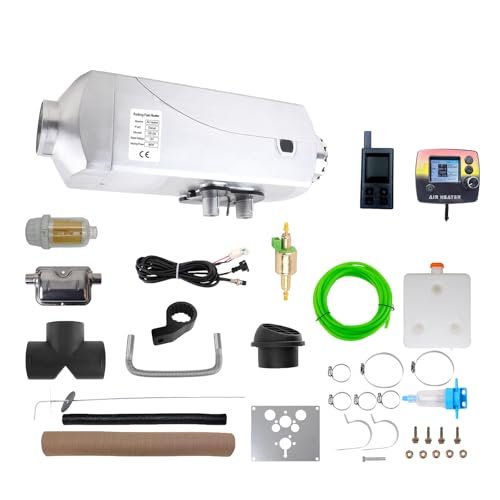
Brand: LSZQJ
This 9 kW heater targets larger spaces and heavy-duty vehicles using an oversized aluminum body for enhanced heat dissipation. The control system incorporates an LCD and ST microcontroller-based motherboard for reported stable operation and fault alerts.
It includes a bi-directional remote for status monitoring from a distance and safety features such as overheat alarm and thermostat. The unit is positioned for users requiring high output combined with monitoring and protective controls in demanding environments.
Buying Guide: How To Choose A Diesel Powered Heater
Selecting the right diesel heater depends on intended use, installation constraints, and environmental factors. Below are key considerations to compare models objectively.
1. Heating Output And Coverage
Heat capacity is measured in kilowatts (kW) or BTU. Choose higher kW for larger cabins, trucks, or garages. For compact vehicles or tents, 5–8 kW is often sufficient; heavy-duty applications may need 8–9 kW.
2. Power Source And Independence
All-in-one units integrate fuel tank and blower; others require external fuel lines. For off-grid use, prioritize self-powered or battery-independent models. If you want plug-in flexibility, look for dual-voltage or AC support.
3. Altitude Performance
Heaters with automatic altitude compensation or explicit high-altitude ratings (e.g., up to 18,000 ft) maintain combustion and efficiency in mountains. If you operate at elevation, confirm altitude specs.
4. Fuel Consumption And Tank Capacity
Compare fuel consumption rates (gal/hour or L/hour) to estimate run time. Bigger internal tanks increase autonomy but add weight. For extended off-grid use, lower consumption improves endurance.
5. Controls And Connectivity
Remote controls, LCD panels, and Bluetooth/app interfaces enable preheating and convenient adjustments. Assess range and feedback: bi-directional remotes provide status updates, improving monitoring.
6. Installation And Portability
All-in-one portable heaters reduce installation time. Toolbox-style or integrated-tank designs are easier to transport. Hardwired or external installation options may fit permanent vehicle setups but require work.
7. Noise, Emissions, And Safety Features
Look for low-noise operation if used in sleeping areas. Check for alarms, overheat protection, and clear exhaust routing requirements. Proper ventilation and installation practices minimize odors and combustion risks.
8. Build Materials And Heat Exchanger Type
Aluminum heat exchangers tend to be lighter with rapid heat transfer; sandblasted or enlarged exchangers can improve efficiency. For heavy use, larger aluminum bodies promote better dissipation.
9. Multi-Use And Versatility
Consider whether the unit supports multiple power inputs, can be used indoors or in vehicles, and offers device charging ports for additional utility during power outages.
10. Maintenance And Serviceability
Evaluate access to filters, combustion chambers, and exhaust for cleaning. Units with simple maintenance steps or widely available parts reduce long-term operational costs.
Comparison Perspectives:
Tips for Getting the Best HVAC Prices
- Prioritize Quality Over Cost
The most critical factor in any HVAC project is the quality of the installation. Don’t compromise on contractor expertise just to save money. - Check for Rebates
Always research current rebates and incentives — they can significantly reduce your overall cost. - Compare Multiple Quotes
Request at least three estimates before making your choice. You can click here to get three free quotes from local professionals. These quotes include available rebates and tax credits and automatically exclude unqualified contractors. - Negotiate Smartly
Once you've chosen a contractor, use the proven strategies from our guide — How Homeowners Can Negotiate with HVAC Dealers — to get the best possible final price.
- Off-Grid Camping: Prioritize self-powered systems and low fuel consumption.
- Vehicle/Marine Use: Favor automatic altitude compensation and compact all-in-one form factors.
- Home/Garage: Look for 110V/220V support and easier plug-in installation.
- High Output Needs: Choose higher kW units with robust heat exchangers and monitoring features.