
Basements typically need efficient, quiet, and flexible heating solutions. This guide compares five top-rated ductless heating options suited for basements, from mini-split heat pumps that handle whole-room climate control to compact wall-mounted infrared units for targeted warmth. Use the summary table to compare capacity and suitability at a glance, then read individual product details and a practical buying guide to choose the best fit for your basement.
| Product | Type | Heating Capacity / Coverage | Key Feature |
|---|---|---|---|
| YITAHOME 12000 BTU Mini Split (230V) | Ductless Mini-Split Heat Pump | 12,000 BTU — Up To ~750 Sq. Ft. | WiFi / Alexa Compatible, 17 SEER2 |
| Daikin 12,000 BTU Entra R32 | Ductless Mini-Split Heat Pump | 12,000 BTU — Up To ~550 Sq. Ft. | 18 SEER2, R32 Refrigerant, ECO+ |
| Daikin 18,000 BTU LV Series | Ductless Mini-Split Heat Pump | 18,000 BTU — Up To ~1,000 Sq. Ft. | 19.5 SEER2, Broad Operating Range |
| Cooper & Hunter 24,000 BTU | Ductless Mini-Split Heat Pump | 24,000 BTU — Larger Basements / Multi-Zone | Pre-Charged, WiFi Ready, 16ft Kit |
| Heat Storm HS-1500-PHX-WIFI | Wall-Mounted Infrared Heater | Zone Heating — Small Areas | WiFi Control, Space-Saving Wall Mount |
Content Navigation
- YITAHOME 12000 BTU Mini Split 230V
- Daikin 12,000 BTU Entra R32 Series
- Daikin 18,000 BTU LV Series
- Cooper & Hunter 24,000 BTU Mini Split
- Heat Storm HS-1500-PHX-WIFI Wall Heater
- Buying Guide: Choosing A Ductless Heater For Your Basement
- 1. Heating Capacity And Room Size
- 2. Insulation, Air Leakage, And Cold Floors
- 3. Efficiency Ratings And Operating Costs
- 4. Operating Temperature Range
- 5. Type Of Heater: Heat Pump Vs Infrared/Forced-Air
- 6. Air Quality And Filtration
- 7. Installation Requirements And Professional Service
- 8. Noise Levels And Location
- 9. Smart Controls And Scheduling
- 10. Safety Features And Local Codes
- 11. Budget Considerations And Lifecycle Costs
- 12. Typical Use Cases And Recommendations
YITAHOME 12000 BTU Mini Split 230V

This YITAHOME model is a ductless mini-split heat pump designed for spaces up to about 750 sq. ft. It includes inverter technology for improved efficiency and reduced energy draw. The system is ETL and AHRI certified, indicating it meets safety and performance standards for residential use.
- Heating Modes: Auto, Heat, Cool, Dry, Fan — automatic defrost and self-diagnosis.
- Controls: WiFi-enabled and Alexa compatible for remote scheduling and control.
- Noise & Comfort: Quiet operation (listed under 41 dB) and iFEEL mode for localized temperature sensing.
- Installation: Comes with a complete installation kit; 208–230V electrical requirement for this variant.
For basements needing year-round heating plus occasional cooling, this unit offers a balanced mix of efficiency, smart features, and capacity for medium-sized spaces.
Daikin 12,000 BTU Entra R32 Series

The Daikin Entra R32 12,000 BTU mini-split is optimized for efficient heating in spaces up to about 550 sq. ft. Using R32 refrigerant and DC inverter technology, it focuses on efficiency and a reduced environmental impact.
Call 888-896-7031 for Free Local HVAC Quotes – Compare and Save Today!
- Efficiency: 18 SEER2 and strong HSPF2 ratings for heating performance.
- Operational Range: Effective heating down to 5°F and cooling up to 115°F, suitable for moderate to cold basements.
- Air Quality & Modes: Features ECO+ and air purification via a photocatalytic filter for improved indoor air quality.
- Installation: Bundled with a Maxwell all-inclusive 15′ kit and wall bracket for professional install.
Choose this unit when energy efficiency and air quality are priorities in a modestly sized basement that may also need occasional cooling or dehumidification.
Daikin 18,000 BTU LV Series
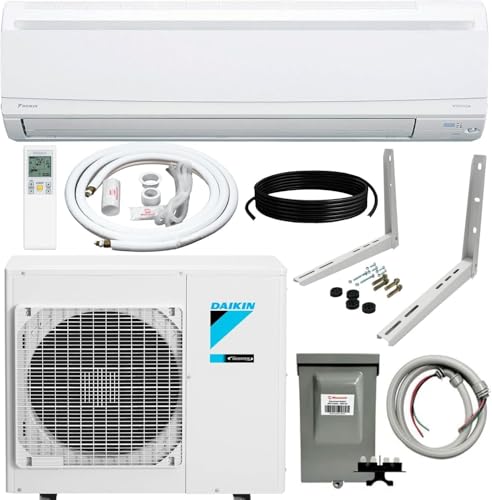
The Daikin LV Series 18,000 BTU unit is built for larger basements and spaces up to roughly 1,000 sq. ft. It offers higher capacity and a broad operating temperature range to support heating in colder climates.
- Power & Efficiency: 18,000 BTU cooling, 21,600 BTU heating capacity with 19.5 SEER2 efficiency.
- Cold-Climate Capability: Operates efficiently in low outdoor temperatures, suitable for cold-region basements.
- Comfort Features: Intelligent Eye sensor, Econo Mode, auto-changeover and advanced filtration for improved air quality.
- Installation: Includes 15′ installation kit; professional installation recommended for correct performance.
This system is appropriate for larger finished basements or open-plan areas where consistent whole-room heating and efficient operation are required across seasons.
Cooper & Hunter 24,000 BTU Mini Split

The Cooper & Hunter 24,000 BTU system is a higher-capacity ductless heat pump designed for large basements, multi-zone setups, or spaces requiring significant heating power. It ships pre-charged and includes an installation kit to simplify setup for professionals.
Call 888-896-7031 for Free Local HVAC Quotes – Compare and Save Today!
- Capacity: 24,000 BTU for larger spaces or multi-room basements.
- Connectivity: WiFi ready with smart port adapter for remote app control.
- Kit Included: 16 ft installation kit with pre-flared and insulated copper line set and communication wiring.
- Installation Note: Marketed as professional equipment; not a DIY product.
Consider this unit when your basement requires high heating output or when expanding an HVAC strategy to support multiple finished rooms with a single outdoor condenser.
Heat Storm HS-1500-PHX-WIFI Wall Heater

The Heat Storm HS-1500 is a wall-mounted infrared heater intended for zone heating rather than whole-basement conditioning. Its compact design preserves floor area while providing localized warmth. WiFi control enables scheduling and remote adjustments.
- Form Factor: Wall mounted design frees up floor space — good for small finished basements or workshop corners.
- Controls & Safety: Touchscreen thermostat, remote control, tip-over safety shutoff (though mounted installations reduce tip-over risk).
- Use Case: Ideal as supplemental heating for cold spots, stair wells, or individual rooms.
Use this heater when you need targeted, instant heat without a full HVAC upgrade. It’s best as a secondary solution or for small, well-insulated basement rooms.
Buying Guide: Choosing A Ductless Heater For Your Basement
Selecting the right ductless heater for a basement involves matching capacity, efficiency, installation constraints, and control features to the space and your needs. Below are the key factors to weigh and how they apply to typical basement scenarios.
1. Heating Capacity And Room Size
Estimate basement square footage and ceiling height. A rough guideline: 12,000 BTU often serves 400–750 sq. ft. depending on insulation and climate; 18,000–24,000 BTU suits larger or poorly insulated basements. For divided basements, consider multiple indoor units or a higher-capacity unit with multi-zone capability.
2. Insulation, Air Leakage, And Cold Floors
Basements with perimeter slab floors, poor insulation, or significant air leaks need more BTUs than a similarly sized heated-floor room. Prioritize sealing and insulation upgrades first, then size the system to the adjusted heat load rather than raw square footage.
3. Efficiency Ratings And Operating Costs
Look for SEER2 and HSPF2 or COP numbers for heating efficiency. Higher SEER2/HSPF2 means lower operating costs. In colder climates, choose heat pumps rated for low-ambient heating or models with good HSPF2 values to ensure consistent performance.
4. Operating Temperature Range
Check the manufacturer’s rated outdoor temperature range for heating. Some mini-splits maintain capacity at very low outdoor temperatures; others lose efficiency below certain thresholds. For cold climates, select models specifying reliable operation near or below your local winter lows.
5. Type Of Heater: Heat Pump Vs Infrared/Forced-Air
- Mini-Split Heat Pumps: Provide whole-room heating and cooling, dehumidification, and air filtration. Efficient for year-round use and larger basements.
- Wall-Mounted Infrared Heaters: Deliver quick, directional heat for a zone. Useful as supplemental heat or for small finished rooms.
- Forced-Air Electric Heaters (Portable/Shop Heaters): Provide fast warm air but can be noisy and less efficient for continuous living-space heating. Better for temporary or workshop use.
6. Air Quality And Filtration
Basements often have higher humidity and dust. Consider units with air purification filters (e.g., photocatalytic or washable filters) and dehumidification modes. Ventilation strategies and dehumidifiers may be required to maintain healthy indoor air quality.
7. Installation Requirements And Professional Service
Mini-split installs require an outdoor condenser, indoor wall or ceiling units, refrigerant lines, and electrical connections. Many units come with installation kits, but professional installation is typically recommended for correct refrigerant handling, sizing, and warranty compliance. Confirm line-set lengths and electrical supply (115V vs 230V) before purchase.
8. Noise Levels And Location
Basements often double as living areas or media rooms; check indoor unit noise ratings. Look for low dB levels for bedroom or lounge spaces. Placement of the indoor head should avoid direct drafts onto sleeping areas for comfort.
9. Smart Controls And Scheduling
WiFi control, voice assistant compatibility, and programmable timers can improve comfort and efficiency. If you plan zoning or remote management, choose models with robust app ecosystems and thermostatic control features.
10. Safety Features And Local Codes
Ensure electrical circuits meet local codes and that the unit carries appropriate safety certifications (e.g., ETL, UL, AHRI). For basements with moisture concerns, ask about corrosion-resistant coatings on outdoor units and elevated mounting options or stands to avoid water contact.
11. Budget Considerations And Lifecycle Costs
Compare upfront costs (equipment + installation) with expected energy use. Higher-efficiency systems cost more initially but yield lower operating expenses. Factor in maintenance needs such as periodic filter cleaning, condensate management, and annual service checks for optimal lifespan.
12. Typical Use Cases And Recommendations
- Finished Living Spaces: Choose a mini-split heat pump sized to the area for whole-room comfort and air filtration.
- Large Open Basements: Consider 18,000–24,000 BTU units or multi-zone systems with multiple indoor heads.
- Workshops / Occasional Use: Portable forced-air or infrared wall heaters may be more cost-effective for intermittent heating.
- Cold-Climate Basements: Prioritize models rated for low-ambient heating and ensure adequate insulation and vapor control.
When selecting any ductless heating option, prioritize proper sizing, professional installation where needed, and long-term efficiency. These factors determine comfort, cost, and system longevity in basement environments.
Tips for Getting the Best HVAC Prices
- Prioritize Quality Over Cost
The most critical factor in any HVAC project is the quality of the installation. Don’t compromise on contractor expertise just to save money. - Check for Rebates
Always research current rebates and incentives — they can significantly reduce your overall cost. - Compare Multiple Quotes
Request at least three estimates before making your choice. You can click here to get three free quotes from local professionals. These quotes include available rebates and tax credits and automatically exclude unqualified contractors. - Negotiate Smartly
Once you've chosen a contractor, use the proven strategies from our guide — How Homeowners Can Negotiate with HVAC Dealers — to get the best possible final price.