
Ceiling-mounted electric garage heaters save floor space and deliver targeted warmth for workshops, garages, and commercial bays. Below is a compact comparison of five top ceiling-mount models selected for power, controls, and installation type to help you evaluate options quickly.
| Model | Power / Volt | Key Features |
|---|---|---|
| Comfort Zone CZ220BK | 5,000W / 240V | Hard-wired, steel construction, adjustable louvers |
| TEMPWARE 7,500W | 7,500W / 240V | Digital controls, ECO mode, timer, adjustable angle |
| Comfort Zone CZ225ER | 6,000W / 240V | Digital thermostat, remote, wide air distribution |
| Dura Heat 10,000W | 10,000W / 240V | High output, remote, LED thermostat, ECO system |
| InoKraft 7,500W | 7,500W / 240V | Digital thermostat, ECO mode, timer, remote |
Content Navigation
- Comfort Zone Hard-Wired Ceiling Mount Garage Heater CZ220BK
- TEMPWARE Electric Garage Heater 7,500W Ceiling Mount
- Comfort Zone Digital Fan-Forced Ceiling Heater CZ225ER
- Dura Heat Hard-Wired Ceiling Mount Heater 10,000W
- InoKraft 7,500W Electric Garage Heater Ceiling Mount
- Buying Guide: How To Choose A Ceiling-Mount Electric Garage Heater
- 1. Power, Coverage, And Heat Output
- 2. Power Supply And Installation Requirements
- 3. Controls, Thermostat, And Automation
- 4. Safety Features And Certifications
- 5. Noise, Airflow, And User Comfort
- 6. Energy Efficiency And Running Costs
- 7. Application Type And Environmental Considerations
- 8. Maintenance, Serviceability, And Warranty
- 9. Comparison Perspectives
Comfort Zone Hard-Wired Ceiling Mount Garage Heater CZ220BK

Overview: A fan-forced ceiling heater designed for installations where floor space is limited. Intended for hard-wired 240V systems, it targets commercial or residential garages and workshops.
Construction & Durability: Built from heavy-gauge steel, the unit emphasizes ruggedness for fluctuating temperature environments. The housing and grille are engineered to resist wear in workshop conditions.
Heat Distribution & Control: Louvers and an adjustable mounting angle provide directional control to focus heat where needed. The fan-forced system supports faster air circulation than passive units.
Safety Features: Includes overheat protection and a thermal cut-out switch to interrupt power in fault conditions. The hard-wired design typically requires professional wiring for code-compliant installation.
Call 888-896-7031 for Free Local HVAC Quotes – Compare and Save Today!
TEMPWARE Electric Garage Heater 7,500W Ceiling Mount
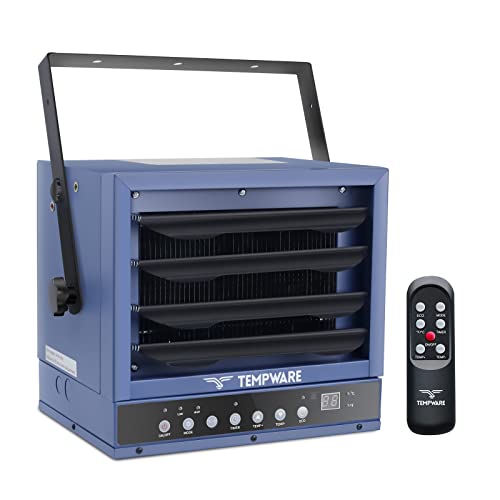
Overview: A high-output 7,500-watt fan-forced ceiling heater with digital controls and smart ECO features designed to heat larger areas efficiently.
Controls & Modes: Features a full-function remote, built-in thermostat adjustable from 45°F to 95°F, ECO mode that adapts operation to ambient temperature, and a 1–12 hour auto-off timer.
Performance & Coverage: Manufacturer-stated maximum BTUs and power levels indicate suitability for large workshops. Adjustable louvers and mounting angle help direct airflow for zone heating.
Safety & Installation: Thermal overheat protection is integrated. The unit is hard-wired 240V and generally requires professional installation to meet electrical code and ensure correct breaker sizing.
Comfort Zone Digital Fan-Forced Ceiling Heater CZ225ER

Call 888-896-7031 for Free Local HVAC Quotes – Compare and Save Today!
Overview: A mid-range 6,000-watt ceiling-mounted heater with a digital thermostat, remote control, and 12-hour timer aimed at garage and workshop applications.
Airflow Design: Fan-forced system with adjustable directed vents for broader and more even heat distribution across larger spaces, minimizing cold corners.
Controls & Convenience: The included remote and digital thermostat enable precise temperature setting and timed operation for automatic comfort management.
Build & Installation: Heavy-gauge steel construction supports durability in fluctuating temperature settings. As a 240V hard-wired unit, proper electrical connection is required for safe operation.
Dura Heat Hard-Wired Ceiling Mount Heater 10,000W

Overview: A high-capacity 10,000-watt ceiling-mounted heater intended for large garages and commercial spaces. It emphasizes maximum coverage and digital control.
Output & Coverage: Rated to deliver substantial BTUs suitable for areas up to the manufacturer’s stated coverage. The 240V / 50A hard-wire design requires a dedicated circuit and professional installation.
Control Features: LED display, adjustable thermostat (45–99°F), remote control, and a programmable timer offer comprehensive operational control and scheduling.
Safety & Features: Integrated overheat protection and an ECO system for energy-conscious cycling. The design is built for continuous use in workshop environments with heavy-duty needs.
InoKraft 7,500W Electric Garage Heater Ceiling Mount

Overview: A 7,500-watt fan-forced heater with digital thermostat, ECO mode, timer, and remote designed for rapid warm-up of garages and workshops.
Performance Claims: Manufacturer notes rapid temperature increase capability in moderately sized spaces and two heat settings (standard and ECO) for balancing comfort with energy use.
Controls & Safety: Offers a digital thermostat adjustable from 40°F to 95°F, 1–12 hour timer, remote control, and overheat protection for automated safety shutdown.
Installation: Hard-wired 240V configuration, recommended for ceiling mounting to maximize floor space and enable efficient convection across the room.
Buying Guide: How To Choose A Ceiling-Mount Electric Garage Heater
Selecting the right ceiling-mounted electric heater depends on several practical factors. Below are key considerations and comparison perspectives to guide a purchase decision.
1. Power, Coverage, And Heat Output
Wattage And BTU: Higher wattage units (6,000–10,000W) produce more BTUs and heat larger areas. Estimate required wattage by room size, ceiling height, and insulation. Use manufacturer coverage guidance as a starting point, and allow more capacity for poorly insulated or high-ceiling spaces.
Heat Distribution: Fan-forced designs circulate air faster than radiant-only units and are preferable for garages where convection is needed to move warm air. Adjustable louvers and mounting angle help focus heat zones.
2. Power Supply And Installation Requirements
Voltage And Circuit Needs: Most ceiling electric garage heaters are 240V hard-wired units and require a dedicated circuit and appropriate breaker sizing. Confirm your electrical panel capacity and consult a licensed electrician for safe wiring and code compliance.
Professional Installation: Hard-wired units generally need professional installation. Budget for electrician labor and any additional conduit or breaker upgrades.
3. Controls, Thermostat, And Automation
Digital Thermostats & Remotes: Digital controls and remote operation improve convenience, enabling precise temperature control and scheduling. Units with timers and ECO modes can reduce energy use while preserving comfort.
Smart Features: Some models adapt runtime based on ambient temperature. Evaluate whether adjustable ranges and timer flexibility meet your daily usage patterns.
4. Safety Features And Certifications
Overheat Protection: Thermal cut-outs or overheat sensors are essential safety features to prevent overheating or fire hazards. Look for ETL or similar compliance indicating independent testing.
Durable Construction: Heavy-gauge steel housings are better for workshop environments. Consider models with protective grilles and secure mounting brackets to resist impact and dust.
5. Noise, Airflow, And User Comfort
Fan Noise: Fan-forced heaters produce mechanical noise. If low noise is important, compare rated dB levels or user reports; some models operate quieter than others.
Air Movement: Strong airflow can be beneficial for spreading heat but may also move dust. Choose vent designs with adjustable louvers for directional control.
6. Energy Efficiency And Running Costs
ECO Modes And Timers: Models with ECO modes and programmable timers can reduce run time and energy consumption. Compare features that enable setback temperatures and auto-shutdown.
Matching Output To Need: Avoid oversizing drastically, which wastes energy; under-sizing will struggle to maintain comfort. Use insulation level and usage patterns to find the right capacity.
7. Application Type And Environmental Considerations
Indoor Vs. Semi-Outdoor: Most ceiling-mounted electric heaters are intended for indoor garage or workshop use. If the space is open or partially exposed, confirm manufacturer guidance on sheltered versus exposed installations.
High Ceiling Spaces: For tall garages or industrial bays, choose higher-output units or supplemental circulation to bring warm air down to working height.
8. Maintenance, Serviceability, And Warranty
Service Access: Check how easily filters (if any), fan assemblies, or heating elements can be serviced. Hard-wired units should still allow safe access panels for maintenance.
Warranty And Support: Compare warranty lengths and available customer support. Longer warranties can indicate confidence in component durability.
9. Comparison Perspectives
- Performance-Focused: Choose higher wattage models like the Dura Heat 10,000W for very large, poorly insulated spaces.
- Controls-Focused: If precise temperature control and scheduling are priorities, models with digital thermostats, remotes, and ECO modes (TEMPWARE, InoKraft, CZ225ER) provide more flexibility.
- Space & Budget Balance: Mid-range 5,000–7,500W units (Comfort Zone CZ220BK, TEMPWARE 7,500W) balance installation complexity, capacity, and cost of operation for typical two-car garages or workshops.
- Installation Complexity: All listed ceiling heaters are hard-wired 240V—plan for electrician involvement and proper breaker sizing.
Using these considerations will help match a ceiling-mounted electric heater to your garage size, insulation, and usage pattern. Focus on safe installation, adequate capacity, and the right level of control for efficient, reliable heat delivery.
Tips for Getting the Best HVAC Prices
- Prioritize Quality Over Cost
The most critical factor in any HVAC project is the quality of the installation. Don’t compromise on contractor expertise just to save money. - Check for Rebates
Always research current rebates and incentives — they can significantly reduce your overall cost. - Compare Multiple Quotes
Request at least three estimates before making your choice. You can click here to get three free quotes from local professionals. These quotes include available rebates and tax credits and automatically exclude unqualified contractors. - Negotiate Smartly
Once you've chosen a contractor, use the proven strategies from our guide — How Homeowners Can Negotiate with HVAC Dealers — to get the best possible final price.