
Summary: This guide reviews five top electric heaters suitable for home use, focusing on wall-mounted smart units, tower and portable ceramic heaters, and infrared systems. The table below summarizes core features to help compare options quickly.
| Product | Form Factor | Key Features |
|---|---|---|
| Heat Storm HS-1500-PHX-WIFI Infrared Heater | Wall-Mounted Infrared | Wi‑Fi control, digital thermostat, tip-over safety, space-saving |
| Dreo Smart Wall Heater WH719S | Wall-Mounted Ceramic (Oscillating) | 120° oscillation, app/Alexa control, 1°F accuracy thermostat |
| Dreo Space Heater 25″ | Portable Tower Ceramic | Fast airflow, quiet operation, tip-over & overheat protection |
| Lasko Oscillating Digital Ceramic Tower Heater 755320 | Tower Ceramic | Adjustable thermostat, timer, remote, oscillation |
| DR Infrared Heater Portable 1500W | Portable Infrared + PTC | Dual heating system, energy saving mode, quiet blower |
Content Navigation
- Heat Storm HS-1500-PHX-WIFI Infrared Heater, Wifi Wall Mounted
- Dreo Smart Wall Heater WH719S, Electric Space Heater
- Dreo Space Heater For Indoor Use, 25″ Fast Electric Heater
- Lasko Oscillating Digital Ceramic Tower Heater, 755320
- Dr Infrared Heater Portable Space Heater, Original 1500-Watt
- Buying Guide: Choosing An Electric Heater For Your House
Heat Storm HS-1500-PHX-WIFI Infrared Heater, Wifi Wall Mounted

This wall-mounted infrared heater is offered as a dedicated wall unit and includes Wi‑Fi connectivity to control temperature remotely from a phone. The model provides a touch screen with a digital thermostat and includes a remote. Safety features include tip-over shut-off, and the wall-mount design preserves floor space, making it suitable for bedrooms, kitchens, and offices.
Key considerations from the feature list: the unit emphasizes smart control and compact installation, and the infrared heating method can produce comfortable radiant warmth. Intended use is indoor spaces where a mounted heat source is beneficial rather than a portable option.
Dreo Smart Wall Heater WH719S, Electric Space Heater

The Dreo WH719S is a wall-mounted electric heater with 120° vertical oscillation to distribute heat more evenly top to bottom. It features smart control via an app, compatibility with Alexa and Google Home, and scheduling for automated operation.
Call 888-896-7031 for Free Local HVAC Quotes – Compare and Save Today!
Thermostat performance is a highlight: a 41°–95°F range with 1°F accuracy using PTC ceramic heating for steady warmth. The product is positioned for homeowners seeking a smart, energy-conscious wall heater with wide heat dispersion suitable for bedrooms and living spaces.
Dreo Space Heater For Indoor Use, 25″ Fast Electric Heater

This 25″ tower ceramic heater emphasizes fast airflow and broad coverage, claiming an 11.5 ft/s airflow generated by a hyperamics thermal design. It targets larger rooms with an extended impeller to increase heat range.
Safety features include ETL-certified overheat protection and a 45° tip-over cutoff. Noise reduction to as low as 32 dB and a child lock setting are additional features called out for quiet, secure operation. Controls include a remote and adjustable thermostat across several modes.
Lasko Oscillating Digital Ceramic Tower Heater, 755320

The Lasko 23″ tower heater is a widely used ceramic heater that offers two heat settings, an adjustable thermostat, and optional widespread oscillation to distribute warm air. It includes a remote control and a built-in timer (1–8 hours) for scheduled shutoff.
Call 888-896-7031 for Free Local HVAC Quotes – Compare and Save Today!
Functionality focuses on straightforward operation and convenience features like remote storage on the unit. This heater suits users who want a familiar tower layout with basic oscillation and timer controls for living rooms and bedrooms.
Dr Infrared Heater Portable Space Heater, Original 1500-Watt
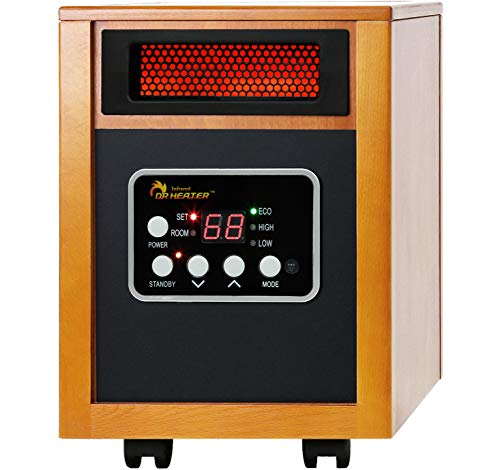
The DR Infrared model is a portable unit combining an infrared quartz tube and PTC ceramic elements in a dual heating system. The manufacturer highlights energy-saving operation with an auto energy saving mode and a quieter high-pressure blower around 39 dB.
Other features include tip-over and overheat protection, a 12-hour timer, and remote control. The blend of infrared and forced-air PTC heating aims to provide rapid warmth for larger rooms while maintaining safety and relatively quiet operation.
Buying Guide: Choosing An Electric Heater For Your House
When selecting an electric heater for home use, consider the following aspects to match device capabilities with room size, safety needs, and convenience preferences.
Heating Technology
- Infrared (Radiant) Heaters: Heat objects and people directly, useful for quick local warmth and wall-mounted setups. Effective in rooms where radiant heat is preferred.
- Ceramic / PTC Heaters: Use a ceramic element and fan to distribute warm air. Good for circulating heat across medium to large rooms and for steady ambient temperature control.
- Hybrid Systems: Some models combine infrared and ceramic (PTC) elements for a balance of radiant and convective heating, improving response time and coverage.
Room Size And Heat Output
- Match heater output to room size. Most household portable heaters use 1500W and are appropriate for single rooms up to about 200–300 sq ft depending on insulation and ceiling height.
- Wall-mounted units can be effective in smaller rooms or supplemental heating for areas where floor space is limited.
Controls, Scheduling, And Smart Features
- Smart Connectivity: Wi‑Fi or app control allows remote temperature adjustments and scheduling. Useful for integrating heaters into daily routines or smart home systems.
- Thermostat Accuracy: Look for precise control (±1°F claims) if maintaining a consistent ambient temperature is important.
- Timers & Schedules: Built-in timers help conserve energy by limiting runtime.
Air Distribution And Oscillation
- Oscillating or tower models distribute heat across a wider area, reducing hot spots. Vertical oscillation is helpful for wall units to spread heat top-to-bottom.
- Fan-driven ceramic heaters will warm a room faster than purely radiant units but may move more dust and produce slight noise.
Safety Features
- Overheat Protection: Automatic shutoff if internal temperatures exceed safe limits.
- Tip‑Over Switch: Essential for portable units to cut power if the heater falls.
- Certifications: Look for ETL, UL, or equivalent safety listings for electrical compliance and testing.
Noise And Placement
- Tower and ceramic fans create some noise; bedroom or office use benefits from models rated for low dB.
- Wall-mounted units are quieter generally since they may rely more on radiant heat; placement should consider clearance requirements and airflow.
Energy Efficiency And Running Costs
- Electric heaters convert nearly all electrical input into heat; efficiency differences lie in how effectively heat is delivered to occupants and controlled to avoid waste.
- Smart thermostats, scheduling, and accurate temperature control reduce runtime and energy use compared with simple on/off models.
Installation And Space Considerations
- Portable heaters require no installation beyond outlet access, while wall-mounted units may need secure mounting and possibly hardwiring depending on model.
- Consider floor space, ventilation, and recommended clearances from combustible materials for safe operation.
Comparison Perspectives
- Best For Small Rooms: Compact wall-mounted infrared units or small ceramic tower heaters with adjustable thermostats.
- Best For Larger Rooms: Tower ceramic models or portable units advertised for extended airflow and higher delivery range.
- Best For Quiet Use: Models specifying low dB operation or radiant heaters that rely less on fans.
- Best For Smart Homes: Wi‑Fi or app-enabled units with voice assistant compatibility and scheduling features.
Maintenance Tips: Keep intake and output grilles clear, vacuum dust from fan and vents periodically following manufacturer guidance, and inspect power cords and mounting hardware for wear.
Tips for Getting the Best HVAC Prices
- Prioritize Quality Over Cost
The most critical factor in any HVAC project is the quality of the installation. Don’t compromise on contractor expertise just to save money. - Check for Rebates
Always research current rebates and incentives — they can significantly reduce your overall cost. - Compare Multiple Quotes
Request at least three estimates before making your choice. You can click here to get three free quotes from local professionals. These quotes include available rebates and tax credits and automatically exclude unqualified contractors. - Negotiate Smartly
Once you've chosen a contractor, use the proven strategies from our guide — How Homeowners Can Negotiate with HVAC Dealers — to get the best possible final price.