
Panel heaters provide quiet, space-saving warmth for bedrooms, offices, and living areas. Below is a quick comparison of the top electric panel heaters chosen for safety features, energy efficiency, mount options, and smart control.
| Product | Type | Key Feature |
|---|---|---|
| Eueiriup 1500W Electric Wall Heater | Plug-In / Freestanding | High-power convection with thermostat |
| ENVI Plug-In Electric Panel Heater | Plug-In Wall-Mount | Low-wattage 24/7 safe operation |
| EnviMAX 220V Hardwired Panel Heater | Hardwired Wall-Mount | High-efficiency, cool-to-touch operation |
| Dreo Smart Wall Heater 1500W | Wall-Mount / Smart | Oscillation + Wi‑Fi, app and voice control |
| DeLonghi Mica Panel Heater 1500W | Freestanding / Wall-Mount | Mica element, quiet full-room heating |
Content Navigation
Eueiriup 1500W Electric Wall Heater

This unit is a 1500W convection panel heater designed for indoor use with an adjustable thermostat and two heat settings. It uses aluminum convection technology and claims fast warm-up, dispersing cold and moisture quickly. The model can be used as a freestanding unit with wheels or wall-mounted and includes an easy control knob switch.
Key listed features: Efficient Heating via aluminum convection, Dual Heat Settings for power-savings, and Quiet Airless Heating with under 30dB operation. The product emphasizes reduced airborne dust and allergy-friendly performance due to its fan-less design.
Safety and usability highlights include plug-in convenience, thermostat control for maintaining ambient temperature, and the option to supplement central heat in targeted rooms. Useful for users seeking portable or wall-mounted versatility with straightforward mechanical controls.
ENVI Plug-In Electric Panel Heater
Call 888-896-7031 for Free Local HVAC Quotes – Compare and Save Today!
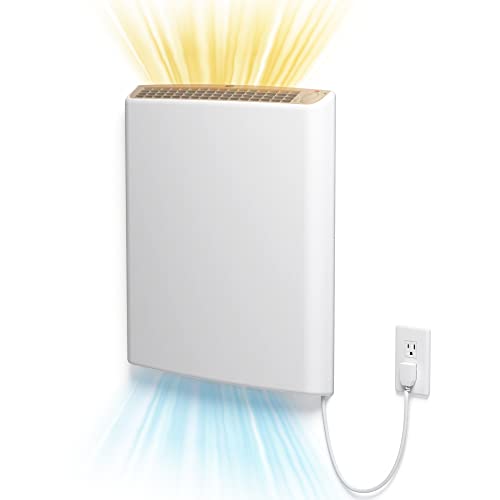
The ENVI plug-in panel heater is a low-wattage wall-mounted solution designed for continuous 24/7 operation. It uses a patented fan-less stack convection design to provide silent, gentle warmth while minimizing dust circulation.
Listed features include Efficient Low-Wattage heating for targeted comfort, a Wall-Sense Safety Sensor that cuts power if removed from the wall, and operation at a cool ~90°F surface temperature. The heater supports allergy-friendly environments by preventing airborne dust and helps maintain humidity.
Installation is pitched as simple (plug-in style) for spot heating near beds, desks, or entryways. The safety sensor and cool-to-touch surface make it appropriate for homes with children or pets, and its silent operation suits bedrooms and study areas.
EnviMAX 220V Hardwired Panel Heater

The EnviMAX is a 220V hardwired panel heater intended for whole-room heating of larger spaces with continuous operation. It emphasizes energy savings by allowing users to lower central heat and heat only occupied areas.
Key features: Energy Savings claims up to 50% reduction on heating costs when used to supplement central heat; Cool-To-The-Touch surface at ~90°F; and a Wall-Sens Safety Sensor to cut power if removed from the wall. The product uses a fan-less Stack Convection technology for silent operation and minimal dust disturbance.
Call 888-896-7031 for Free Local HVAC Quotes – Compare and Save Today!
Designed for hardwired installation, this model is suited to homeowners or installers planning semi-permanent placement. It targets users seeking continuous, unobtrusive heating with safety measures for households with vulnerable occupants.
Dreo Smart Wall Heater 1500W

Dreo’s wall heater combines a 1500W PTC ceramic element with 120° vertical oscillation for broader heat distribution. It is positioned as a smart, app-compatible heater with scheduling, remote control, and voice assistant integration.
Highlighted features: Widespread Warmth from wide oscillation, Smart Control through the Dreo app and Alexa/Google compatibility, and Fast, Accurate Temperature Control with 1°F adjustment precision over a 41–95°F range. The heater includes a 24-hour timer and remote for in-room convenience.
This product is aimed at users who prioritize programmable comfort and connected-home integration. The oscillation feature differentiates it by actively moving warm air rather than relying solely on passive convection.
De’Longhi Mica Panel Heater 1500W

De’Longhi’s mica panel uses a mica heating element to deliver quiet, efficient heat across medium to large rooms. The unit converts electricity to heat with stated high efficiency and includes adjustable thermostat controls.
Product features: Quiet Heater operation that minimizes dust circulation, Maximize Efficiency with direct electrical-to-heat conversion, and Built-In Safety including thermal shutoff, tip-over switch (on freestanding mode), and standby functions to help prevent freezing or overheating.
This model suits consumers looking for established-brand reliability, full-room heating performance, and multiple mounting options. The mica element is intended to provide steady, gentle warmth without forced air movement.
Buying Guide: How To Choose An Electric Panel Heater
Choosing the right panel heater requires balancing room size, mounting preference, control features, energy use, and safety requirements. The sections below break down the main considerations.
Room Size And Wattage
Match heater wattage to the room area. Higher wattage (1200–1500W) suits larger rooms or faster heat-up; lower wattage (300–600W) is efficient for small rooms or zonal heating. Consider ceiling height and insulation quality — poorly insulated rooms require more power.
Mounting And Installation
Options include plug-in wall-mounted, hardwired wall-mounted, or freestanding units. Plug-in models offer easy installation and portability. Hardwired units are more permanent and may be better for large rooms or continuous use. Freestanding units provide flexibility but take floor space.
Heating Method And Air Quality
Panel heaters use convection, mica, or infrared elements. Fan-less convection and mica designs reduce dust movement and are more allergy-friendly. Infrared or mica panels deliver radiant warmth that feels immediate. If air quality is a concern, favor fan-less designs to avoid stirring dust and allergens.
Controls And Smart Features
Simple mechanical thermostats provide reliable temperature control. Digital thermostats, timers, and remote or app controls add convenience and scheduling for energy savings. Smart connectivity enables remote scheduling and voice control, helpful for integrated smart homes.
Energy Efficiency And Operating Cost
Look for features that reduce runtime: programmable timers, accurate thermostats, and zone-targeting capability. Lower-wattage continuous heaters can be cost-effective when heating small, frequently used spaces. Energy claims like “save up to X%” depend on usage patterns and baseline heating systems.
Noise And Comfort
Fan-less models provide silent operation, ideal for bedrooms and offices. Oscillating or fan-assisted units move air more actively and may distribute warmth faster but can create low-level noise and circulate dust.
Safety Features
Important safety elements include overheat protection, tip-over switch (for freestanding units), and cool-to-touch surfaces for wall-mounted units. Wall-sense sensors that cut power if the unit is removed add an extra safety layer, particularly in homes with children or pets.
Durability And Warranty
Check manufacturer warranties and the durability of heating elements (mica, ceramic, aluminum). Metal housings and quality thermal sensors typically indicate longer service life. Warranty length and warranty terms provide insight into expected reliability.
Installation And Maintenance
Consider whether you need professional installation for hardwired models. Plug-in models are simpler but check local codes for continuous wall-mounted use. Maintenance for most panel heaters is minimal — occasional surface cleaning is usually sufficient. Avoid blocking air flow around convection units.
Comparison Perspectives
- Best For Quiet, Allergy-Friendly Heating: Fan-less convection or mica panels.
- Best For Smart Home Integration: Wi‑Fi enabled models with app and voice control.
- Best For Easy Installation: Plug-in wall-mount units that include safety sensors.
- Best For Whole-Room, Permanent Use: Hardwired panels sized for the room.
- Best For Portability And Flexibility: Freestanding models with wheels and thermostat.
Making an informed choice means matching the heater’s specifications to the room’s needs and household priorities: safety, noise, control, and long-term operating cost. Use the comparison perspectives above to identify the product features that matter most for your space.
Tips for Getting the Best HVAC Prices
- Prioritize Quality Over Cost
The most critical factor in any HVAC project is the quality of the installation. Don’t compromise on contractor expertise just to save money. - Check for Rebates
Always research current rebates and incentives — they can significantly reduce your overall cost. - Compare Multiple Quotes
Request at least three estimates before making your choice. You can click here to get three free quotes from local professionals. These quotes include available rebates and tax credits and automatically exclude unqualified contractors. - Negotiate Smartly
Once you've chosen a contractor, use the proven strategies from our guide — How Homeowners Can Negotiate with HVAC Dealers — to get the best possible final price.