Choosing the right forced air garage heater depends on garage size, fuel type, installation preference, and safety features. Below is a concise summary of five top forced-air heaters spanning portable propane units and hard-wired electric models to match different needs.
Product
Type
Output
Primary Use
Dura Heat 17,060 BTU Electric
Hard-Wired Electric
17,060 BTU / 5,000W
Large Garage / Workshop
Mr. Heater 125,000 BTU
Portable Propane
125,000 BTU
Jobsite / Large Garage
Mr. Heater 60,000 BTU
Portable Propane
60,000 BTU
Medium Garage / Workshop
InoKraft Maxheat MH125
Portable Propane
125,000 BTU
Very Large Spaces / Shops
TEMPWARE 7,500W Electric Ceiling
Hard-Wired Electric Ceiling
Up To 25,590 BTU (7,500W)
Large Garage / Shop
Note: All products are forced-air designs that move warm air quickly across a workspace; propane units provide higher BTU per unit, while electric models favor permanent installation and zero on-site combustion.
This portable propane forced air heater delivers 125,000 BTU for rapid heating in large garages, shops, or job sites. Key listed features include Quiet Burner Technology for reduced noise relative to standard propane heaters, a 10 ft hose and regulator for tank hookup, and a high-temperature limit switch for safety. The design emphasizes high output and portability with a focus on open or well-ventilated spaces.
Ideal for large-volume spaces where quick temperature rise is needed, this model requires proper ventilation and adherence to safety guidelines. The heater’s quieter operation can reduce distraction in active work environments.
Call 888-896-7031 for Free Local HVAC Quotes – Compare and Save Today!
The InoKraft Maxheat MH125 is a 125,000 BTU forced air propane heater configured for large garages and commercial spaces. Notable features include a Smart 25–95°F Auto On/Off Control, fast heating via a heavy-duty forced air fan, adjustable heat angle, and multiple safety protections including overheat auto-shutoff and gas leak prevention. The unit is CSA certified and designed for environments that require automated temperature control and robust output.
This model combines high capacity with convenience features like automatic temperature control, making it suitable where sustained ambient temperature management is important for work or storage spaces. Proper ventilation and clearance are required for safe operation.
The Mr. Heater MH60QFAV provides 60,000 BTU with adjustable output from 30,000 to 60,000 BTU, suitable for moderate-sized garages and workshops. It uses QBT (Quieter Burner Technology) and can run up to 14 hours on a 20 lb propane tank at the low setting. The variable output enables energy-efficient operation while maintaining usable warmth across a workspace.
Its portability and fuel efficiency on lower settings make it a pragmatic choice for users who need powerful yet flexible heating without permanent installation. As a propane device, ventilation and safety-cutoffs remain essential considerations.
Call 888-896-7031 for Free Local HVAC Quotes – Compare and Save Today!
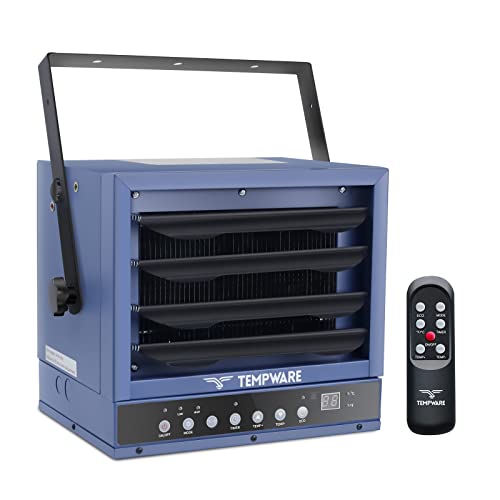
The TEMPWARE electric ceiling heater is a hard-wired, fan-forced unit delivering up to 7,500 watts of power with a max BTU-equivalent of about 25,590. It features adjustable louvers, an ECO mode with an auto temperature sensor, a 12-hour timer, and a full-function remote. Installation is 240V hard-wired and intended for permanent ceiling mounting.
This heater targets large garages and workshops where overhead installation preserves floor space. The integrated thermostat, timer, and safety overheat protection support steady climate control without on-site combustion emissions.
The Comfort Zone hard-wired ceiling heater provides 5,000 watts of fan-forced heat and is designed for ceiling installation in garages, warehouses, or storage areas. Key features include a space-saving ceiling mount, heavy-gauge steel construction, adjustable louvers for targeted heat distribution, and thermal cut-out for overheat protection.
As a permanent overhead solution, this unit is appropriate where preserving floor space is important and where controlled, distributed heat is prioritized over portable high-BTU solutions. Hard-wired installation requires professional wiring per local codes.
Buying Guide For Forced Air Garage Heaters
Choosing the correct forced air garage heater involves assessing space size, fuel type, installation limits, and safety. Below are core considerations and comparison perspectives to guide purchase decisions.
1. Match Heater Output To Space
BTU/Watt Needs: Estimate required BTU using garage volume and insulation level. Larger, poorly insulated spaces need higher BTU (e.g., 60k–125k BTU for large shops). Electric models list watts—convert roughly 3,412 BTU per kW.
Heat Distribution: Forced-air fans move heat quickly. Ceiling units distribute more evenly; portable units provide directional warm air.
2. Fuel Type: Propane vs Electric
Propane Forced-Air: Higher BTU per unit, portable, and fast heating for large spaces. Requires ventilation and safe fuel storage. Good for job sites or detached garages.
Electric Hard-Wired: Cleaner operation (no combustion), suitable for attached garages or enclosed spaces, often requires professional 240V installation. Best where venting or fuel storage is impractical.
3. Installation And Placement
Ceiling Mount: Saves floor space and provides broad coverage. Often hard-wired and requires professional installation.
Portable Units: Offer flexibility and no permanent wiring; must follow clearance requirements and safety codes for indoor use.
4. Safety Features And Codes
Overheat Protection: Automatic shut-off prevents overheating; important for continuous operation.
Tip-Over/ Tilt Shutoff: Relevant for portable models to reduce fire risk.
Certifications: Look for CSA, ETL, or similar listings indicating compliance with safety standards.
Ventilation Requirements: Propane units need adequate ventilation and CO monitoring in enclosed spaces.
5. Controls, Thermostat, And Convenience
Thermostatic Control: Built-in thermostats or remote control allow temperature management and energy savings.
Timers & ECO Modes: Useful for scheduling and limiting runtime to conserve energy.
Remote Control / Digital Display: Helpful for quick adjustments from the workspace.
6. Noise And Operation
Quieter Burner Technology: Some propane units advertise reduced noise, beneficial for occupied workspaces.
Fan Noise: Forced-air fans produce sound; ceiling mounts may muffle noise relative to floor units.
7. Portability vs Permanent Installation
Portable Units: Offer rapid deployment and higher BTU per unit; consider storage of propane tanks and safety clearances.
Permanent Units: Hard-wired electric units provide continuous operation, no local combustion, and better integration with thermostats, but require installation.
8. Energy Efficiency And Operating Cost
Electric Heaters: Convert electricity to heat efficiently at the unit level but can be costly to run at high wattage.
Propane Heaters: Often more BTU per dollar of fuel for short-term heating; operational cost depends on local propane prices and usage patterns.
Fan And Burner Care: Periodic cleaning and inspection extend service life; follow manufacturer maintenance schedules.
10. Comparison Perspectives
High-BTU Portable (125k): Best For Very Large or Open Spaces Where Ventilation Is Available. Offers rapid heat but needs ventilation and safety clearances.
Medium-BTU Portable (60k): Balanced For Medium Garages; more fuel-efficient at variable outputs and easier to handle.
Hard-Wired Ceiling Electric (5,000–7,500W): Best For Attached Garages Or Enclosed Workshops Where No Combustion Is Preferred; requires permanent electrical upgrade.
Thermostatic And Remote Control Models: Offer energy savings and precise comfort management across both fuel types.
When evaluating options, quantify your garage volume, consider insulation, decide on fuel preference, and confirm local code requirements for installation and ventilation. Prioritize certified safety features and the right combination of output and control for sustained, safe comfort in your workspace.
Tips for Getting the Best HVAC Prices
Prioritize Quality Over Cost The most critical factor in any HVAC project is the quality of the installation. Don’t compromise on contractor expertise just to save money.
Check for Rebates Always research current rebates and incentives — they can significantly reduce your overall cost.
Compare Multiple Quotes Request at least three estimates before making your choice. You can click here to get three free quotes from local professionals. These quotes include available rebates and tax credits and automatically exclude unqualified contractors.