
Quick Guide: This article reviews five forced-air unit heaters suitable for garages, workshops, warehouses, and jobsite spaces. Each selection includes key specs, features, mounting and fuel type considerations, and ideal use cases to help you compare options objectively.
| Model | Type / Fuel | Output | Best For |
|---|---|---|---|
| Dura Heat EWH5510 | Electric, Hard-Wired | 17,060 BTU / 5,000 W | Large garages up to ~750 sq. ft. |
| TEMPWARE 7500-Watt Garage Heater | Electric, Ceiling-Mount | Up To 25,590 BTU Equivalent | Workshops, adjustable mounting |
| Reznor UDXC-200 | Natural Gas, Ceiling/Wall | 200,000 BTU (Two Stages) | Large commercial/warehouse spaces |
| Mr. Heater F271390 | Propane, Forced Air | 125,000 BTU | Large garages, job sites needing portable power |
| Mr. Heater MH60QFAV | Propane, Portable Forced Air | Variable 30,000–60,000 BTU | Medium workshops, intermittent heat |
Content Navigation
- Dura Heat EWH5510 Electric Forced Air Heater With Remote Control
- TEMPWARE 7500-Watt Digital Fan-Forced Ceiling Mount Shop Heater
- Reznor UDXC-200 Commercial Natural Gas Garage Heater Ceiling Mount
- Mr. Heater 125,000 BTU Forced Air Propane Heater F271390
- Mr. Heater MH60QFAV 60,000 BTU Portable Propane Forced Air Heater
- Buying Guide: How To Choose A Forced Air Unit Heater
Dura Heat EWH5510 Electric Forced Air Heater With Remote Control

The Dura Heat EWH5510 Is A Hard-Wired Electric Garage Heater Designed For Larger Residential Garages Up To About 750 Square Feet. It Operates On 240V At 5,000 Watts And Provides A High Output Of 17,060 BTU.
Key Features:
- Coverage: Rated To Heat Up To Approximately 750 Sq. Ft.
- Power And Installation: Hard-Wired 240V / 5,000W / 30A — Requires Professional Installation.
- Controls: Remote Control With Adjustable Thermostat And LED Display (45–99°F).
- Design: Large Fan And Housing Intended For Permanent Garage Or Shop Mounting.
Considerations: Electric hard-wired units avoid combustion and ventilation concerns but require appropriate electrical capacity and certified installation. Remote thermostat control simplifies temperature management in medium-to-large garages.
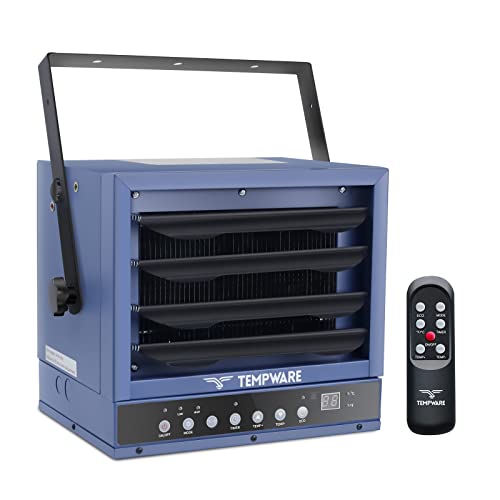
TEMPWARE 7500-Watt Digital Fan-Forced Ceiling Mount Shop Heater
Call 888-896-7031 for Free Local HVAC Quotes – Compare and Save Today!
The TEMPWARE Ceiling-Mount Heater Is A High-Powered Electric Option With Digital Controls, Remote, And Adjustable Louvers. It Is Intended For Permanent Installation In Workshops And Garages.
Key Features:
- Power Range: 6,250–7,500 Watts With Max Equivalent Up To 25,590 BTU Output.
- Mounting: Ceiling-Mount With Adjustable Angle And Louvers To Direct Airflow.
- Smart Controls: Digital Thermostat, ECO Mode, 12-Hour Timer, Full-Function Remote.
- Safety: Overheat Protection And Built-In Temperature Sensor.
Considerations: Ceiling-mounted electric heaters maximize floor space and distribute heat broadly. This model’s programmable features and ECO mode help control runtime and energy use. Hard-wiring and electrical capacity should be verified prior to installation.
Reznor UDXC-200 Commercial Natural Gas Garage Heater Ceiling Mount

The Reznor UDXC-200 Is A High-Capacity Natural Gas Forced-Air Heater For Commercial And Industrial Spaces. It Offers Multi-Stage Output, Durable Mounting Options, And High Thermal Efficiency.
Key Features:
Call 888-896-7031 for Free Local HVAC Quotes – Compare and Save Today!
- High Output: Rated For Up To 200,000 BTU With Two Fire Levels For Load Flexibility.
- Efficiency: Approximately 83% Thermal Efficiency Rating.
- Mounting Versatility: Threaded Retainers For Ceiling Suspension Or Wall Mounting (Bracket Sold Separately).
- Application: Designed For Warehouses, Large Garages, Factories, And Commercial Workshops.
Considerations: Natural gas units deliver continuous high output and lower operating cost in many commercial settings, but they require professional gas hookup, appropriate ventilation, and adherence to local codes. The UDXC series suits spaces where centralized high-BTU heating is necessary.
Mr. Heater 125,000 BTU Forced Air Propane Heater F271390

The Mr. Heater F271390 Is A High-Output Propane Forced-Air Heater Designed For Large Garages, Shops, And Jobsite Spaces Where Portability And Strong Heat Output Are Required.
Key Features:
- Output: 125,000 BTU Capacity For Rapid Heating Of Large Areas.
- Noise: Features Quiet Burner Technology For Reduced Operational Noise.
- Safety: High-Temperature Limit Switch And Included Hose & Regulator For Standard Propane Tanks.
- Use Case: Suited To Contractors, Large Drive-In Garages, And Temporary Heating Needs.
Considerations: Propane forced-air units provide portability and very high BTU output but require safe fuel storage, proper ventilation, and adherence to manufacturer safety instructions. Fuel logistics and run-time on tanks are practical considerations for job sites.
Mr. Heater MH60QFAV 60,000 BTU Portable Propane Forced Air Heater

The Mr. Heater MH60QFAV Offers A Variable Output Forced-Air Propane Option With QBT Technology For Quieter Operation. It Balances Portability And Adjustable Heat For Medium To Large Spaces.
Key Features:
- Variable Output: 30,000–60,000 BTU Range To Match Heat Demand.
- Quiet Operation: QBT Technology Claims About 50% Quieter Performance Than Standard Models.
- Run-Time: Up To 14 Hours On A 20 lb Tank At Low Setting (Dependent On Conditions).
- Portability: Compact Dimensions And Built For Movable Jobsite Use.
Considerations: Variable BTU provides flexibility to save fuel during milder conditions. Propane models like this are effective where electrical supply is limited or portability is needed, but ventilation and safe tank handling remain essential.
Buying Guide: How To Choose A Forced Air Unit Heater
Selecting The Right Forced-Air Unit Heater Depends On Several Technical And Practical Factors. This Guide Breaks Down The Key Considerations To Compare Models Objectively.
Fuel Type And Installation
Electric forced-air heaters avoid combustion products and ventilation requirements, making them appropriate for enclosed garages and workshops if electrical capacity is adequate. They require proper circuit sizing and often professional hard-wiring for larger models.
Natural Gas units provide continuous high output and lower operating cost in many commercial scenarios but require gas lines, combustion clearance, and code-compliant venting or indoor-exempt designs. Professional gas hookup and permits may be necessary.
Propane forced-air heaters are typically portable and ideal for temporary or remote job sites. They require safe fuel storage, tank regulators, and attention to ventilation to prevent accumulation of combustion byproducts in enclosed spaces.
Output Capacity And Coverage
Match BTU Or Wattage To The Space Volume. As A Rule Of Thumb, large garages and workshops require higher BTU ratings. Consider insulation, ceiling height, and typical outdoor temps when estimating coverage. Multi-stage or variable-output heaters provide better control and efficiency across variable loads.
Mounting And Air Distribution
Ceiling-Mounted Units Provide Even Distribution And Save Floor Space, Suitable For Permanent Installations. Portable Forced-Air Units Are Better For Temporary Worksites Or When You Need To Move Heat Around. Adjustable Louvers Or Directional Ducting Improve targeted heating for cold benches or doorways.
Controls, Thermostat, And Automation
Remote Controls Or Built-In Thermostats Offer Convenience And Energy Savings. Digital Displays, Timers, And ECO Modes Allow Better Runtime Management. For shops used intermittently, programmable timers reduce fuel and energy waste.
Safety Features And Noise
Look For Overheat Protection, High-Temperature Limit Switches, And Tip-Over Or Flame-Out Safeguards Where Applicable. For indoor or occupied spaces, noise level matters; models with quieter burner technology or sound-dampening features improve working conditions.
Efficiency And Operating Cost
Natural gas and properly sized electric heaters can offer lower operating costs depending on local rates. Check thermal efficiency ratings for gas units and inverter or ECO modes for electric models. Factor in installation costs and fuel logistics when comparing lifetime operating expense.
Code, Ventilation, And Professional Installation
Large hard-wired electric and gas units often require professional installation, permits, and adherence to local building codes. Confirm whether ceiling hangers, brackets, or venting are included or sold separately. Improper installation can lead to safety hazards and voided warranties.
Comparison Perspectives
- Portability vs Permanence: Propane units offer portability; electric ceiling mounts favor permanent installations.
- Upfront Cost vs Operating Cost: Electric units can be simpler to install but may cost more to operate at high output compared to natural gas in some areas.
- Noise and Comfort: Consider quieter burner technologies for indoor occupied spaces; electric fans may be quieter at lower power levels.
- Control Precision: Digital thermostats and remote controls enhance precision and can reduce wasted runtime across all fuel types.
Final Recommendation Approach: Define Your Space Size, Fuel Availability, Mounting Preference, And Need For Portability. Compare Models According To Output, Safety Features, And Control Options To Match The Specific Use Case.
Tips for Getting the Best HVAC Prices
- Prioritize Quality Over Cost
The most critical factor in any HVAC project is the quality of the installation. Don’t compromise on contractor expertise just to save money. - Check for Rebates
Always research current rebates and incentives — they can significantly reduce your overall cost. - Compare Multiple Quotes
Request at least three estimates before making your choice. You can click here to get three free quotes from local professionals. These quotes include available rebates and tax credits and automatically exclude unqualified contractors. - Negotiate Smartly
Once you've chosen a contractor, use the proven strategies from our guide — How Homeowners Can Negotiate with HVAC Dealers — to get the best possible final price.