
Finding the right heater for a garage floor or garage space requires balancing heat output, installation type, safety, and energy use. The table below summarizes five top-rated solutions that fit different garage setups, from hardwired ceiling units to portable wall or floor models and high-BTU gas units.
| Product | Type | Best For |
|---|---|---|
| GiveBest Electric Wall Heater with WiFi and Remote Control | Wall/Floor Portable Electric | Small To Medium Garages, Portable Use |
| Heat Storm HS-6000-GC Heater | Hardwired Ceiling/Wall Electric | Medium Garages, Wi‑Fi Control |
| Comfort Zone Hard-Wired Ceiling Mount Garage Space Heater CZ230ERBK | Ceiling-Mount Fan-Forced Electric | Large Garages, Workshop Areas |
| TEMPWARE Electric Garage Heater 7500W | Ceiling-Mount Fan-Forced Electric | Large Garages, Adjustable Output |
| Mr. Heater Big Maxx MHU80NG Natural Gas Unit Heater | Natural Gas Unit Heater | Very Large Garages Or Commercial Spaces |
Content Navigation
- GiveBest Electric Wall Heater With WiFi And Remote Control
- Heat Storm HS-6000-GC Heater, Gray
- Comfort Zone Ceiling Mount Garage Space Heater CZ230ERBK
- TEMPWARE Electric Garage Heater 7500-Watt Ceiling Mount
- Mr. Heater Big Maxx MHU80NG Natural Gas Unit Heater
- Buying Guide: How To Choose A Garage Floor Heater
GiveBest Electric Wall Heater With WiFi And Remote Control

Type: Wall or Floor Portable Electric Heater. Power: 1500W. This unit is designed for flexible placement: wall-mounted to save floor space or freestanding using retractable feet and a carry handle.
The heater offers Wi‑Fi control, remote, and touch panel, enabling scheduled preheating and remote temperature adjustments. An integrated thermostat and ECO mode aim to maintain set temperatures while reducing energy use when the target is reached.
Listed features emphasize portability, multiple control options, and eco-focused thermostat control. The unit is suitable for smaller garages, workshops, or targeted spot heating where a single 1,500W output can supplement other heat sources.
Safety and convenience features include remote access for preheating and a user-friendly touch display. As a portable electric option, it requires standard electrical availability and is best for garages with modest heat-loss or as supplemental heat.
Call 888-896-7031 for Free Local HVAC Quotes – Compare and Save Today!
Heat Storm HS-6000-GC Heater, Gray

Type: Hardwired Ceiling Or Wall-Mounted Electric Heater. Power Range: 3000 to 6000 watts. Designed to cover medium-sized garage areas with quiet, adjustable heat output.
Key features include variable wattage (3000–6000W), Wi‑Fi control, and hardwired installation. The heater provides quiet operation and offers adjustable BTU equivalent output to match different garage sizes.
The unit’s ceiling or wall mount flexibility allows placement to maximize space usage and direct heat distribution. Wi‑Fi connectivity gives remote control capability for preheating and scheduled operation.
As a hardwired system, it requires appropriate electrical capacity and professional installation according to local codes. Its multi-level output makes it suitable for garages with moderate to high heat loss where centralized elevation of warmth is preferred.
Comfort Zone Ceiling Mount Garage Space Heater CZ230ERBK

Call 888-896-7031 for Free Local HVAC Quotes – Compare and Save Today!
Type: Hardwired Fan-Forced Ceiling Mount Electric Heater. Power: 7,500 Watts (240V). The unit is engineered for large garages and workshops, claiming wide coverage and heavy-duty construction.
Major product attributes include heavy gauge steel construction, adjustable louvers, variable mounting angle, digital thermostat, and a 12-hour timer. The fan-forced design focuses airflow for targeted warming and even distribution.
The heater is intended to maximize floor space by ceiling mounting and distribute heat across larger footprints. Overheat protection and a digital thermostat contribute to controlled operation in spaces that experience fluctuating temperatures.
Because it is a hardwired 240V system, professional electrical installation and adherence to clearance requirements are necessary. This design is suitable for garages used for workshop activities or where consistent localized warmth across a broad area is required.
TEMPWARE Electric Garage Heater 7500-Watt Ceiling Mount
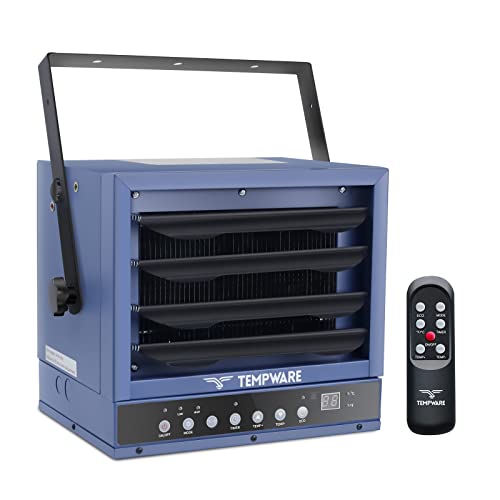
Type: Hardwired 240V Fan-Forced Ceiling Heater. Power Range: 6,250 to 7,500 Watts. This model highlights adjustable louvers, dual heat settings, and built-in safety functions.
Notable features include an adjustable mounting angle, ECO mode with a temperature sensor, programmable 1–12 hour timer, and built-in thermostat. Maximum output claims coverage up to 1,250 sq. ft., with multiple settings to tailor performance.
The heater’s ECO and timer functions help manage runtime and potentially reduce energy usage when full output is unnecessary. Overheat protection and thermostatic control are specified safety elements for continuous operation in a workshop or garage environment.
As with other high-output ceiling units, proper 240V circuits, installation, and clearance planning are required. This model suits homeowners or small-business owners needing higher wattage to heat larger or poorly insulated garage spaces effectively.
Mr. Heater Big Maxx MHU80NG Natural Gas Unit Heater
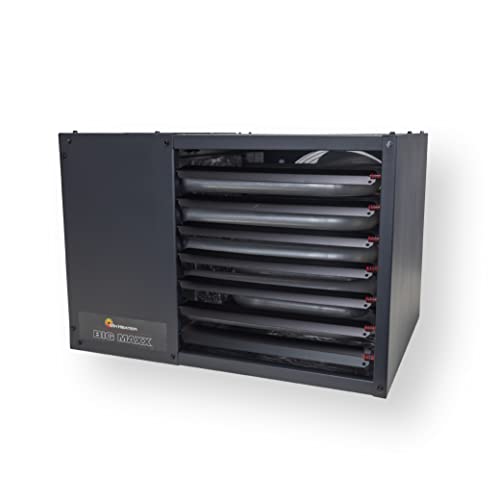
Type: Natural Gas Unit Heater. Output: 80,000 BTU, Coverage Up To 2,000 Sq. Ft. This high-output gas heater is designed for very large garages, commercial bays, or workshops with significant heat loss.
Product highlights include an included LP conversion kit, angle brackets for mounting, and specification details such as dimensions and clearance requirements. The unit is intended for permanent installation with appropriate venting when required by category.
As a gas-fired option, it offers higher BTU output compared with electric counterparts and is suited for spaces where electrical infrastructure may be limiting or where higher heat delivery is necessary. Installation requires gas plumbing, venting considerations, and adherence to local building codes.
Because of clearance and venting needs, this unit is typically selected for large-volume spaces and commercial-style garages rather than small residential setups. Professional installation and setup are essential for safe and efficient operation.
Buying Guide: How To Choose A Garage Floor Heater
Choosing the right heater for a garage floor or overall garage heating depends on several variables: garage size, insulation, electrical capacity, desired installation type, safety features, and control options. Below are key considerations and comparison perspectives.
Heat Output And Coverage
- BTU Or Wattage: For electric heaters, higher wattage means higher heat output; for gas, BTUs measure capacity. Match output to garage volume and insulation level.
- Coverage Estimates: Manufacturers often list square footage. Use these as starting points and increase capacity for poorly insulated spaces or colder climates.
Installation Type
- Ceiling-Mounted Hardwired Units: Free up floor space and distribute heat broadly; require 240V circuits and professional installation.
- Wall-Mounted/Portable Electric: Easier to install and move; limited by standard 120V circuit output and suited for supplemental heating or smaller garages.
- Gas Unit Heaters: Offer high BTU output for large spaces; need gas hookups, venting, and professional installation.
- Underfloor Heating Options: Radiant mats provide warm floors and targeted comfort for specific floor areas but are typically not sized for whole-garage heating.
Control, Convenience, And Energy Use
- Thermostats And Timers: Built-in thermostats and timers help maintain consistent temperatures and reduce runtime.
- Wi‑Fi And Remote Control: Remote activation and scheduling aid convenience and preheating without being in the garage.
- ECO Modes: Automatic cycles and ECO settings reduce energy draw once target temperatures are met.
Safety Features
- Overheat Protection: Shuts down the unit if temperatures exceed safe limits.
- Tip‑Over Switches: Important for portable units to cut power if knocked over.
- Clearance And Mounting Requirements: Adhere to recommended clearances for ceiling, wall, and gas units to avoid fire hazards.
Durability And Environment
- Build Materials: Heavy-gauge steel housings and robust fans are better for workshops and commercial use.
- Moisture And Outdoor Use: Some heaters are rated for indoor/outdoor use; check IP ratings for damp garages or partially exposed bays.
Energy Source And Operating Cost Considerations
- Electric vs. Gas: Electric heaters are simpler to install but may be limited by available circuits. Gas heaters provide high output and may be more practical for very large spaces.
- Running Time: Use thermostatic control and zoning to heat only occupied areas and minimize runtime.
Comparison Perspectives
- Small Garage/Supplemental Heat: Portable wall/floor electric heaters with Wi‑Fi and remote control provide flexibility for spot heating.
- Medium Garage/Whole-Space Even Heat: Hardwired ceiling or wall electric units with higher wattage and adjustable louvers distribute warm air across the floor area.
- Large Garage/Commercial Use: High-BTU natural gas unit heaters or high-wattage ceiling fan-forced electric heaters are designed to handle greater heat loss and larger volumes.
Practical Checklist Before Purchase
- Measure garage volume and assess insulation and sealing quality.
- Confirm electrical capacity (120V vs 240V) or gas availability.
- Decide mounting preference: floor, wall, ceiling, or portable.
- Prioritize safety features and local code requirements for installation.
- Choose control features that match your convenience needs (thermostat, Wi‑Fi, remote).
Use the comparison perspectives and checklist to match heater type and capacity to your garage’s specific heating demands. Proper installation and attention to safety and control features will improve performance and user experience.
Tips for Getting the Best HVAC Prices
- Prioritize Quality Over Cost
The most critical factor in any HVAC project is the quality of the installation. Don’t compromise on contractor expertise just to save money. - Check for Rebates
Always research current rebates and incentives — they can significantly reduce your overall cost. - Compare Multiple Quotes
Request at least three estimates before making your choice. You can click here to get three free quotes from local professionals. These quotes include available rebates and tax credits and automatically exclude unqualified contractors. - Negotiate Smartly
Once you've chosen a contractor, use the proven strategies from our guide — How Homeowners Can Negotiate with HVAC Dealers — to get the best possible final price.