
Finding a reliable garage heater with remote means balancing power, safety, installation type, and controls. Below is a concise comparison of five top garage heaters that include remote control functionality, followed by focused product summaries and a practical buying guide to help match features to your space and needs.
| Product | Installation | Power/Voltage | Remote | Key Safety |
|---|---|---|---|---|
| Comfort Zone CZ230ER | Ceiling Hard-Wired | 7,500W / 240V | Yes | Overheat Protection, Digital Thermostat |
| CTSC 10000W Electric Heater | Ceiling Hard-Wired | 10,000W / 240V | Yes | Overheat Protection, ETL Listed |
| TEMPWARE 7500W Heater | Ceiling Hard-Wired | 7,500W / 240V | Yes | Thermostat, Overheat Protection |
| InoKraft 7500W Heater | Ceiling Hard-Wired | 7,500W / 240V | Yes | ECO Mode, Overheat Protection |
| Barphygo 4800W Heater | Ceiling Plug-In (240V) | 4,800W / 240V | Yes | Thermostat, Overheat Protection, ETL Listed |
Content Navigation
Comfort Zone Ceiling Heater

This ceiling-mounted fan-forced heater is designed for hard-wired installation and aims to maximize floor space in crowded garages. The unit claims coverage up to 1,250 sq. ft. and uses adjustable louvers and a variable mounting angle for targeted airflow.
Key features include a heavy gauge steel body for durability, a digital thermostat, a 12-hour timer, and built-in overheat protection. The remote enables temperature and timer adjustments without direct access to the unit. As a ceiling model, it suits workshops where floor footprint and safety from obstruction are priorities.
CTSC 10000W Garage Heater

The CTSC model is a high-output 10,000W hard-wired heater with a digital thermostat, remote control, and timer. It offers three operating modes: high, low, and fan-only. The unit includes a voltage display to help diagnose low-voltage installation issues during setup.
Call 888-896-7031 for Free Local HVAC Quotes – Compare and Save Today!
Constructed from SPCC cold-rolled steel, the unit is ETL listed and includes overheating protection. The remote plus digital touch panel provide dual control methods. This model is suited for larger, poorly insulated garages or commercial workshop spaces where higher wattage is required.
TEMPWARE Ceiling Shop Heater
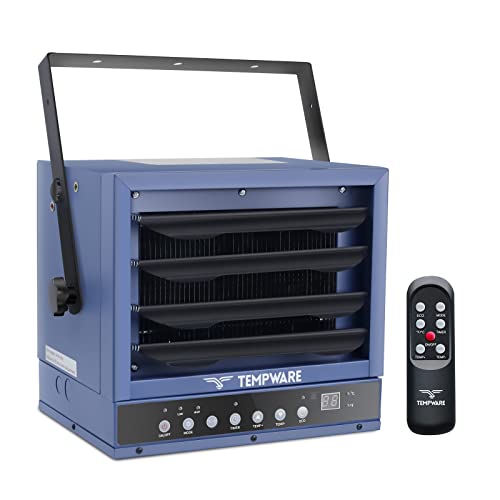
TEMPWARE’s 7,500W ceiling heater provides adjustable louvers, two heat settings, an ECO mode, and a 12-hour timer. The built-in temperature sensor and smart ECO logic automatically adjust operation to maintain set temperatures and reduce energy use.
The unit features a thermostat range and overheat protection. Adjustable mounting and directional louvers help target heat to workbenches or vehicle bays. Remote control allows hands-free adjustments while working in the garage.
InoKraft 7500W Garage Heater

InoKraft’s 7,500W hard-wired heater emphasizes rapid heating performance and quiet operation. It offers two heat settings, a full-range digital thermostat (40°F–95°F), a 12-hour timer, ECO mode, and overheat protection.
Call 888-896-7031 for Free Local HVAC Quotes – Compare and Save Today!
The remote control operates all primary functions. The manufacturer highlights a quiet operating level and an ECO mode that reduces runtime when ambient temperature is near setpoint. This configuration is appropriate for garages where noise and energy management are concerns.
Barphygo 4800W Ceiling Heater

The Barphygo model is a 4,800W ceiling-mounted unit with a plug-in 240V configuration and full-function remote. It provides thermostat control, an 8-hour timer, and ETL listing for safety standards compliance.
This heater is tailored for smaller garages or focused zone heating up to about 400 sq. ft. The lower wattage can be advantageous where full hard-wired installation is not desired or where electrical capacity is limited.
Buying Guide: Choosing The Right Garage Heater With Remote
Selecting a garage heater with a remote requires matching unit capabilities to your space, wiring, and usage patterns. Below are objective factors to weigh before purchase.
Tips for Getting the Best HVAC Prices
- Prioritize Quality Over Cost
The most critical factor in any HVAC project is the quality of the installation. Don’t compromise on contractor expertise just to save money. - Check for Rebates
Always research current rebates and incentives — they can significantly reduce your overall cost. - Compare Multiple Quotes
Request at least three estimates before making your choice. You can click here to get three free quotes from local professionals. These quotes include available rebates and tax credits and automatically exclude unqualified contractors. - Negotiate Smartly
Once you've chosen a contractor, use the proven strategies from our guide — How Homeowners Can Negotiate with HVAC Dealers — to get the best possible final price.
Installation Type
- Hard-Wired Ceiling Mount: Typical for higher-wattage units (7,500W and above). Offers permanent, clutter-free installation but requires professional electrical work for 240V circuits.
- Plug-In 240V: Easier to install if you have a 240V outlet; suitable for mid-range wattage heaters and for renters or temporary setups.
- Portable Plug-In (120V): Lower wattage and mobility; best for small garages or spot heating.
Wattage And Coverage
- Estimate BTU/watt needs relative to square footage and insulation. Higher wattage (7,500W–10,000W) is suited to larger or poorly insulated garages.
- Lower wattage (around 4,800W or 1,500W portable) works for small spaces or supplemental heating.
Controls And Remote Features
- Confirm the remote supports the functions you need: power, temperature setpoint, timer, and mode selection.
- Digital thermostats offer more precise control and energy savings through automated cut-in/out cycles.
Energy Efficiency And Modes
- ECO modes and programmable timers reduce runtime and energy costs by cycling heat or shutting down when set temperatures are reached.
- Multiple heat settings or fan-only modes increase flexibility for shoulder seasons.
Safety Features
- Look for overheat protection, tip-over sensors (for portable units), and ETL/UL listings. These features are important in enclosed garages with combustible materials or vehicle fuels present.
- Durable metal housings and proper clearances reduce fire risk from hot surfaces or blocked airflow.
Noise Levels
- Fan-forced heaters generate noise. If the garage doubles as a workspace, compare noise ratings or manufacturer claims to ensure acceptable sound levels.
Durability And Build
- Cold-rolled steel housings and commercial-grade elements improve durability in harsher environments.
- For uninsulated spaces, consider higher wattage and robust construction designed for temperature extremes.
Installation And Electrical Requirements
- Verify available circuits and breakers. High-wattage units commonly require dedicated 240V circuits and professional installation.
- Voltage indicators on some models can help diagnose supply issues during setup.
Zone Heating Strategy
- Decide Between one large unit versus multiple smaller units for targeted heat. Multiple units allow selective heating of work areas and may reduce overall energy use if you only use part of the garage at a time.
Maintenance And Replacement Parts
- Check availability of replacement parts (elements, fans) and ease of filter or fan maintenance. Hard-wired ceiling units should be mounted where routine checks are accessible.
Comparison Perspectives
- High Output Needs: Choose high-wattage, hard-wired models (e.g., 10,000W) for large, poorly insulated spaces.
- Noise Sensitive: Look for models marketed with lower dB levels or quieter fan operation.
- Energy Conscious: Prioritize ECO modes, programmable timers, and precise thermostats.
- Installation Flexibility: Plug-in 240V options provide easier installation but lower maximum output.