
Choosing the right heater for a garage depends on space, fuel type, installation constraints, and whether you prefer radiant tube heat or forced-air/infrared alternatives. The table below summarizes the five selected units featured in this guide, emphasizing their primary fuel source, output, and best-use scenarios.
| Product | Fuel / Type | BTU / Output | Best For |
|---|---|---|---|
| SunStar Garage Tube Heater – LP (SIR45-15-L) | Liquid Propane Radiant Tube | 45,000 BTU | Radiant heat, low-ceiling installs |
| SunStar Garage Tube Heater – Natural Gas | Natural Gas Radiant Tube | 45,000 BTU | Radiant heat, connected gas supply |
| Mr. Heater Big Maxx MHU50NG | Natural Gas Unit Heater (Forced-Air) | 50,000 BTU | Quick warm-up, ventilated spaces |
| Mr. Heater Big Maxx MHU80NG | Natural Gas Unit Heater (Forced-Air) | 80,000 BTU | Larger garages, high capacity |
| TEMPWARE Electric Garage Heater | Electric Fan-Forced | Up To 25,590 BTU Equivalent (7,500 W) | Hardwired electric shops, zone heating |
Content Navigation
- SunStar Garage Tube Heater – LP, 45,000 BTU
- SunStar Garage Tube Heater – Natural Gas, 45,000 BTU
- Mr. Heater Big Maxx MHU50NG Natural Gas Unit Heater
- Mr. Heater Big Maxx MHU80NG Natural Gas Unit Heater, 80,000 BTU
- TEMPWARE Electric 7500W Ceiling Mount Shop Heater
- Buying Guide: How To Choose The Right Garage Heater
- Heating Method: Radiant Versus Forced-Air Versus Electric Infrared
- Fuel Source And Availability
- Installation And Venting Requirements
- Capacity And Space Sizing
- Efficiency And Operating Costs
- Safety, Clearances, And Local Codes
- Control Options And Convenience
- Maintenance And Serviceability
- Comparison Perspectives
SunStar Garage Tube Heater – LP, 45,000 BTU

This SunStar model is a liquid propane radiant tube heater designed for garage and shop applications where radiant heating is preferred. The unit is listed with an overall length of 110 inches, allowing for straightforward mountings along rafters or ceiling joists. Efficiency is noted up to 84.5%, which reflects the unit’s combustion and heat transfer characteristics for a radiant tube design.
Key installation notes include the minimum mounting height of 8 feet above the floor, which aligns with typical safety and performance recommendations for tube heaters. Radiant tube heaters warm surfaces and people directly rather than heating the entire air volume, which can be advantageous for intermittently used garages where localized warmth is preferred.
Features to consider from the manufacturer listing: compact overall length for installation flexibility, claimed high efficiency, and LP fuel compatibility. Installation requires proper gas supply, venting considerations per local code, and clearance adherence for safe operation.
SunStar Garage Tube Heater – Natural Gas, 45,000 BTU

Call 888-896-7031 for Free Local HVAC Quotes – Compare and Save Today!
This SunStar tube heater shares the same tube-radiant layout and dimensions as the LP unit but is configured for natural gas. It is sized at 45,000 BTU with an overall length of 110 inches, making it suitable for many single-car and smaller two-car garages when used as the primary heating source.
The product notes the same efficiency figure up to 84.5% and the same 8-foot minimum mounting height. As a natural gas model, the heater requires a compatible gas hookup and adherence to venting and clearance codes applicable to category I appliances. Radiant tubes like this are effective at warming vehicles, workbenches, and people without needing to maintain a high ambient air temperature.
When comparing the LP and natural gas versions, fuel availability and connection type are the primary differentiators. Both units emphasize compact tube length for easier ceiling or rafter installation.
Mr. Heater Big Maxx MHU50NG Natural Gas Unit Heater
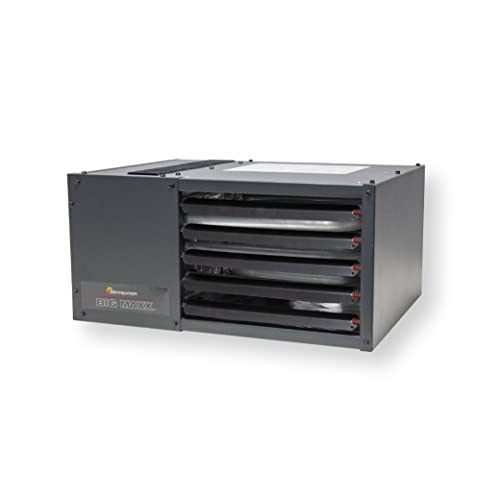
The Mr. Heater Big Maxx MHU50NG is a natural gas forced-air unit heater offering 50,000 BTU output and designed to heat up to around 1,250 square feet, per manufacturer performance notes. Unlike radiant tube heaters, unit heaters use a fan to move warmed air into the space, enabling faster overall air temperature rise.
Notable features include a powered exhaust that allows for vertical or horizontal venting, and external access to thermostat and gas connections for easier service. This unit is more suited when you want rapid warming of the garage air volume rather than direct radiant warmth to objects and people.
Call 888-896-7031 for Free Local HVAC Quotes – Compare and Save Today!
Installation considerations: forced-air units require proper venting, clearance, and thermostat wiring. For garages where air exchange and quick recovery from cold are priorities, a unit heater like this provides a different performance profile compared to tube radiant systems.
Mr. Heater Big Maxx MHU80NG Natural Gas Unit Heater, 80,000 BTU
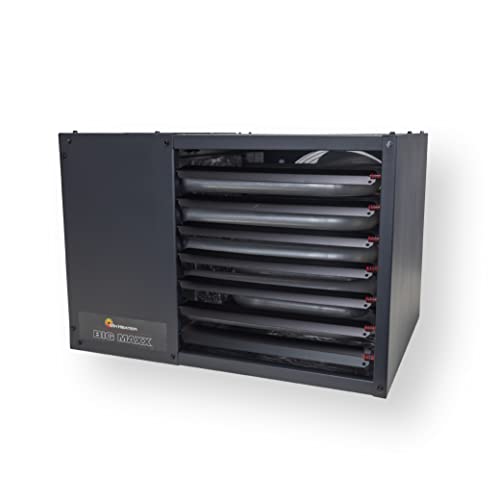
The MHU80NG is a higher-capacity forced-air option from Mr. Heater rated at 80,000 BTU and intended for larger garages or workshop spaces up to approximately 2,000 square feet per the manufacturer’s coverage guidance. The unit supports category 1 vertical and category 3 horizontal venting, offering flexibility for different vent layouts.
Included in the product description are two angle brackets and a conversion kit (when applicable), though items such as thermostat and regulator are not included. The unit’s design emphasizes higher output and flexible venting for larger or poorly insulated spaces where a higher heat delivery is required.
As with other forced-air heaters, expect faster warm-up times for ambient air but less targeted radiant heat compared to tube heaters. Clearance and venting requirements, along with gas supply capability, are key installation points to confirm before purchasing.
TEMPWARE Electric 7500W Ceiling Mount Shop Heater
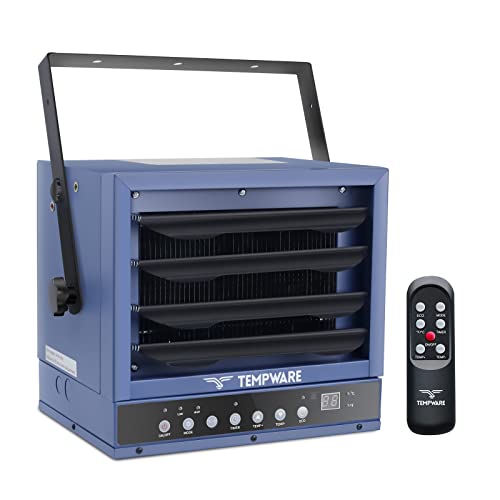
The TEMPWARE 7,500-watt ceiling-mounted unit is a hardwired electric fan-forced heater with adjustable louvers and two heat settings. The manufacturer states maximum output equivalent to about 25,590 BTU and coverage up to approximately 1,250 square feet in typical scenarios.
Built-in features include an adjustable angle, a thermostat with ECO mode, a 12-hour timer, and overheat protection. Electric shop heaters provide predictable electric heat without combustion, venting, or gas hookups, making them suitable for attached garages and workshops with appropriate electrical capacity.
Considerations for electric units include the required 240V hardwiring, amperage available in your electrical panel, and the heater’s ability to deliver continuous heat without the same high peak outputs of gas-fired units.
Buying Guide: How To Choose The Right Garage Heater
This guide covers key considerations to match a heater to your garage use case. Evaluate each factor to determine whether a radiant tube heater or an alternative heater type better fits your needs.
Heating Method: Radiant Versus Forced-Air Versus Electric Infrared
- Radiant Tube Heaters: Heat surfaces and people directly. Effective for zone warming and intermittent use. Good when you want heat on vehicles, benches, or immediate work areas without raising whole-room air temperature.
- Forced-Air Unit Heaters: Use fans to distribute warm air quickly. Better for evenly heating the entire garage volume or larger spaces. Can provide faster warm-up but may lose heat faster with open doors.
- Electric Fan-Forced / Infrared: Electric units are cleaner (no combustion) and simpler to install where 240V service exists. Infrared electric heaters provide radiant warmth; fan-forced electric units move warmed air.
Fuel Source And Availability
- Natural Gas / Propane: Consider local availability, existing hookups, and fuel cost trends. Gas-fired units typically deliver higher BTU outputs and lower operating cost per BTU compared to electric in many regions.
- Electric: Easier installation if 240V hardwiring is already present. No venting required but operating cost depends on local electricity rates.
Installation And Venting Requirements
- Tube Heaters: Require proper clearances, hang points along the tube length, and compliance with combustion air and venting codes.
- Unit Heaters: Often require venting (exhaust), powered exhaust options, or direct-venting. Access to the exterior wall or roof is necessary for safe combustion exhaust.
- Electric Units: Typically require hardwired connection and secure mounting; no combustion venting is needed.
Capacity And Space Sizing
- Match heater output to garage volume, not just floor area. Consider ceiling height, insulation level, door openings, and how often the garage is used.
- Tube heaters are effective for targeted zones and can be sized lower when occupants or work areas are the priority. Forced-air units should be sized to raise and maintain ambient temperature in the whole space.
Efficiency And Operating Costs
- Check listed efficiency numbers where provided for gas units. Higher efficiency reduces fuel consumption for the same heat output.
- Estimate operating cost using local fuel or electricity rates and typical run time. Electric heaters have predictable per-hour costs; gas heaters depend on fuel price fluctuations but often cost less per BTU.
Safety, Clearances, And Local Codes
- Always follow manufacturer clearance specifications (e.g., minimum mounting heights such as 8 feet) and local building and mechanical codes.
- Combustion appliances require appropriate ventilation, carbon monoxide awareness, and sometimes dedicated detectors in attached garages.
Control Options And Convenience
- Consider thermostats, remote controls, timers, and smart integration. Forced-air and electric units often support thermostats and timed operation for energy management.
- Radiant tubes typically pair with wall thermostats or dedicated controls to manage on/off cycles for comfort and efficiency.
Maintenance And Serviceability
- Look for units with accessible controls, easy access to gas and electrical connections, and available replacement parts. Regular maintenance includes combustion inspection for gas-fired units and checking electrical connections for electric heaters.
Comparison Perspectives
- Targeted Comfort: If the goal is to warm people and specific work areas without heating all the air, radiant tube heaters are an efficient choice.
- Whole-Space Heating: For evenly warming an entire garage quickly, forced-air gas heaters deliver higher air turnover and faster ambient temperature rise.
- Clean, Low-Installation Impact: Electric heaters avoid combustion venting and fuel lines, making them easier for attached garages, but verify electrical capacity first.
When selecting a garage heater, weigh the trade-offs between installation complexity, ongoing cost, and the type of heat delivery you need. Consult local HVAC or gas professionals for installation quotes and to confirm code compliance before purchase or installation.
Tips for Getting the Best HVAC Prices
- Prioritize Quality Over Cost
The most critical factor in any HVAC project is the quality of the installation. Don’t compromise on contractor expertise just to save money. - Check for Rebates
Always research current rebates and incentives — they can significantly reduce your overall cost. - Compare Multiple Quotes
Request at least three estimates before making your choice. You can click here to get three free quotes from local professionals. These quotes include available rebates and tax credits and automatically exclude unqualified contractors. - Negotiate Smartly
Once you've chosen a contractor, use the proven strategies from our guide — How Homeowners Can Negotiate with HVAC Dealers — to get the best possible final price.