
Basements need heaters that provide steady, widespread warmth and strong safety features. This guide reviews five heaters suited for large basements, comparing their heat delivery, coverage, installation type, and safety. Use the summary table to quickly compare models and then read short, objective reviews to match a unit to your space and needs.
| Heater | Type | Key Strength |
|---|---|---|
| Dreo Space Heater 25″ (Gold) | Portable Ceramic Tower | Fast airflow & extended range |
| Dreo 1500W Oscillating Space Heater | Portable PTC Ceramic | Balanced coverage with safety features |
| Dreo Oil Filled Radiator | Oil-Filled Radiant Heater | Even, sustained radiant heat |
| Dr Infrared Heater Portable | Infrared + PTC Dual System | Strong output for large rooms |
| Heat Storm HS-1500-PHX-WIFI | Wall-Mounted Infrared | Space-saving, Wi‑Fi control |
Content Navigation
- Dreo Space Heater For Indoor Use, 25″ 11.5ft/s Fast Electric Heater
- Dreo Space Heater, 1500W Electric Heaters With Thermostat
- Dreo Oil Filled Radiator, Electric Radiant Heaters For Large Room
- Dr Infrared Heater Portable Space Heater, Original, 1500-Watt
- Heat Storm HS-1500-PHX-WIFI Infrared Heater, Wifi Wall Mounted
- Buying Guide: Choosing The Right Heater For A Large Basement
Dreo Space Heater For Indoor Use, 25″ 11.5ft/s Fast Electric Heater

This 25″ ceramic tower from Dreo emphasizes fast airflow and an extended impeller to push warm air farther across large rooms. The listed features highlight an 11.5 ft/s airflow rate and a design meant to broaden heat range, which helps distribute warmth in open basement layouts.
- Heat Delivery: High-velocity airflow for quicker warm-up of larger spaces.
- Safety: V0 flame-retardant material, ETL-certified overheat and tip-over protection, reinforced plug, and a child lock.
- Noise: Claimed low noise down to 32 dB, suitable for activity areas and quiet use.
- Best Use: Situations where forced convective heat and rapid room circulation are needed.
Dreo Space Heater, 1500W Electric Heaters With Thermostat

Dreo’s 1500W PTC ceramic heater balances rapid heating with multiple safety measures. The product description notes coverage around 200 sq. ft. and a quiet operation designed to be suitable for bedrooms and larger rooms.
- Heat Delivery: 1500W PTC ceramic element for quick heat; 70° oscillation for wider distribution.
- Safety & Controls: ETL-certified, multiple protections (tip-over, overheat), 12-hour timer, automatic shut-off, and a long flat cord.
- Noise & Comfort: Noise level claimed at ~34 dB; oblique airflow aims to reduce fan noise.
- Best Use: Basements that need a portable heater with timed operation and safety for unattended hours.
Dreo Oil Filled Radiator, Electric Radiant Heaters For Large Room

Call 888-896-7031 for Free Local HVAC Quotes – Compare and Save Today!
The oil-filled radiator provides radiant and convective heat with steady, long-lasting warmth. Its multiple fins and oil medium allow it to maintain temperature and continue dispersing heat after the element cycles off, which can be advantageous in cooler basements with poor insulation.
- Heat Delivery: 1500W with 7 fins for wide, even heat dispersion and sustained warmth.
- Safety: Triple overheat protection, tilt protection, ETL listing, and burn-proof plug.
- Efficiency: Radiant heat suits spaces where maintaining a stable ambient temperature is preferred over fast bursts.
- Best Use: Finished basements or hobby spaces where prolonged, even heating is needed and noise must be minimal.
Dr Infrared Heater Portable Space Heater, Original, 1500-Watt
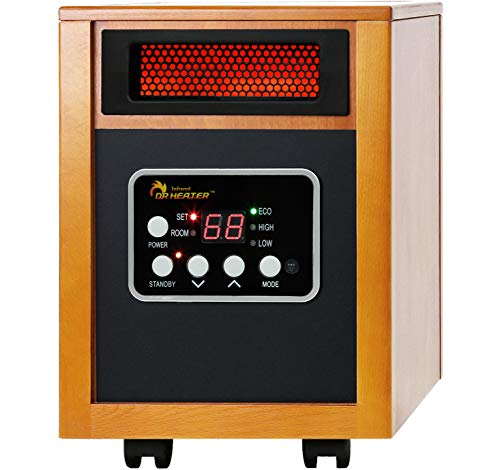
This Dr Infrared model lists a dual heating system (infrared quartz tube + PTC) designed to deliver higher effective heat and deeper warmth useful in larger volumes like basements. The description emphasizes energy-saving modes and a blower to move heat across the room.
- Heat Delivery: Infrared + PTC combination aims to provide both radiant warmth and convective air movement.
- Controls & Runtime: Features high/low settings, auto energy-saving mode, and a 12-hour timer.
- Safety & Noise: Tip-over and overheat protection with a low-noise blower (~39 dB claimed).
- Best Use: Larger basements where a mix of radiant penetration and forced convection helps reach occupants and objects.
Heat Storm HS-1500-PHX-WIFI Infrared Heater, Wifi Wall Mounted

The Heat Storm wall-mounted infrared heater installs on a wall to save floor space and deliver directional radiant heat. Wi‑Fi control and an integrated thermostat allow remote scheduling, which can be helpful for maintaining comfort in an often-unused basement area.
- Heat Delivery: Infrared radiant heating targets people and objects directly rather than only heating air.
- Installation & Space: Wall-mounted design preserves floor area — useful when basements have limited usable floor space.
- Controls & Connectivity: Touchscreen, remote, and Wi‑Fi enable remote scheduling and temperature control.
- Best Use: Basements where wall mounting is possible and targeted radiant heat is preferred over bulk air heating.
Buying Guide: Choosing The Right Heater For A Large Basement
Basements vary by size, insulation, ceiling height, and intended use. Choose a heater after considering coverage, heat type, installation, safety, noise, and controls.
Call 888-896-7031 for Free Local HVAC Quotes – Compare and Save Today!
Tips for Getting the Best HVAC Prices
- Prioritize Quality Over Cost
The most critical factor in any HVAC project is the quality of the installation. Don’t compromise on contractor expertise just to save money. - Check for Rebates
Always research current rebates and incentives — they can significantly reduce your overall cost. - Compare Multiple Quotes
Request at least three estimates before making your choice. You can click here to get three free quotes from local professionals. These quotes include available rebates and tax credits and automatically exclude unqualified contractors. - Negotiate Smartly
Once you've chosen a contractor, use the proven strategies from our guide — How Homeowners Can Negotiate with HVAC Dealers — to get the best possible final price.
Heat Type And Coverage
- Forced Air / Ceramic (PTC): Good for quicker warm-up and circulating heat across open areas. Oscillation helps distribute heat evenly.
- Radiant / Infrared: Heats objects and people directly; efficient in spaces where you want directed warmth or where air exchange is high.
- Oil-Filled Radiator: Provides sustained, even warmth and minimal noise; slower to change temperature but retains heat after cycling off.
- Dual Systems: Infrared + convection combos can provide both penetration and room circulation, useful for larger volumes.
Power And Coverage Metrics
- Wattage: 1500W units are common and effective for many basement zones; larger, poorly insulated basements may need multiple units or supplemental heat sources.
- Square-Foot Guidance: Check manufacturer coverage (often in sq. ft.). For open basements, assume lower effective coverage due to high ceilings and heat loss.
Installation And Space Constraints
- Portable Units: Offer flexibility to move heat where needed; ensure clearance and do not use with extension cords unless specified.
- Wall-Mounted Heaters: Save floor space and provide directed infrared heat; require a suitable wall and mounting for safe operation.
- Permanent Wiring: Some wall models may benefit from professional installation if higher current or dedicated circuits are necessary.
Safety Features
- Tip-Over & Overheat Protection: Essential for basements used as workshops, play areas, or storage.
- Certifications: ETL, UL, or equivalent listings indicate tested safety compliance.
- Child Lock & Flame-Retardant Materials: Useful where children, pets, or flammable materials are present.
Controls, Timers, And Smart Features
- Thermostat Accuracy: A fine-grain thermostat (±1°F where available) helps maintain steady temperatures and reduce cycles.
- Timers & Schedules: Allow preheating before occupancy and reduce energy use when spaces are unused.
- Smart/Wi‑Fi Control: Remote operation and scheduling can be convenient for rarely visited basements or multizone setups.
Noise And Comfort
- Fans And Blowers: Provide faster heat distribution but add noise; check dB ratings if noise matters.
- Radiant Heaters: Often quieter, good for hobby rooms or media spaces in basements.
Energy Efficiency And Operation Costs
- Run Time Strategy: Use thermostats and timers to minimize runtime. Consider zoning with multiple smaller units instead of one oversized unit for better control.
- Insulation And Air-Sealing: Improving basement insulation, sealing drafts, and insulating ductwork provide more effective results than increasing heater size alone.
Multiple Comparison Perspectives
- Quick Warm-Up vs Sustained Heat: Choose ceramic/forced-air heaters for quick bursts; oil-filled or infrared for steady, long-term warmth.
- Portability vs Permanence: Portable units are flexible and lower-commitment; wall-mounted and oil-filled units can be better for continuous, hands-off heating.
- Safety Priority vs Output Priority: In cluttered basements or those with combustible materials, prioritize heaters with multiple safety interlocks and certifications.