
Choosing a heavy duty space heater depends on room size, mounting needs, and power source. The table below summarizes five durable options suitable for garages, workshops, and larger indoor areas. Each selection highlights coverage, power type, and key strengths to help you compare quickly.
| Product | Power / Coverage | Primary Use |
|---|---|---|
| Dura Heat EWH5510 | 5,000W (240V) / Up To 750 sq. ft. | Hard‑wired Garage Heater |
| NewAir 5600W Portable Garage Heater | 5,600W / Up To 600 sq. ft. | Large Garage or Workshop |
| Dura Heat EUH1465 | 1,500W / Portable Forced Air | Workshop Bench Or Jobsite |
| Remington REM-222A-120 | 1,500W / Up To 165 sq. ft. | Portable Jobsite Or Small Workshop |
| BEYOND HEAT Milkhouse | 1,300–1,500W / Indoor Use | Durable Small Workshop Or Garage |
Content Navigation
Dura Heat EWH5510 Electric Garage Heater

The Dura Heat EWH5510 is a high-capacity, hard‑wired electric heater designed for garages and workshops. It provides 5,000W (17,060 BTU) and claims coverage up to 750 sq. ft., making it suitable for two‑car garages or larger work spaces that require sustained heat.
- Power And Installation: Requires 240V / 30A hard‑wiring and professional installation, which suits permanent garage setups.
- Controls: Remote control with an adjustable digital thermostat and LED display, settable between 45–99°F.
- Design: Built for garage environments with a robust enclosure; intended for continuous use when installed properly.
For buyers needing a fixed, high-output solution with remote thermostat control, this unit targets spaces where a hard‑wired heater is acceptable and professional installation is intended.
NewAir 5600W Portable Garage Heater

The NewAir 5600W is a fan‑forced, portable electric heater aimed at large garages and workshops. With 5,600 watts of heating power, the unit is specified to heat spaces up to 600 sq. ft.
Call 888-896-7031 for Free Local HVAC Quotes – Compare and Save Today!
- Construction: Rugged steel body with black powder coat designed to resist scuffs in workshop settings.
- Thermostat & Auto Fan: Built‑in thermostat with auto‑fan control maintains set temperature and cycles as needed.
- Portability: Includes cord wrap and carrying handle for relocation and storage convenience.
This model suits users who want very high output without permanent installation. The fan‑forced design accelerates warm air distribution across larger bay areas or work zones.
Dura Heat EUH1465 Portable Forced Air Heater
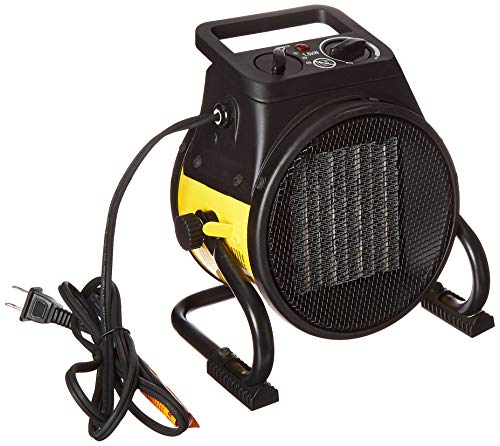
The Dura Heat EUH1465 is a compact forced‑air heater delivering 1,500W (5,120 BTU) via a PTC ceramic element. Designed with a rugged steel body and pivoting base, it fits small workshops, garages, and jobsite benches.
- Heating Modes: Heat mode and fan‑only mode provide flexible use as a heater or an air circulator.
- Durability: Steel construction and a pivoting base allow directional heat while standing up to workshop conditions.
- Application: Best for localized heating or supplemental warmth near a work area.
As a portable forced‑air option, this unit is useful where targeted heat and toughness are priorities without the need for hard‑wiring.
Remington REM-222A-120 Heavy‑Duty Portable Heater

The Remington 1500W heavy‑duty electric heater is specified for portable use at jobsites, workshops, or small garages. It is designed to heat areas up to 165 sq. ft.
Call 888-896-7031 for Free Local HVAC Quotes – Compare and Save Today!
- Performance: Two heat settings plus an adjustable thermostat let users fine‑tune output and efficiency.
- Fast Heat: Heats quickly with a compact footprint for placement near workstations.
- Versatility: Intended for both residential and light commercial use where portability and speed matter.
This option targets users needing a durable, portable heater for close‑range heating at a jobsite or single‑bay workshop.
BEYOND HEAT Milkhouse Durable Space Heater

The BEYOND HEAT Milkhouse unit offers 1,300–1,500W with a built‑in thermostat and three heat settings. It emphasizes safety features like tip‑over and overheat protection, plus an anti‑freeze mode that activates below 40°F.
- Settings: Fan‑only, 1300W, and 1500W modes provide flexibility for year‑round use.
- Safety: Tip‑over switch and internal overheat device are included, and the unit has ETL certification.
- Build: Marketed as heavy‑duty materials for extended service life in garage or workshop environments.
This heater is appropriate for users who want a rugged small‑form option with safety features and multiple modes for varied conditions.
Buying Guide: Choosing A Heavy Duty Space Heater
Selecting the right heavy duty heater requires matching capacity, installation, and safety to your space and use case. The sections below cover the core factors to compare before buying.
1. Heating Capacity And Coverage
Wattage and BTU: Higher wattage or BTU values translate to greater heating capacity. For single‑car garages or small workshops, 1,500W units provide localized warmth. For two‑car garages or 400–750 sq. ft. spaces, 5,000–5,600W hard‑wired or portable units are more appropriate.
Square Footage Estimates: Use manufacturer coverage claims as a starting point, and adjust for ceiling height, insulation, and cold exposure. Poorly insulated spaces require higher output.
2. Power Type: Portable vs Hard‑Wired
Portable Electric Heaters: Plug‑in units (typically 1,500W) offer mobility and plug‑and‑play convenience. They work well for spot heating or temporary jobsite use.
Hard‑Wired Garage Heaters: High‑output 240V models (3,000–5,600W) often require professional installation but deliver sustained heat for large areas. Consider electrical capacity and code requirements.
3. Air Distribution And Fan Design
Fan‑Forced vs Convection: Fan‑forced heaters circulate warm air quickly across a bay or workspace; convection units heat more slowly but can maintain even temperatures. Choose fan‑forced for rapid warming and large open areas.
Directional Control: Pivoting bases or louvers help target heat to workbenches or entry points, reducing wasted output.
4. Durability And Build
Materials: Steel housings and powder‑coat finishes resist dents and abrasion. Look for units designed for workshop or light industrial environments if durability is a priority.
Mounting And Portability: Fixed ceiling/wall heaters free up floor space but need installation. Portable units with handles and cord wraps maximize flexibility.
5. Safety Features And Certifications
Tip‑Over And Overheat Protection: These features are essential in garages and jobsites. Look for automatic shutoff mechanisms and thermal cutoffs.
Certifications: ETL or UL listings indicate compliance with recognized safety standards. Hard‑wired installations may require additional electrical code compliance.
6. Controls And Thermostats
Integrated Thermostats: Digital thermostats and remote controls allow precise temperature management and energy savings. Mechanical thermostats are simpler but less precise.
Auto‑Fan And Timers: Auto‑fan maintains set temperatures more efficiently. Timers add convenience for scheduled operation.
7. Noise Level
Fan Noise: High‑output fan‑forced units produce measurable noise; for workshops this may be acceptable, but if the heater will be used near living areas or offices choose quieter designs or lower fan speeds.
8. Energy Use And Efficiency
Matching Output To Need: Oversized heaters may cycle less efficiently. For spot heating, a smaller portable unit can be more efficient. For whole‑garage heating, higher wattage may be necessary despite greater energy draw.
Thermostat Control: Proper thermostat usage reduces run time and energy consumption.
9. Installation And Electrical Requirements
Circuit Capacity: Confirm your panel and circuit can support the heater’s amperage. Hard‑wired units often require a dedicated 240V circuit and professional installation.
Safety Precautions: Follow manufacturer instructions regarding clearances, grounding, and placement away from flammable materials.
10. Use Case Comparisons
- Spot Heating For A Workbench: Choose a portable forced‑air 1,500W unit with directional controls (e.g., compact Dura Heat EUH1465 or Remington).
- Whole Garage Or Large Workshop: Consider 5,000W+ options (e.g., Dura Heat EWH5510 or NewAir 5600W) for even coverage and sustained output.
- Occasional Indoor Use With Safety Focus: Look for ETL certification and tip‑over protection (e.g., BEYOND HEAT Milkhouse).
Comparing features across these perspectives—capacity, power type, distribution, durability, and safety—will clarify which heavy duty heater best fits your garage, workshop, or jobsite needs.
Tips for Getting the Best HVAC Prices
- Prioritize Quality Over Cost
The most critical factor in any HVAC project is the quality of the installation. Don’t compromise on contractor expertise just to save money. - Check for Rebates
Always research current rebates and incentives — they can significantly reduce your overall cost. - Compare Multiple Quotes
Request at least three estimates before making your choice. You can click here to get three free quotes from local professionals. These quotes include available rebates and tax credits and automatically exclude unqualified contractors. - Negotiate Smartly
Once you've chosen a contractor, use the proven strategies from our guide — How Homeowners Can Negotiate with HVAC Dealers — to get the best possible final price.