
Choosing the right immersion heater for a hot tub requires matching power, safety features, and material compatibility. Below is a concise guide and a comparison table of top immersion heaters suitable for hot tubs, spas, buckets, and small pools.
| Product | Power | Key Feature | Material / Safety |
|---|---|---|---|
| JNICEANTAI 1800W Hot Tub Heater | 1800W | GFCI Plug & Thermostat | 316L Stainless Steel, Auto-reset GFCI |
| JNICEANTAI 3000W 240V Pool Heater | 3000W (240V) | Higher Power For Larger Volumes | 316L Stainless Steel, GFCI |
| Briidea 1500W Titanium Heater | 1500W | Titanium Construction, Wide Temp Range | Titanium, Corrosion Resistant |
| Ostutry 1500W Immersion Heater | 1500W | 15 Presets & LED Temp Display | Thermostat, Dry Burn Protection |
| GRILLME 1000W Heater With Controller | 1000W | Separate Temp Controller, 316L Shell | 316L Stainless Steel, Waterproof |
Content Navigation
JNICEANTAI 1800W Hot Tub Heater
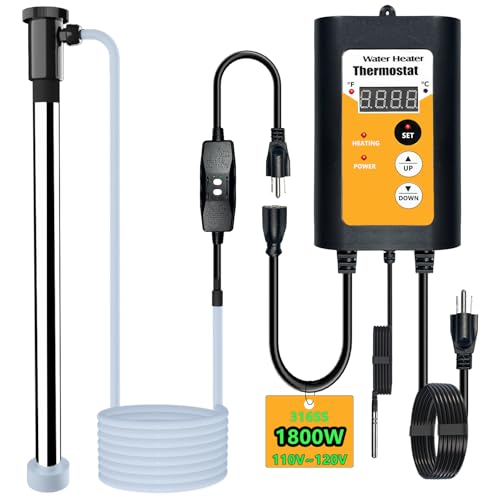
This 1800W immersion heater is designed for tubs, inflatable pools, and small above-ground pools. It features built-in GFCI protection with auto-reset and overload safeguards intended to reduce electrical risk around water. The unit uses 316L stainless steel tubing for improved corrosion resistance and heat transfer. The device is described as fully submersible and includes a thermostat for temperature control. The design emphasizes safety in damp environments and suitability for a variety of water uses.
JNICEANTAI 3000W 240V Pool Heater

The 3000W 240V immersion heater provides higher power intended for larger hot tubs or small pools where faster temperature rise is required. It includes GFCI and overload protection and is constructed from 316L stainless steel for better resistance to salt, chlorine, and corrosion. The heater’s length and power rating make it suitable for more substantial water volumes, but installation requires a compatible 240V supply and proper grounding for metal containers as noted by the manufacturer.
Briidea 1500W Titanium Heater

Call 888-896-7031 for Free Local HVAC Quotes – Compare and Save Today!
The Briidea model uses a titanium heating element, which provides superior corrosion resistance compared with common stainless steels. Rated at 1500W, it includes an intelligent thermostat and corrosion-proof temperature probe for automatic shutoff at the preset temperature. The temperature range spans from freezing to high setpoints, and the manufacturer highlights compatibility with a wide range of liquids, including saltwater and groundwater, making it useful where metal corrosion is a concern.
Ostutry 1500W Immersion Heater

Ostutry’s unit emphasizes user control with 15 built-in temperature presets and a visible LED display for real-time temperature monitoring. The auto-thermostat maintains the set temperature and includes dry-burn protection to shut off if not immersed. At 1500W, it targets typical hot tub volumes and portable tubs. The preset and display features are useful where consistent water temperature monitoring is desired or where multiple users require different temperature setpoints.
GRILLME 1000W Heater With Controller

The GRILLME model is 1000W and is supplied with a separate intelligent temperature controller and probe, suitable for precise temperature adjustment from near-freezing to boiling points. Constructed from 316L stainless steel, it offers superior corrosion resistance relative to 304 stainless steel. The lower wattage is suitable for small tubs or where a slower, controlled temperature rise is acceptable. The temperature probe length and controller allow remote placement for easier monitoring.
Buying Guide: How To Choose The Right Hot Tub Immersion Heater
Selecting an immersion heater for a hot tub involves several technical and safety factors. Below are the main considerations to compare across models.
Call 888-896-7031 for Free Local HVAC Quotes – Compare and Save Today!
Power Rating And Water Volume
Wattage determines how quickly the heater raises water temperature. Higher wattage (e.g., 1800–3000W) produces faster heating for larger hot tubs and small pools. Lower wattage (e.g., 1000–1500W) is better suited for portable tubs, buckets, or slower, controlled heating. Estimate your water volume and choose a wattage that balances heating time and available electrical capacity.
Voltage And Electrical Requirements
Many immersion heaters are 120V (standard household), while higher-power units may require 240V circuits. Check your circuit capacity, required amperage, and whether dedicated circuits or professional installation are necessary. Models with built-in GFCI or external controllers often include additional cord and plug requirements.
Safety Features
Look for GFCI protection, auto-reset overload, and dry-burn protection. GFCI helps prevent electrical shock by cutting power when leakage is detected. Dry-burn or automatic shutoff prevents heating when the element isn’t immersed. Protective covers or anti-scald guards reduce risk of direct contact with the heating element.
Material And Corrosion Resistance
Common sheath materials include 304 stainless steel, 316L stainless steel, and titanium. 316L is more resistant to chlorine and salt than 304. Titanium is highly corrosion-resistant and suitable where saltwater or chemical exposure is expected. Choose material based on water chemistry and longevity needs.
Temperature Control And Monitoring
Thermostats, LED displays, and separate controllers assist in maintaining consistent temperatures. Built-in presets simplify repeated use, while external controllers with long probes allow placement away from heat for safer monitoring. Real-time displays reduce guesswork and can prevent overheating.
Placement And Submersion Design
Confirm that the heater is fully submersible and that manufacturer instructions specify minimum immersion depth. Perforated or guarded covers help dissipate heat and prevent direct contact with the element. Avoid devices not rated for continuous unattended operation and follow recommended maximum run times.
Compatibility With Hot Tub Materials
Metal tubs may require professional grounding. Verify manufacturer notes on use with metal containers. For inflatable or vinyl hot tubs, ensure the sheath material and guard won’t damage the liner and maintain required clearance from flammable materials during operation.
Portability And Use Cases
Consider whether you need a portable unit for travel and camping or a more permanent setup. Portable models prioritize compact size and plug-and-play use, while higher-power and 240V units may be better for semi-permanent or larger-volume applications.
Maintenance And Lifespan
Scale buildup can reduce efficiency on many immersion heaters. Look for models with accessible heating elements or instructions for descaling. Titanium and 316L constructions tend to offer longer service life in corrosive environments.
Multiple Comparison Perspectives
- Speed vs. Efficiency: Higher wattage heats faster but may require more robust electrical supply.
- Durability vs. Cost: Titanium and 316L cost more but resist corrosion better than 304 stainless steel.
- Safety vs. Convenience: Built-in GFCI and auto-reset features improve safety but can add weight and cord complexity.
- Control vs. Simplicity: Units with external controllers offer precision; simple plug-in models are easier to use for occasional tasks.
When comparing models, map your hot tub volume, water chemistry, and electrical capacity to the heater’s power, material, and safety features. Ensure installation follows local electrical codes for water-adjacent appliances.
Tips for Getting the Best HVAC Prices
- Prioritize Quality Over Cost
The most critical factor in any HVAC project is the quality of the installation. Don’t compromise on contractor expertise just to save money. - Check for Rebates
Always research current rebates and incentives — they can significantly reduce your overall cost. - Compare Multiple Quotes
Request at least three estimates before making your choice. You can click here to get three free quotes from local professionals. These quotes include available rebates and tax credits and automatically exclude unqualified contractors. - Negotiate Smartly
Once you've chosen a contractor, use the proven strategies from our guide — How Homeowners Can Negotiate with HVAC Dealers — to get the best possible final price.