
Choosing the right industrial electric heater for a warehouse involves evaluating wattage, mounting, voltage, and safety features. The table below summarizes five well-suited Amazon models selected for commercial and large-space heating needs.
| Product | Type | Power / Voltage | Key Feature |
|---|---|---|---|
| Global Industrial Fan Forced Wall Heater | Wall-Mounted Fan-Forced | 3000/4000W • 208/240V | Built-In Thermostat, Recessed Option |
| Dr Infrared Garage Shop Heater DR-988A | Hard-Wired Shop Heater | 4800/5600W • 208/240V | High Wattage, NEMA 6-30P Cord |
| Comfort Zone Ceiling Mount Heater CZ220 | Ceiling-Mount Fan-Forced | 5000W • 240V | Ceiling Mount, Adjustable Louvers |
| Qmark MUH078 Unit Heater | Self-Contained Unit Heater | 7500W • 208V | Pull-Through Air Design, Thermal Cutout |
| Qmark MUH0541 Unit Heater | Self-Contained Unit Heater | 5000W • 480V | High-Voltage Option, Linear Thermal Cutout |
Content Navigation
- Global Industrial Fan Forced Wall Heater
- Dr Infrared Garage Shop Heater
- Comfort Zone Ceiling Mount Heater
- Qmark 7500W Unit Heater
- Qmark 5000W 480V Unit Heater
- Buying Guide: How To Choose An Industrial Electric Heater For A Warehouse
- 1. Heat Output And Coverage
- 2. Voltage And Electrical Infrastructure
- 3. Mounting Type And Air Distribution
- 4. Safety And Control Features
- 5. Durability And Construction
- 6. Noise And Fan Considerations
- 7. Installation And Maintenance
- 8. Integration With Building Controls
- 9. Energy Efficiency And Operating Costs
- 10. Safety And Code Compliance
- Comparison Perspectives To Consider
Global Industrial Fan Forced Wall Heater

This wall-mounted fan-forced heater is designed for rapid warm-up compared with traditional convection units. It lists dual wattage settings (3000/4000W) and supports 208/240V service, making it adaptable for many commercial electrical systems.
Key listed features include: Quicker Than A Conventional Convection Heater, a Recessed For Optional Space installation option to reduce footprint, and a Built-In Thermostat for localized temperature control. These characteristics suit loading bays, small warehouse offices, and areas where wall mounting is preferred over ceiling or floor units.
Installation implications: wall reinforcement and proper electrical circuit capacity are required. The built-in thermostat supports zone control but check compatibility if integrating with a centralized control system.
Dr Infrared Garage Shop Heater

Call 888-896-7031 for Free Local HVAC Quotes – Compare and Save Today!
The DR-988A is a high-capacity hard-wired shop heater offered in 4800/5600-watt ratings for 208/240V systems. It is targeted at garages, workshops, and smaller warehouse zones that require powerful forced-air heating.
The product listing emphasizes that 240-Volt Is Required and that a Special Outlet (NEMA# 6-30R) is needed for the power cord (NEMA#6-30P plug). The high wattage makes this unit appropriate where quick recovery and higher output are necessary, but it requires compatible electrical infrastructure and an appropriate breaker and receptacle.
From an operational perspective, ensure the facility’s panel can handle continuous load at this rating and that wiring, conduit, and outlet types conform to local codes.
Comfort Zone Ceiling Mount Heater

This ceiling-mounted fan-forced heater is a 5000-watt, 240V unit intended to free floor space while delivering distributed heat. It is described as ideal for workshop & garage environments and lists ETL compliance for safety verification.
Listed features include: Efficient Ceiling Mount to maximize floor use, Robust Steel Construction for durability in fluctuating temperatures, and Precise Heat Distribution via louvers and adjustable mounting angle. The fan-forced design supports more even temperature distribution compared with radiant-only units.
Call 888-896-7031 for Free Local HVAC Quotes – Compare and Save Today!
Considerations include mounting height and airflow direction to avoid heating wasted vertical space. Ceiling mounts are effective for spot heating and minimizing interference with material handling operations.
Qmark 7500W Unit Heater
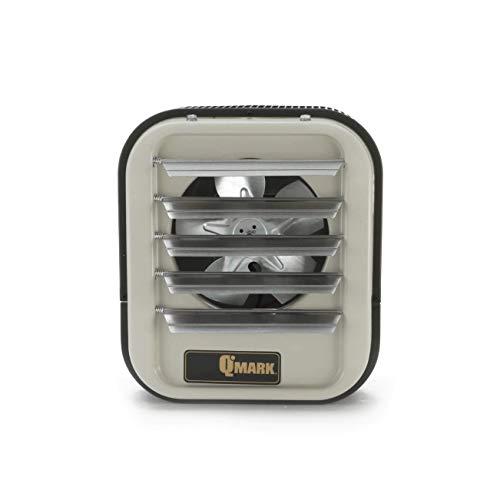
The Qmark MUH078 is a self-contained unit heater rated at 7500 watts, 208V. It uses a pull-through air design to evenly distribute large volumes of heat while maintaining a compact footprint.
Key listed features: Unit Heater Power for high output coverage, Versatile Use that allows stand-alone operation or integration with ductwork, and Safety Features including a linear thermal cutout that protects the full length of the heating element and often a 24V control transformer for safer thermostat wiring.
This style is commonly used in medium-to-large industrial spaces, loading docks, and manufacturing areas where continuous high output and robust protection against overheating are required.
Qmark 5000W 480V Unit Heater
The Qmark MUH0541 is a 5000-watt, 480V self-contained unit heater suitable for facilities with high-voltage distribution. It shares the same pull-through air design and rugged metal construction as other Qmark models.
Highlighted features include the linear thermal cutout for element protection, the option to connect to existing ductwork, and a compact form factor for space-conscious installations. The 480V rating is useful in industrial settings where higher-voltage feeders reduce current and wiring sizes.
Electrical design implications: 480V heaters reduce ampacity requirements but require appropriate transformers or motor control centers for control circuits, and compliance with industrial electrical safety practices.
Buying Guide: How To Choose An Industrial Electric Heater For A Warehouse
Selecting the right heater requires balancing heat output, mounting, electrical capacity, safety features, and operational needs. Below are objective criteria to compare models and plan installation.
1. Heat Output And Coverage
Determine the required BTU or wattage by calculating cubic footage and target temperature rise. Industrial units are commonly rated in watts; higher wattage equals faster heat and larger coverage. For warehouses, consider ceiling height, insulation level, and door openings when estimating needed wattage.
2. Voltage And Electrical Infrastructure
Match heater voltage to site supply: 208/240V is common for medium loads, while 480V suits large facilities where lower current reduces conductor sizing. Confirm panel capacity, breaker sizing, and outlet or hard-wiring requirements (e.g., NEMA 6-30R for some models). Engage a licensed electrician for load calculation and code compliance.
3. Mounting Type And Air Distribution
Options include ceiling-mounted, wall-mounted, and self-contained unit heaters. Ceiling mounts free floor area and distribute heat downwards; wall mounts allow closer control at workstations; self-contained units can stand alone and connect to ducts for targeted distribution. Consider airflow patterns to avoid short-cycling heat into open doors or high ceilings.
4. Safety And Control Features
Look for thermal cutouts, overheat protection, built-in thermostats, and control transformers. Linear thermal cutouts protect heating elements across their length. Low-voltage control transformers (e.g., 24V) improve wiring safety for thermostats. Verify ETL/UL listings or similar certifications for reduced risk in industrial environments.
5. Durability And Construction
Industrial units should have heavy-gauge steel construction and protected motors to withstand dust, temperature swings, and operational impacts. Corrosion-resistant finishes and accessible service panels improve longevity and ease maintenance.
6. Noise And Fan Considerations
Fan-forced units provide rapid heat but introduce noise and air movement. For warehouse operations where noise matters, review fan size and speed options. High-velocity fans help distribution but may not suit quiet office areas within a warehouse.
7. Installation And Maintenance
Assess ease of installation: hard-wired vs. plug-in, mounting complexity, and access for servicing. Units that support duct connections or adjustable louvers allow targeted heating and reduce wasted energy. Plan filter access and periodic inspections for safe operation.
8. Integration With Building Controls
For multi-zone warehouses, consider heaters compatible with central thermostats, digital controls, or building management systems. Low-voltage control transformers simplify integration. Evaluate whether built-in thermostats suffice or if remote control and scheduling are necessary for energy management.
9. Energy Efficiency And Operating Costs
Electric heaters convert electrical energy to heat at close to 100% efficiency, but operating cost depends on local electricity rates and duty cycle. Use zoning, timers, and thermostats to limit run time. For large areas, balance heater placement and insulation improvements to reduce overall energy consumption.
10. Safety And Code Compliance
Confirm local mechanical and electrical code requirements for industrial heaters, including clearances, mounting height, ventilation, and wiring. High-wattage industrial heaters often require dedicated circuits and specialized receptacles or hard wiring; follow manufacturer installation instructions and obtain required permits.
Tips for Getting the Best HVAC Prices
- Prioritize Quality Over Cost
The most critical factor in any HVAC project is the quality of the installation. Don’t compromise on contractor expertise just to save money. - Check for Rebates
Always research current rebates and incentives — they can significantly reduce your overall cost. - Compare Multiple Quotes
Request at least three estimates before making your choice. You can click here to get three free quotes from local professionals. These quotes include available rebates and tax credits and automatically exclude unqualified contractors. - Negotiate Smartly
Once you've chosen a contractor, use the proven strategies from our guide — How Homeowners Can Negotiate with HVAC Dealers — to get the best possible final price.
Comparison Perspectives To Consider
- Output vs. Voltage: Higher wattage increases heat but requires higher current; switching to 480V models may reduce wiring costs through lower amperage.
- Mounting vs. Footprint: Ceiling mounting conserves floor space; self-contained units offer flexibility if duct integration is needed.
- Safety vs. Control: Built-in thermostats and thermal cutouts add protection and simple control; external BMS integration enables scheduling and energy optimization.
- Durability vs. Cost: Heavy-gauge steel, protective motor enclosures, and certified components typically yield longer service life in industrial settings.