
Efficient, Quiet, And Wall-Mountable Options — This guide compares five infrared and panel-style space heaters suited to bedrooms, offices, and living spaces. Below is a quick summary table to help you scan core specs and designs before detailed reviews.
| Product | Type / Wattage | Mounting | Key Feature |
|---|---|---|---|
| Könighaus Infrared Space Heater | 300W / 600W | Wall-Mounted | Powder-Coated Aluminum Frame, 5-Year Warranty |
| Ballu Mica Infrared Space Heater | 1500W | Wall Or Portable (Stand) | Wi‑Fi App Control, Mica Far-Infrared Element |
| SUNKOS Radiant Convection Far-Infrared Heater | Model For Large Rooms (Thermostat) | Portable / No Fan | Flexible Carbon Nano Film, Safety Features |
| NORRUK Wall-Mounted 500W Panel | 500W | Wall-Mounted / Portable Stand | Convection + Writable Surface, Quiet |
| EconoHome Wall Heater Panel With Thermostat | 400W | Wall-Mounted | Convection Panel, Thermostat, cETL Approved |
Content Navigation
- Könighaus Infrared Space Heater
- Ballu Mica Infrared Space Heater
- SUNKOS Radiant Convection Far-Infrared Heater
- NORRUK Wall-Mounted 500W Panel
- EconoHome Wall Heater Panel With Thermostat
- Buying Guide: Choosing An Infrared Panel Heater
- 1. Match Heater Output To Room Size
- 2. Infrared Versus Convection
- 3. Safety Features And Certifications
- 4. Controls, Scheduling, And Smart Integration
- 5. Installation And Mounting Options
- 6. Noise, Air Quality, And Maintenance
- 7. Material, Durability, And Warranty
- 8. Energy Efficiency And Operating Patterns
- 9. Surface Temperature And Touch Safety
- 10. Application-Specific Needs
Könighaus Infrared Space Heater

This model is offered in 300W and 600W variants, intended for small to medium rooms. The unit uses infrared heating to deliver direct radiant warmth rather than relying solely on air circulation.
Key features include high-performance infrared output, maintenance-free operation, and a powder-coated aluminum frame for a low-profile wall-mounted installation. The manufacturer provides a 5-year warranty and a 30-day satisfaction guarantee.
Design factors: the panel emphasizes an unobtrusive look and quick warm-up for near-field comfort. Safety includes over-heating protection. Coverage guidance lists roughly 43–86 ft² for 300W and 86–142 ft² for 600W, useful when matching heater capacity to room size.
Ballu Mica Infrared Space Heater

Call 888-896-7031 for Free Local HVAC Quotes – Compare and Save Today!
The Ballu unit is a higher-power panel at 1500W, intended for larger rooms. It combines mica far-infrared elements with convection effects to provide a wider heat spread and rapid surface warmth in seconds.
Controls: this heater supports remote, onboard digital panel, and Wi‑Fi app control, plus integration with voice assistants like Alexa. Programmable scheduling and thermostat control allow automated operation and targeted energy use.
Durability is emphasized via a long-life mica element and an all-metal body. The product lists a 2-year warranty. Heating behavior targets even distribution and a 180° panoramic pattern to reduce cold spots, suitable for open-plan areas or taller rooms.
SUNKOS Radiant Convection Far-Infrared Heater

This model emphasizes far-infrared technology with a flexible carbon nano heating film designed to produce infrared wavelengths associated with comfortable radiant warmth. It is marketed for performance in larger rooms up to 300 sq ft.
Safety and user features include multiple protections: tip-over shut-off, overheat protection, V0 flame-retardant plug, and an extended power cord. The thermostat supports targeted temperature ranges and quick creation of a local warm zone.
Call 888-896-7031 for Free Local HVAC Quotes – Compare and Save Today!
Because it uses a no‑fan design, the SUNKOS unit operates quietly and with reduced dust circulation. Its construction and safety features make it suitable for households with children or pets where surface temperature and flame retardance are priorities.
NORRUK Wall-Mounted 500W Panel
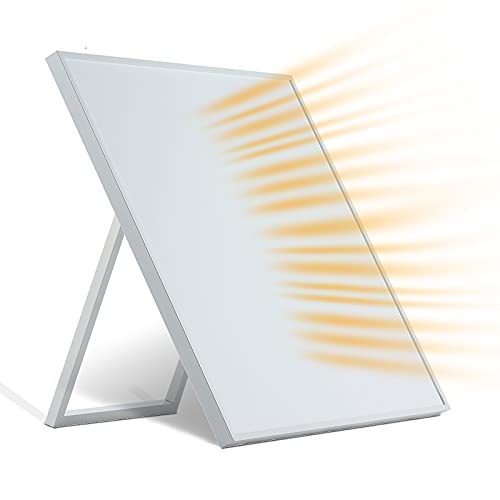
The NORRUK panel is positioned as a quiet convection heater with a 500W rating suitable for rooms around 150 sq ft. It uses a fan-free design to reduce noise and dust movement and to maintain relative humidity.
Multifunctional elements include a portable stand option, overheat protection, and a glossy surface that can serve as a writable or paintable whiteboard for multi-use spaces. The manufacturer highlights energy efficiency and long-term cost reductions.
Performance notes: convection heating produces steady ambient warmth rather than immediate radiant heat, which can be preferable for whole-room comfort and for locations like bedrooms, garages, or offices where quiet operation matters.
EconoHome Wall Heater Panel With Thermostat

The EconoHome panel is a 400W convection heater rated for rooms up to about 120 sq ft. It emphasizes energy savings, claiming substantially lower electricity consumption compared to conventional space heaters.
Built-in features include a thermostat, overheat protection, and cETL approval, with a 3-year manufacturer warranty. The unit provides primarily convective heat with some radiant contribution from the panel surface.
Installation options note potential hard-wiring for permanent wall mounting. The slim profile and low depth suit tight wall spaces. The thermostat range and cETL listing help address safety and regulatory expectations for indoor electric heating.
Buying Guide: Choosing An Infrared Panel Heater
This buying guide covers key considerations when selecting an infrared or panel-style heater, including room size, heating method, controls, safety, and installation. Use these perspectives to match a heater to your needs.
1. Match Heater Output To Room Size
Wattage correlates to heating capacity. As a rule of thumb, estimate 10–20 watts per square foot for maintaining comfort in a typical insulated room. Infrared radiant heaters provide direct warmth to people and objects, while convective panels raise overall ambient air temperature.
2. Infrared Versus Convection
- Infrared (Radiant): Heats objects and occupants directly. Good for spot heating, high ceilings, or drafty spaces where heating the entire air volume is inefficient.
- Convection (Panel): Warms room air gradually for whole-room comfort. Better for sustained ambient temperature and when quiet, dust-free operation is needed.
3. Safety Features And Certifications
Look for overheat protection, tip-over switches for portable units, flame-retardant materials, and recognized safety listings such as cETL, UL, or equivalent certifications. Surface temperature ratings and mesh or protective grills matter for households with children or pets.
4. Controls, Scheduling, And Smart Integration
Thermostats and programmable schedules can significantly reduce energy consumption. Wi‑Fi control and voice assistant compatibility provide remote access and automation for daily routines. Choose units with accurate thermostats for stable temperature control.
5. Installation And Mounting Options
Decide between wall-mounted, hard-wired panels and portable stand units. Wall-mounted panels free floor space and offer discreet integration. Ensure mounting hardware is compatible with wall type and surface, and consider professional installation for hard-wired models.
6. Noise, Air Quality, And Maintenance
Fan-free infrared and convection panels produce minimal noise and do not circulate dust, benefiting allergy sufferers. Check maintenance requirements—many panel heaters are maintenance-free, while fan units may require occasional cleaning.
7. Material, Durability, And Warranty
Materials like powder-coated aluminum or all-metal bodies resist corrosion and improve heat transfer. Check warranty lengths and manufacturer support policies to assess long-term value and reliability.
8. Energy Efficiency And Operating Patterns
Consider how you will use the heater: occasional spot heating favors radiant models with quick warm-up, while continuous occupancy benefits from thermostatic convectors to maintain a steady setpoint. Programmable control reduces runtime and energy costs.
9. Surface Temperature And Touch Safety
Panel surface temperature varies with design—some are warm to the touch while others are engineered to stay cooler. For homes with children or pets, prefer models with lower surface temperatures or protective meshes.
10. Application-Specific Needs
- Bedrooms: prioritize quiet, low-dust convection panels with thermostats.
- Offices / Workspaces: choose quick radiant units or oscillating panels for focused warmth.
- Garages / Workshops: robust, higher-wattage panels with durable construction and safety features.
- Vacation Homes / Intermittent Use: portable models with fast warm-up and app control can be advantageous.
Use the combination of wattage guidance, heating method, controls, and safety attributes to narrow choices. Matching the heater type to your primary use case leads to better comfort and energy outcomes.
Tips for Getting the Best HVAC Prices
- Prioritize Quality Over Cost
The most critical factor in any HVAC project is the quality of the installation. Don’t compromise on contractor expertise just to save money. - Check for Rebates
Always research current rebates and incentives — they can significantly reduce your overall cost. - Compare Multiple Quotes
Request at least three estimates before making your choice. You can click here to get three free quotes from local professionals. These quotes include available rebates and tax credits and automatically exclude unqualified contractors. - Negotiate Smartly
Once you've chosen a contractor, use the proven strategies from our guide — How Homeowners Can Negotiate with HVAC Dealers — to get the best possible final price.