
Mini split heat pump systems combine efficient cooling and heating without ductwork, making them a versatile option for homes, garages, and additions. The table below summarizes five selected mini split units with heater functions, highlighting capacity, voltage, and notable features for quick comparison.
| Product | Capacity | Voltage | Key Features |
|---|---|---|---|
| COSTWAY 12000BTU Mini Split | 12,000 BTU | 115V | Inverter, 5 Modes, Quiet Operation |
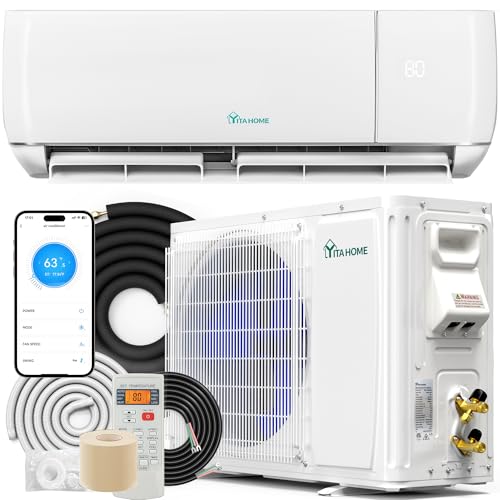
| YITAHOME 12000 BTU Mini Split (WiFi) | 12,000 BTU | 115V | WiFi/Alexa, 5 Modes, ETL/AHRI Certified |
| Mountman 12000 BTU Mini Split | 12,000 BTU | 110/120V | Auto-Maintain, Sleep Mode, Pre-Charged Condenser |
| MRCOOL 18000 BTU Easy Pro | 18,000 BTU | 230V | DIY Friendly, 5th Gen, Covers Up To 800 Sq Ft |
| Oylus 12000 BTU Mini Split | 12,000 BTU | 115V | 19 SEER2, HSPF2 8.5, ECO Mode |
Content Navigation
COSTWAY 12000BTU Mini Split

The COSTWAY 12000BTU Mini Split is a wall-mounted ductless unit with integrated heat pump functionality designed for rooms up to about 750 sq. ft. Its inverter compressor adjusts speed to reduce cycling, which supports energy efficiency and longer equipment life.
Key operational modes include auto, cool, dry, heat, and fan, plus four fan speeds and special modes such as sleep, ECO, iFEEL, and turbo. The included remote offers a 0.5–24 hour timer and a display that automatically turns off after inactivity to avoid sleep disturbance. The product listing cites AHRI pre-charged condenser compatibility, simplifying installation in many retrofit scenarios.
Performance claims focus on efficient year-round comfort, while the inverter design emphasizes steady temperatures and reduced power spikes. The unit notes quiet operation, which is useful in bedrooms or offices where noise is a consideration.
YITAHOME 12000 BTU WiFi Enabled
Call 888-896-7031 for Free Local HVAC Quotes – Compare and Save Today!
The YITAHOME 12000 BTU model pairs inverter heat pump performance with smart connectivity. It supports WiFi control and Alexa integration, enabling remote scheduling and voice commands through supported ecosystems.
Designed for spaces up to 750 sq. ft., the unit is ETL and AHRI certified, offering documented efficiency and safety compliance. Operational modes include auto, cool, dry, heat, and fan, plus advanced features such as automatic defrost, self-cleaning, iFEEL temperature sensing, and a 24-hour timer for programmable operation.
The product highlights low noise performance (below 41 dB) and a built-in HEALTH mode with negative ions, electrostatic dust removal, and PM2.5 filtration, targeting improved indoor air quality alongside thermal comfort.
Mountman 12000 BTU Mini Split

The Mountman 12000 BTU system emphasizes year-round reliability with functions like auto defrost, high-temperature self-cleaning, and a washable anti-dust filter. It targets low-maintenance operation for seasonal transitions.
Available modes include cool, heat, dry, and fan, with four fan speeds and an ECO mode claimed to save up to 30% energy. The listing highlights an ultra-quiet sleep mode at 26 dB and a turbo boost for faster temperature changes. The condenser is pre-charged, which can simplify installation when paired with the included kit.
Call 888-896-7031 for Free Local HVAC Quotes – Compare and Save Today!
Mountman notes operation to low ambient temperatures (auto defrost engaging down to -4°F), an important specification when selecting systems for cold climate use or unconditioned spaces.
MRCOOL 18000 BTU Easy Pro Series

The MRCOOL Easy Pro 18000 BTU is positioned for larger spaces up to roughly 800 sq. ft. and is part of a DIY-capable line designed for simplified installation by qualified homeowners or contractors.
This fifth-generation ductless mini split includes both heating and cooling heat pump functionality. The higher capacity and 230V voltage accommodate larger rooms or open-plan living spaces where a 12,000 BTU unit may be undersized. The listing emphasizes the system as an all-season HVAC solution suitable for home, office, or light commercial settings.
MRCOOL’s product literature often focuses on installer-friendly features, pre-charged linesets in some SKUs, and compatibility with common controls; check specific package contents for included installation materials and local electrical requirements.
Oylus 12000 BTU Mini Split

The Oylus 12000 BTU unit highlights higher efficiency metrics with a 19 SEER2 cooling rating and an HSPF2 8.5 heating performance indicator. These values suggest improved seasonal efficiency compared to lower-SEER models.
The listing cites an operating temperature range from 61°F to 88°F and ECO mode for reduced energy use. Control is via included remote with a 24-hour timer and LED display that can be disabled at night. The system targets energy-saving comfort for spaces up to 750 sq. ft.
Oylus stresses efficiency gains up to 36% over traditional models, referencing inverter technology that modulates compressor speed. The product is positioned for owners prioritizing energy performance and consistent indoor temperature control.
Buying Guide: How To Choose A Mini Split With Heater
Selecting the right mini split heat pump involves matching capacity, efficiency, features, and installation requirements to your space and usage patterns. Below are objective factors to compare.
Tips for Getting the Best HVAC Prices
- Prioritize Quality Over Cost
The most critical factor in any HVAC project is the quality of the installation. Don’t compromise on contractor expertise just to save money. - Check for Rebates
Always research current rebates and incentives — they can significantly reduce your overall cost. - Compare Multiple Quotes
Request at least three estimates before making your choice. You can click here to get three free quotes from local professionals. These quotes include available rebates and tax credits and automatically exclude unqualified contractors. - Negotiate Smartly
Once you've chosen a contractor, use the proven strategies from our guide — How Homeowners Can Negotiate with HVAC Dealers — to get the best possible final price.
Capacity And Room Sizing
- Calculate square footage of the space to be conditioned. Typical guidance: 9,000–12,000 BTU for spaces up to ~750 sq. ft., 18,000 BTU for larger rooms up to ~800 sq. ft., but confirm with load calculations for accuracy.
- Consider ceiling height, insulation, window area, and sun exposure; these affect the effective load and may require upsizing.
Voltage And Electrical Requirements
- Smaller 12,000 BTU units often operate on 115/120V, compatible with standard circuits. Larger units (e.g., 18,000 BTU) may require 208/230V service and dedicated breakers.
- Verify the electrical supply at the installation location and consult an electrician for panel upgrades or dedicated lines.
Efficiency Ratings
- SEER2 (Seasonal Energy Efficiency Ratio) measures cooling efficiency; higher numbers indicate lower operating costs during cooling seasons.
- HSPF2 (Heating Seasonal Performance Factor) indicates heating efficiency for heat pumps. For heating-first applications, prioritize higher HSPF2 values.
- Inverter compressors provide modulation for steady temperature control and improved part-load efficiency.
Cold-Climate Performance
- Check the low ambient heating capability and whether the unit includes a reliable auto-defrost mode. Some models specify functionality down to single-digit Fahrenheit or below.
- Defrost strategies and cold-start behaviors influence actual heating performance in colder regions.
Controls, Connectivity, And Indoor Air Quality
- Smart features such as WiFi and voice assistant compatibility enable remote scheduling and integration with home automation.
- Look for air filtration features or modes that reduce particulates (PM2.5), ionization, or electrostatic filtration if indoor air quality is a priority.
Noise Levels
- Check decibel ratings for indoor unit operation, particularly for bedrooms or office spaces. Values under ~40 dB are generally considered quiet for many interiors.
Installation And Warranty Considerations
- Confirm whether the system includes a pre-charged condenser and installation kit, which can simplify installation and lower labor time.
- Verify warranty terms for compressor, parts, and labor. Some DIY-capable brands offer support documentation tailored to homeowner installations; professional installation may be required for warranty validity.
Maintenance And Long-Term Operation
- Consider models with self-cleaning or washable filters to reduce routine maintenance effort.
- Look for features like automatic defrost and anti-mold cycles to maintain performance and indoor air quality across seasons.
Comparison Perspectives
- Capacity Perspective: Choose larger BTU units for open layouts; smaller units suffice for single rooms or well-insulated areas.
- Efficiency Perspective: Higher SEER2/HSPF2 yields lower operating costs; prioritize if runtime or utility costs are major concerns.
- Feature Perspective: If smart home integration or advanced filtration is essential, prefer WiFi-enabled or HEALTH-mode units.
- Installation Perspective: For DIY or limited contractor access, select systems marketed with easy-install features or pre-charged linesets; for complex installs, plan for professional HVAC services.