
The following guide compares popular oil-filled radiator heaters with thermostats so you can choose the right model for bedrooms, living rooms, or offices. Below is a quick summary of the selected units and their standout traits.
| Model | Brand | Key Feature |
|---|---|---|
| Dreo Oil Filled Radiator | Dreo | Digital Thermostat, Remote, Eco Mode |
| Amazon Basics Oil Space Heater | Amazon Basics | Adjustable Thermostat, 3 Heat Settings |
| De’Longhi EW7707CM | De’Longhi | ComfortTemp Feature, Thermal Slot Design |
| De’Longhi Dragon TRD40615E | De’Longhi | Digital Controls, 24-Hour Timer |
| PELONIS Champagne Oil Heater | PELONIS | Multiple Temperatures, ECO Mode |
Content Navigation
Dreo Oil Filled Radiator

The Dreo oil-filled radiator is a 1500W unit designed for whole-room warmth. Key safety features include triple overheat protection, tilt detection, and ETL listing. The unit has a digital thermostat and an eco mode to maintain set temperatures with reduced cycling. The product lists a 24-hour timer, remote control, and child lock for unattended operation.
Performance claims emphasize a 360° dispersion with seven fins for faster heat distribution and quiet operation. For users prioritizing automated temperature maintenance, the Dreo’s sensors and algorithms are designed to minimize fluctuations. The combination of safety features and programmable modes makes this model suitable for bedrooms and living rooms where steady ambient heat and unattended operation are desired.
Amazon Basics Oil Space Heater

The Amazon Basics radiator offers three heat settings (1500W/900W/600W) and an adjustable thermostat for basic temperature control. Its seven oil-filled fins are intended to preserve heat longer once the unit is turned off, leveraging thermal mass for sustained warmth.
Call 888-896-7031 for Free Local HVAC Quotes – Compare and Save Today!
Safety features include tip-over protection and an ETL safety certificate. The design focuses on straightforward controls and reliable radiant heat distribution, making it appropriate for users seeking simple, low-maintenance operation with manual thermostat adjustment. The unit’s efficiency is supported by the retained heat characteristic of oil-filled radiators.
De’Longhi EW7707CM

The De’Longhi EW7707CM emphasizes energy management via its ComfortTemp feature that automatically adjusts power to maintain target temperatures. De’Longhi notes this can improve efficiency compared to running at maximum thermostat settings continuously.
Controls are described as simple, with a thermal slot design that aims to increase airflow while reducing surface temperature. The model is positioned for users prioritizing regulated energy usage and passive safety; the lower external surface temperature may be relevant for homes with children or pets where contact safety is a consideration.
De’Longhi Dragon Digital
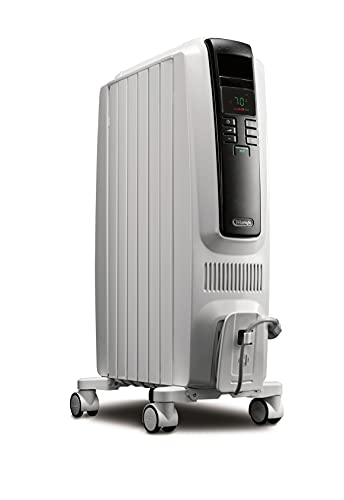
The De’Longhi Dragon TRD40615E features a digital control panel with LED display and a 24-hour programmable timer, allowing precise scheduling. De’Longhi highlights a unique radiator design that increases radiant surface area for more effective heat transfer.
Call 888-896-7031 for Free Local HVAC Quotes – Compare and Save Today!
This model targets users who value digital programmability and rapid heat distribution from an oil-filled platform. The timer and digital settings enable tailored runtime and temperature profiles, helpful for maintaining comfort per daily routines without constant manual adjustment.
PELONIS Champagne Oil Heater

The PELONIS Champagne model provides three heat modes and five temperature settings ranging from 65°F to 85°F, plus an ECO mode intended to optimize energy usage based on ambient conditions. The manufacturer emphasizes 360° circulation and caster wheels for mobility.
Key attributes include adjustable thermostat control and features aimed at balancing energy efficiency with consistent warmth. The inclusion of a distinct ECO mode and multiple temperature presets can benefit users who need flexible temperature profiles across different rooms or occupancy levels.
Buying Guide
The following considerations help compare oil-filled radiator heaters with thermostats across performance, safety, and usability.
Heating Power And Room Size
Match the heater’s wattage and design to the room size. Most listed models operate up to 1500W, suitable for small to medium rooms. For larger spaces, consider portable positioning or multiple units. Check manufacturer guidance on recommended room coverage when available.
Thermostat Type And Control
Thermostats vary from basic adjustable knobs to digital thermostats with sensors and timers. Digital thermostats and programmable timers provide finer control and better temperature maintenance, while manual knobs are simpler and can be more durable.
Energy Efficiency Features
Look for eco modes, auto power modulation, and thermal sensors. Devices that modulate power to maintain a set temperature typically reduce runtime at maximum power, which can lower energy consumption over extended use.
Heat Distribution And Design
Count the fins and examine any manufacturer claims about surface area or slot designs. More fins and increased radiant surface area can enhance steady heat distribution. Consider units that balance heat transfer with lower external surface temps if safety is needed.
Safety Features
Essential safety features include overheat protection, tip-over switch, and third-party listings (ETL/UL). If the heater will be used around children or pets, seek units with reduced surface temperatures and stable bases.
Noise And Operation
Oil-filled radiators are commonly quieter than fan-based heaters because they use convection and radiant heat. If silent operation is important for bedrooms or study areas, prioritize units advertised as whisper-quiet or fanless.
Mobility And Placement
Consider weight, caster wheels, and carrying handles for moving the unit between rooms. Also check dimensions and clearance recommendations to avoid blocking airflow or creating hot-spot risks near furniture.
Controls And Usability
Remote controls, LED displays, timers, and child locks improve usability for scheduled or unattended operation. Simpler controls may be preferable for users who want straightforward manual adjustments.
Maintenance And Longevity
Oil-filled radiators are sealed and generally maintenance-free regarding the heat medium. Compare build materials, warranty coverage, and brand support for long-term serviceability.
Comparison Perspectives
- Price vs. Features: Basic models with manual thermostats often cost less but lack programmability. Digital models add scheduling and sensors for precise control.
- Efficiency vs. Comfort: Units with eco modes and modulation aim for efficiency; models that emphasize larger radiant surface area may provide more even perceived warmth.
- Safety vs. Surface Temperature: Some designs focus on minimizing external temperature; others prioritize maximum radiant output. Choose based on household safety needs.
- Portability vs. Stability: Caster wheels and handles aid portability; wider bases and heavier designs may offer improved stability.
When selecting an oil-filled radiator heater with a thermostat, weigh room size, desired control precision, and safety requirements. Review product specifications for wattage, thermostat type, and protective features to choose the model that matches your use case and schedule.
Tips for Getting the Best HVAC Prices
- Prioritize Quality Over Cost
The most critical factor in any HVAC project is the quality of the installation. Don’t compromise on contractor expertise just to save money. - Check for Rebates
Always research current rebates and incentives — they can significantly reduce your overall cost. - Compare Multiple Quotes
Request at least three estimates before making your choice. You can click here to get three free quotes from local professionals. These quotes include available rebates and tax credits and automatically exclude unqualified contractors. - Negotiate Smartly
Once you've chosen a contractor, use the proven strategies from our guide — How Homeowners Can Negotiate with HVAC Dealers — to get the best possible final price.