
Keeping a greenhouse warm during cold months requires reliable, controllable heating. Below is a quick comparison table of five top-rated greenhouse heaters chosen for their thermostats, safety features, and heating modes.
| Product | Brand | Power / Modes | Key Feature |
|---|---|---|---|
| Greenhouse Heater With Thermostat | SOSUNLID | 1500W | Auto temperature control kit with digital thermostat |
| Buyplus Greenhouse Heater | Buyplus | 1500W | Digital thermostat with waterproof probe |
| Greenhouse Heater With Digital Thermostat | Joanolga | 1500W / Fan mode | Two modes, low noise |
| LHUKSGF 3-Mode Greenhouse Heater | LHUKSGF | 20W / 750W / 1500W | Three-stage PTC ceramic heating |
| 1500W Greenhouse Heater With APP | SwSun | 1500W, smart control | Wi‑Fi app control and alerts |
Content Navigation
- SOSUNLID Greenhouse Heater With Thermostat
- Buyplus 1500W Heater With Digital Thermostat
- Joanolga 1500W Heater With Two Modes
- LHUKSGF 3-Mode PTC Ceramic Heater
- SwSun 1500W Smart Heater With APP Control
- Buying Guide: How To Choose A Greenhouse Heater
- Heating Capacity And Coverage
- Power Levels And Energy Management
- Thermostat Accuracy And Control Type
- Safety Features
- Heating Element And Technology
- Noise And Ventilation Needs
- Installation And Mounting Options
- Remote Monitoring And Alerts
- Durability And Weather Resistance
- Comparison Perspectives
- Practical Tips For Setup
SOSUNLID Greenhouse Heater With Thermostat

The SOSUNLID unit is a 1500W heater sold as an integrated kit that includes a digital thermostat. The thermostat enables automatic temperature control by switching the heater on and off to maintain a setpoint.
Advertised heating capability covers up to about 120 sq ft. The heater has a fast warm-up profile, with the fan and heating element designed for rapid heat delivery and adjustable wind speed for circulation.
Built for safety, the unit uses fireproof materials and includes over-temperature protection. The thermostat supports up to 15A appliances, which aligns with the 1500W power draw typical for household circuits.
Buyplus 1500W Heater With Digital Thermostat

Call 888-896-7031 for Free Local HVAC Quotes – Compare and Save Today!
Buyplus offers a 1500W greenhouse heater paired with a digital thermostat and a waterproof temperature probe for accurate ambient sensing. The thermostat range is adjustable from 40°F to 108°F (5°C–42°C).
Manufacturer claims indicate coverage up to approximately 215 sq ft, reflecting a wide-area output for insulated greenhouses or sheltered patios. The unit features 3-second rapid heating and an auto cut-off thermal protector.
Safety is emphasized via a self-resetting heat breaker which interrupts power at internal over-temperature and restores operation once safe. The device is described as multi-use for patios, garages, and grow tents.
Joanolga 1500W Heater With Two Modes

Joanolga supplies a 1500W heater featuring dual modes: fan-only (20W) for circulation and fan+heater (1500W) for active heating. The heater is rated to warm roughly 150 ft² and emphasizes low noise performance.
The included digital thermostat connects to the heater using a corded plug and allows the same 40°F–108°F control window. An internal temperature limiter provides overheat protection that shuts down the unit if thresholds are reached.
Call 888-896-7031 for Free Local HVAC Quotes – Compare and Save Today!
This model is positioned for greenhouse and patio use where an occasional fan-only mode is helpful for ventilation during milder weather, while the full output engages when temperatures drop.
LHUKSGF 3-Mode PTC Ceramic Heater
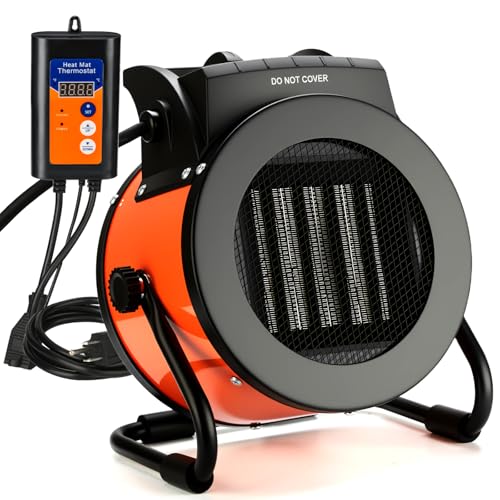
LHUKSGF provides an advanced option with three output stages (20W, 750W, 1500W) using PTC ceramic technology. This enables finer control over energy use and temperature ramp-up for different greenhouse sizes.
Temperature setpoints are adjustable between 40°F–108°F (5°C–42°C). The PTC ceramic element heats rapidly and is known for stable temperature output and inherent safety characteristics, such as reduced overheating risk.
Because of the multi-stage outputs, this model is adaptable to seasonal changes and can reduce energy consumption by operating at 750W when full power is unnecessary.
SwSun 1500W Smart Heater With APP Control

SwSun markets a Wi‑Fi enabled 1500W heater with app control for remote temperature adjustments and real-time monitoring. Users can set high/low alerts and receive notifications if conditions fall outside set thresholds.
Safety protections include overheat shutoff and tip-over protection. The app integration supports scheduling and threshold-based automation, suitable for growers who need remote oversight of greenhouse conditions.
Smart control allows more active management of day/night cycles and quick alerts to intervene if a heater trips or environmental changes occur due to weather or power issues.
Buying Guide: How To Choose A Greenhouse Heater
Selecting the right greenhouse heater depends on space size, insulation quality, control needs, and safety features. Below are key considerations and comparison perspectives to evaluate models objectively.
Heating Capacity And Coverage
Estimate the greenhouse volume (square footage × height) and choose a heater rated to maintain desired temperatures for that volume. Manufacturers often state approximate coverage in square feet; compare those claims against insulation levels and local temperature lows.
Power Levels And Energy Management
Look for multi-stage outputs (example: 750W/1500W) if you need seasonal flexibility. Multi-stage or adjustable power saves energy by matching output to heat loss rather than running at full capacity continuously.
Thermostat Accuracy And Control Type
Thermostat precision matters for plant health. Options include basic digital thermostats, waterproof probe sensors, and smart Wi‑Fi control. Probe-sensing thermostats often provide more accurate ambient readings than built-in sensors alone.
Safety Features
Essential protections include overheat shutoff, tip-over protection (if portable), and IP-rated moisture resistance for humid environments. Look for fire-resistant housing and automatic reset breakers for added safety.
Heating Element And Technology
PTC ceramic elements heat quickly and maintain stable output with lower overheating risk. Infrared models heat objects and plant surfaces directly and can be efficient for targeted heating. Fan-forced heaters distribute warm air quickly for whole-space warming.
Noise And Ventilation Needs
Consider units with a fan-only mode for air circulation without heating. Lower-noise units are preferable for adjacent living spaces. Proper air circulation prevents cold spots and reduces humidity-related issues.
Installation And Mounting Options
Decide between portable units and fixed installations. Wall-mount or ceiling-mount options free floor space and may offer safer placement away from plants. Check cord length and mounting hardware compatibility for your greenhouse structure.
Remote Monitoring And Alerts
Smart models with app alerts can notify you of temperature excursions, power loss, or device faults. Remote control is useful for remote properties or growers who travel frequently.
Durability And Weather Resistance
Choose heaters with appropriate IP ratings if exposed to condensation or occasional wet conditions. Durable housings and dustproof designs increase longevity in greenhouse environments.
Tips for Getting the Best HVAC Prices
- Prioritize Quality Over Cost
The most critical factor in any HVAC project is the quality of the installation. Don’t compromise on contractor expertise just to save money. - Check for Rebates
Always research current rebates and incentives — they can significantly reduce your overall cost. - Compare Multiple Quotes
Request at least three estimates before making your choice. You can click here to get three free quotes from local professionals. These quotes include available rebates and tax credits and automatically exclude unqualified contractors. - Negotiate Smartly
Once you've chosen a contractor, use the proven strategies from our guide — How Homeowners Can Negotiate with HVAC Dealers — to get the best possible final price.
Comparison Perspectives
- Cost Efficiency: Multi-stage heaters typically use less energy than single-stage full-power units when managed correctly.
- Reliability: Simple thermostats and PTC elements often require less maintenance than complex smart systems.
- Control Flexibility: Smart heaters offer remote oversight but rely on network stability; wired thermostats avoid connectivity dependence.
- Safety Tradeoffs: Infrared and ceramic heaters can be safer for direct plant exposure than open-element heaters.
Practical Tips For Setup
- Place the thermostat probe away from direct heater airflow to avoid false readings.
- Ensure adequate ventilation to prevent humidity buildup when heating overnight.
- Use a dedicated circuit for high-power units to avoid tripping breakers shared with other equipment.
- Confirm mounting clearances recommended by the manufacturer to reduce fire risk.