
Choosing the right overhead shop heater depends on fuel type, mounting, coverage, and safety features. The table below summarizes five top options that suit ceiling or overhead installation in garages, shops, and workshops.
| Product | Type | Power / Output | Mount |
|---|---|---|---|
| Mr. Heater Big Maxx MHU80NG | Natural Gas Unit Heater | 80,000 BTU | Ceiling/Wall (overhead) |
| CTSC 10000W Electric Garage Heater | Electric Fan-Forced | 10000W | Hardwired Ceiling/Wall |
| Comfort Zone CZ220BK | Electric Fan-Forced | 5000W | Ceiling Mount |
| VEVOR 10000W Electric Garage Heater | Electric Fan-Forced | 10000W | Ceiling/Wall Mount |
| TEMPWARE 7500W Electric Heater | Electric Fan-Forced | 6250–7500W | Ceiling Mount |
Content Navigation
- Mr. Heater Big Maxx MHU80NG Natural Gas Unit Heater
- CTSC 10000W Electric Garage Heater With Digital Thermostat
- Comfort Zone Ceiling Mount 5000W Fan-Forced Heater
- VEVOR 10000W Hardwired Wall/Ceiling Mount Shop Heater
- TEMPWARE 7500W Ceiling Mount Shop Heater With Timer
- Buying Guide: Choosing An Overhead Shop Heater
- Heat Source: Electric Vs Gas
- Mounting And Placement
- Coverage And Output
- Controls, Thermostat, And Scheduling
- Installation And Electrical Requirements
- Safety Features And Certifications
- Noise, Airflow, And Heat Distribution
- Energy Efficiency And Operating Cost
- Durability And Environment
- Comparison Perspectives
Mr. Heater Big Maxx MHU80NG Natural Gas Unit Heater
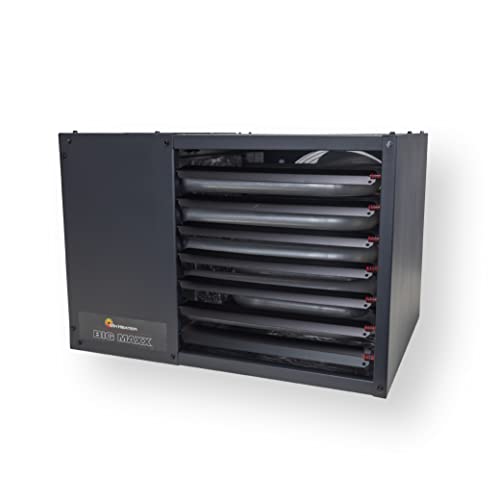
This natural gas unit heater is designed for large open areas, offering 80,000 BTU output and coverage up to 2,000 sq. ft. The unit ships with two angle brackets and a propane conversion kit (thermostat, hose, and regulator are not included). It supports category 1 vertical and category 3 horizontal venting, with a required minimum 8 ft clearance from floor to base.
Key installation considerations include fuel hookup (natural gas) and venting orientation. Electrical draw is minimal (120V, 2.3 amps) because combustion provides heat. The heater’s dimensions (approx. 29.33” L x 15.50” W x 26.37” H) and mounting brackets allow for overhead placement in commercial or large residential garages. This option suits users needing a high-output, gas-powered overhead heater for large spaces.
CTSC 10000W Electric Garage Heater With Digital Thermostat

This 10000W electric fan-forced heater is designed for hardwired ceiling or wall installation in workshops. Notable features include a digital thermostat, remote control, timer, ECO mode, and a voltage display to help diagnose improper installation voltage. The unit is ETL listed and constructed from SPCC cold-rolled steel for durability.
Call 888-896-7031 for Free Local HVAC Quotes – Compare and Save Today!
The heater offers three operating modes (high, low, fan-only) and provides integrated safety via overheating protection. The voltage display is useful for installers and troubleshooting; fans may underperform at voltages below 208V, so verifying supply is important. This unit targets users who want strong electric heating and built-in control features for overhead mounting in medium to large spaces.
Comfort Zone Ceiling Mount 5000W Fan-Forced Heater

The Comfort Zone CZ220BK is a ceiling-mounted, hard-wired electric space heater rated at 5,000 watts and 240V. Its space-saving overhead design is ideal where floor space is at a premium. The unit includes adjustable louvers and mounting angle to direct airflow and improve heat distribution.
Constructed from heavy-gauge steel, it emphasizes robustness for garage and warehouse use. Safety features include thermal cut-out and overheat protection. As a lower-wattage ceiling mount heater, this model suits smaller workshops or single-car garages where targeted warm air distribution and compact overhead installation are priorities.
VEVOR 10000W Hardwired Wall/Ceiling Mount Shop Heater

This VEVOR model is a 10000W electric heater that supports both wall and ceiling mounting, with digital controls, remote, and a 9-hour timer. It emphasizes high airflow and two adjustable power levels to suit different weather conditions, and claims to maintain tight temperature tolerance for stable operation.
Call 888-896-7031 for Free Local HVAC Quotes – Compare and Save Today!
Built from SPCC cold-rolled steel and ETL certified, the unit includes automatic overheat protection. Coverage and performance depend on insulation and ceiling height; it’s positioned as a high-power electric option for workshops needing even convection and flexible mounting locations.
TEMPWARE 7500W Ceiling Mount Shop Heater With Timer
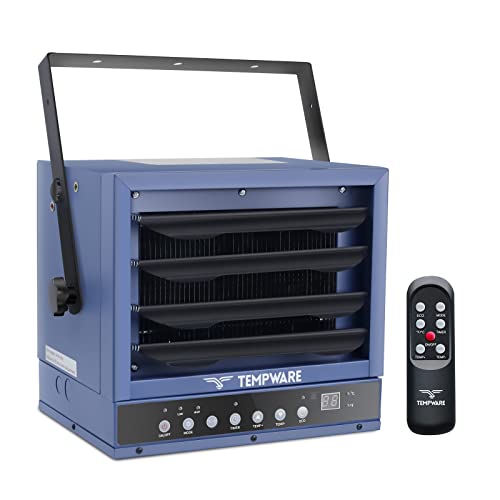
The TEMPWARE heater is a 7500W ceiling-mounted option with adjustable louvers, two heat settings (6,250W–7,500W), a full-function remote, ECO mode, and a 12-hour timer. It includes a built-in thermostat adjustable from 45°F to 95°F and automatic overheat protection for safety.
The unit advertises a maximum BTU equivalent of about 25,590 and the ability to heat up to 1,250 sq. ft., depending on insulation and layout. The adjustable angle and louvers let users direct heat where needed, making it suitable for medium garages and workshops where precise directional airflow and programmable controls are desired.
Buying Guide: Choosing An Overhead Shop Heater
Selecting an overhead shop heater involves balancing heat source, installation, coverage, controls, and safety. Below are the key factors to evaluate before purchasing.
Heat Source: Electric Vs Gas
- Gas (Natural Or Propane) — Offers high BTU output and lower operating cost in many regions for large, poorly insulated spaces. Requires fuel line hookup, combustion venting, and clearance considerations.
- Electric — Easier to install if 240V hardwire is available. Cleaner operation, no venting, and good for spaces where combustion is undesirable. Electric models vary by wattage and are best when matched to available electrical capacity.
Mounting And Placement
- Ceiling Mounts — Save floor space and distribute heat downward; ideal for stalls, garages, and workshops with open floor areas.
- Wall/Ceiling Flexible Mounts — Offer directional aiming and install flexibility for sidewall or overhead positioning.
- Clearances — Verify required clearances (e.g., Mr. Heater requires min 8 ft from floor to base); overhead mounting must comply with manufacturer specs and local codes.
Coverage And Output
- Match heater output to room size: BTU for gas and watts for electric. Consider insulation, ceiling height, and whether you need spot heating or whole-space convection.
- High-output gas units (e.g., 80,000 BTU) suit large, open, poorly insulated spaces. Electric units from 5,000–10,000W are better for medium-sized garages or well-insulated workshops.
Controls, Thermostat, And Scheduling
- Built-in thermostats and programmable timers reduce energy use and maintain comfort. Remote control and ECO modes add convenience.
- Digital displays help with troubleshooting (e.g., CTSC’s voltage display) and accurate setpoint control.
Installation And Electrical Requirements
- Electric Heaters — Often require 240V hardwiring and a dedicated circuit; verify breaker size and wiring gauge. Professional installation is recommended for high-wattage units.
- Gas Heaters — Require proper gas line sizing, venting, and adherence to combustion-air requirements. Use certified technicians for hookup and venting.
Safety Features And Certifications
- Look for ETL/UL listings, overheat protection, thermal cutouts, and tip/tilt sensors where applicable.
- For gas units, ensure correct venting category and clearances from combustibles. For electric models, verify housing durability and cooling/ventilation for long-term reliability.
Noise, Airflow, And Heat Distribution
- Fan-forced units provide faster warm-up and better convection; however, fans add noise. Consider fan-only modes for air circulation without heat.
- Adjustable louvers and mounting angles improve directional heating for benches or specific work zones.
Energy Efficiency And Operating Cost
- Electric heaters are near 100% efficient at point of use but may cost more depending on electricity rates. Gas heaters can be more economical for high BTU loads.
- Programmable thermostats, ECO modes, and timers reduce runtime and overall cost.
Durability And Environment
- Choose robust steel construction for harsh workshop conditions. Look for corrosion-resistant finishes in humid or unheated spaces.
- Consider IP ratings for units that may be exposed to dust or intermittent outdoor use.
Comparison Perspectives
- Size & Coverage — Choose a gas unit like Mr. Heater for very large bays; pick a 10,000W electric for medium-large insulated garages; use 5,000–7,500W ceiling units for single garages or targeted heating.
- Installation Complexity — Electric hardwired units are simpler (no venting) but need proper breakers. Gas units require venting and plumbing expertise.
- Operational Convenience — Models with digital thermostats, timers, and remote controls offer easier daily use and energy savings.
Use this guide to prioritize what matters most for your shop: raw power and lower fuel cost (gas), simple installation and cleaner operation (electric), or compact ceiling-mounted designs for targeted heating. Always verify local codes and manufacturer installation instructions before purchase and installation.
Tips for Getting the Best HVAC Prices
- Prioritize Quality Over Cost
The most critical factor in any HVAC project is the quality of the installation. Don’t compromise on contractor expertise just to save money. - Check for Rebates
Always research current rebates and incentives — they can significantly reduce your overall cost. - Compare Multiple Quotes
Request at least three estimates before making your choice. You can click here to get three free quotes from local professionals. These quotes include available rebates and tax credits and automatically exclude unqualified contractors. - Negotiate Smartly
Once you've chosen a contractor, use the proven strategies from our guide — How Homeowners Can Negotiate with HVAC Dealers — to get the best possible final price.