
The following guide compares top shop heating options including tube heaters, natural gas unit heaters, and high-powered electric garage heaters suitable for workshops and service bays. Below is a quick summary table of the selected products for easy comparison.
| Product | Type | Key Output | Mounting |
|---|---|---|---|
| SunStar Garage Tube Heater – SIR45-15-L | Propane/Natural Gas Tube Heater | 45,000 BTU | Ceiling / High-Mount |
| Mr. Heater Big Maxx MHU80NG | Natural Gas Unit Heater | 80,000 BTU | Wall/Ceiling |
| TEMPWARE Electric Garage Heater | Electric Fan-Forced Heater | Up To 25,590 BTU Equivalent | Ceiling Mount |
| VEVOR Electric Garage Heater 10000W | Electric Fan-Forced Heater | ~34,000 BTU Equivalent | Wall/Ceiling |
| Comfort Zone Hard-Wired Ceiling Heater CZ220BK | Electric Ceiling Heater | 5,000 Watt (Fan-Forced) | Ceiling Mount |
Content Navigation
- SunStar Heating Products Garage Tube Heater – LP, 45,000 BTU
- Mr. Heater F260560 Big Maxx MHU80NG Natural Gas Unit Heater
- TEMPWARE Electric Garage Heater, 7500-Watt Digital Fan-Forced Ceiling Mount
- VEVOR Electric Garage Heater, 10000-Watt Digital Fan-Forced Shop Heater
- Comfort Zone Hard-Wired Ceiling Mount Garage Electric Heater CZ220BK
- Buying Guide: How To Choose The Right Shop Tube Heater Or Garage Heater
- 1. Heating Type And Heat Distribution
- 2. Fuel Source And Operating Cost
- 3. Installation And Mounting
- 4. Coverage Area And BTU/Watt Capacity
- 5. Control Features And Thermostat Options
- 6. Venting, Combustion Air, And Safety
- 7. Durability, Warranty, And Certification
- 8. Noise And Air Movement
- 9. Electrical Service And Panel Capacity
- 10. Layout And Zoning Strategies
SunStar Heating Products Garage Tube Heater – LP, 45,000 BTU

The SunStar tube heater is a linear infrared-style heater designed for overhead installation. Its compact 110-inch length and ability to be mounted as low as 8 feet above the floor assist in installation flexibility for shops with limited ceiling height.
Key features listed by the manufacturer include efficiencies up to 84.5% and a rated output of 45,000 BTU. The tube form factor provides a long, narrow footprint suited to run along rafters or ceiling joists, delivering radiant heat to work areas without relying solely on room air circulation.
Use-case considerations: tube heaters like this model are generally effective at targeting work zones and vehicle bays. They require appropriate gas hookups and venting provisions per local codes. Installation height and clearances are critical for safe operation.
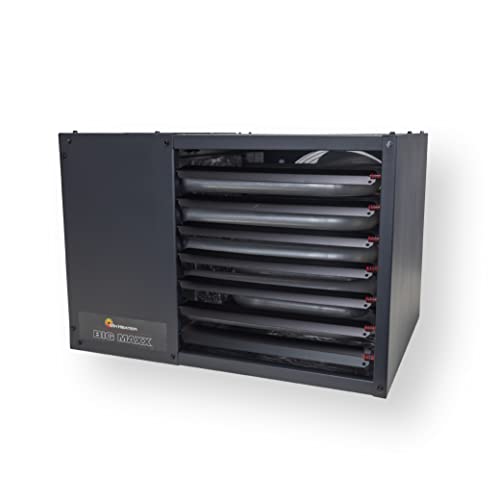
Mr. Heater F260560 Big Maxx MHU80NG Natural Gas Unit Heater
Call 888-896-7031 for Free Local HVAC Quotes – Compare and Save Today!
The Mr. Heater Big Maxx is a high-output natural gas unit heater intended for large garage and shop spaces. The unit’s specifications include 80,000 BTU performance and coverage up to roughly 2,000 sq. ft. when paired with appropriate ducting or open-space heating strategies.
This package includes two angle brackets and a liquid propane conversion kit; thermostats and line components are not included. The heater is designed for installation with minimum clearances (8 ft. from floor to base) and supports Category 1 vertical and Category 3 horizontal venting options.
Relevant considerations: unit heaters concentrate combustion and fan-driven heat in one cabinet, providing fast convective heating. They require gas connection, electrical supply (120 V), and compliant venting. Evaluate airflow patterns in the shop to determine optimal mounting orientation and louvers.
TEMPWARE Electric Garage Heater, 7500-Watt Digital Fan-Forced Ceiling Mount
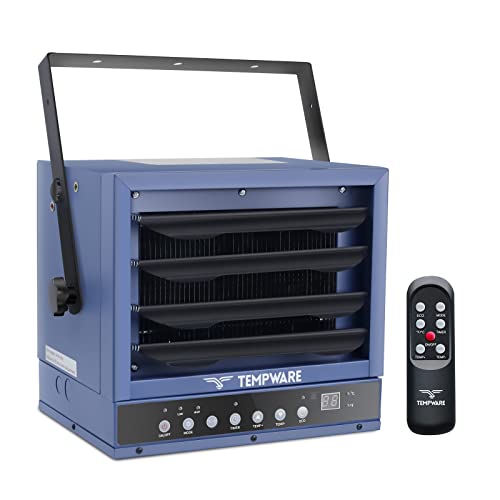
TEMPWARE’s ceiling-mounted electric model is offered as a hardwired solution with variable power ranges from 6,250 to 7,500 watts and an estimated maximum equivalent of 25,590 BTU. It includes a full-function remote, built-in thermostat, ECO mode, and a 12-hour timer for automated control.
Design highlights include adjustable louvers and a variable mounting angle to direct airflow. Safety features include overheat protection. The heater is positioned as suitable for areas up to approximately 1,250 square feet, depending on insulation and ceiling height.
Call 888-896-7031 for Free Local HVAC Quotes – Compare and Save Today!
Electric models like this avoid combustion byproducts and venting requirements, simplifying installation in many jurisdictions. They require appropriate 240V hardwiring and adequate circuit protection. Consider the electrical service capacity of the building before selection.
VEVOR Electric Garage Heater, 10000-Watt Digital Fan-Forced Shop Heater

The VEVOR 10,000W heater is a high-power electric solution for larger workshops, with a claim to cover up to 90 sq. meters. It offers two adjustable power levels, precise temperature control with a reported 2°F stability, and overheat automatic shutoff protection.
Construction uses SPCC cold-rolled steel for the cabinet and includes ETL certification. The unit supports wall or ceiling mounting and includes a remote and timer for convenience. The high wattage corresponds to elevated current demand and typically requires 240V service and a dedicated circuit.
When comparing to gas tube heaters, high-wattage electric units provide straightforward installation in spaces with adequate electrical infrastructure while avoiding combustion air and venting considerations. Electrical capacity and ongoing operating cost relative to fuel prices should be considered.
Comfort Zone Hard-Wired Ceiling Mount Garage Electric Heater CZ220BK

The Comfort Zone CZ220BK is a 5,000-watt hard-wired ceiling-mounted fan-forced heater designed for workshops and garages. It emphasizes a space-saving overhead form factor and adjustable louvers for targeted heating.
Key attributes include heavy-gauge steel construction for durability and targeted air distribution via adjustable mounting angle. The unit features thermal cut-out and overheat protection for safety and is ETL-compliant for electrical safety.
This model suits smaller to mid-sized workshop areas or as supplemental heating paired with other systems. Installation requires 240V hardwiring and proper electrical permitting where required. It is a compact option where floor space is limited.
Buying Guide: How To Choose The Right Shop Tube Heater Or Garage Heater
Selecting the appropriate heater for a workshop involves balancing heating performance, installation complexity, operational cost, and safety. Below are the primary factors to compare and verify before purchase.
1. Heating Type And Heat Distribution
- Tube Heaters (Infrared/Radiant) — Deliver radiant heat along a linear element. Effective for targeted work areas and vehicle bays where radiant warmth is preferred over heating all air volume.
- Unit Heaters — Combine combustion or electric elements with a fan to distribute convective heat. Suitable for rapidly warming larger volumes.
- Electric Fan-Forced Heaters — Provide fast convective heat without combustion products; they require adequate electrical capacity.
2. Fuel Source And Operating Cost
- Natural Gas / Propane — Often lower operational cost in many areas and higher BTU outputs per unit; requires gas lines and venting considerations and combustion clearances.
- Electric — Cleaner installation (no venting) but operating cost depends on local electricity rates and may require significant circuit capacity for high-wattage units.
3. Installation And Mounting
- Check minimum clearances from the floor, walls, and combustible materials as specified by the manufacturer.
- Ceiling-mounted tube heaters require secure rafters or joists and may need brackets to span joist spacing; unit heaters may need wall brackets or ceiling supports.
- Hardwiring versus plug-in: many high-capacity electric units require 240V hardwiring and a dedicated breaker.
4. Coverage Area And BTU/Watt Capacity
- Estimate the shop’s cubic volume (sq. ft. x ceiling height) and consider insulation level. Higher ceilings mean more heat loss; radiant heaters can be more efficient for spot heating.
- Compare BTU ratings for gas models and watt ratings for electric models; convert as needed (1 watt ≈ 3.412 BTU) to evaluate equivalent outputs.
5. Control Features And Thermostat Options
- Look for built-in thermostats, remote control, programmable timers, and ECO modes to manage runtime and reduce energy consumption.
- Compatibility with external thermostats or building control systems can be important in larger shops.
6. Venting, Combustion Air, And Safety
- Gas-fired heaters require correct venting category per installation (e.g., Category 1 vs Category 3), proper combustion air supply, and adherence to local codes.
- Electric heaters eliminate combustion concerns but still require overheat protection, thermal cutouts, and proper electrical protection.
- Consider installing CO monitoring and smoke detection where gas combustion is present.
7. Durability, Warranty, And Certification
- Prefer units with robust metal construction for workshop environments where debris and impacts are possible.
- Verify UL/ETL listings and manufacturer warranty terms for commercial or heavy-duty usage.
8. Noise And Air Movement
- Fan-forced heaters generate air movement and noise. If quiet operation is important for certain tasks, consider radiant tube heaters or lower-speed fan units.
- Evaluate louver adjustability and plume direction to avoid blowing dust across sensitive work surfaces.
9. Electrical Service And Panel Capacity
- High-wattage electric options require the correct circuit breaker size, wiring gauge, and often 240V service. Confirm available electrical capacity before ordering.
- Consider staged or multi-unit installations to distribute electrical load.
10. Layout And Zoning Strategies
- Large shops benefit from zoning: use tube or radiant heaters to warm specific bays or workstations and maintain lower ambient temperature elsewhere to reduce costs.
- Combining systems (e.g., a gas unit heater for bulk heating and radiant tubes for spot warming) can optimize comfort and efficiency.
Comparison Perspectives
- Cost-Per-BTU Perspective — Gas systems typically provide more BTU per dollar of fuel in many regions; calculate local utility rates for accurate comparisons.
- Installation Complexity Perspective — Electric heaters have simpler installation when adequate electrical service exists; gas systems need venting and gas piping.
- Maintenance Perspective — Gas combustion systems require periodic inspection for venting and burner performance; electric systems generally need less routine combustion-related maintenance.
- Operational Flexibility Perspective — Radiant tube heaters provide precise spot heating; fan-forced units change room air temperature faster.
When evaluating a specific model, cross-check manufacturer-specified clearances, installation manuals, certification marks, and local code requirements. For mixed-use or commercial shops, consult a licensed HVAC or mechanical contractor to size equipment and plan safe installation and venting.
Tips for Getting the Best HVAC Prices
- Prioritize Quality Over Cost
The most critical factor in any HVAC project is the quality of the installation. Don’t compromise on contractor expertise just to save money. - Check for Rebates
Always research current rebates and incentives — they can significantly reduce your overall cost. - Compare Multiple Quotes
Request at least three estimates before making your choice. You can click here to get three free quotes from local professionals. These quotes include available rebates and tax credits and automatically exclude unqualified contractors. - Negotiate Smartly
Once you've chosen a contractor, use the proven strategies from our guide — How Homeowners Can Negotiate with HVAC Dealers — to get the best possible final price.