
Finding a space heater that provides steady warmth without a noisy blower matters for bedrooms, offices, and shared spaces. Below are five compact ceramic and PTC models that emphasize quieter operation and steady heat delivery. The summary table lists core specs to help you compare at a glance.
| Product | Heat Type | Power | Notable Feature |
|---|---|---|---|
| Dreo Space Heater (Upgraded) | PTC Ceramic | 1500W | Precise Thermostat, Tilt Sensor |
| Dreo Space Heater (Portable Remote) | PTC Ceramic | 1500W | 70° Oscillation, Quiet Mode |
| VOCRS 1500W PTC Heater | PTC Ceramic | 700/1000/1500W | Eco Mode, Remote, Timer |
| WINHL Small Portable Heater | PTC Ceramic | 1500W | Wide-Angle Auto Oscillation |
| Aikoper 1500W Electric Heater | PTC Ceramic | 1500W | Adjustable Thermostat, Fan Mode Option |
Content Navigation
- Dreo Space Heater, Portable Electric Heaters For Indoor Use
- Dreo Space Heater, 1500W PTC Ceramic Heaters With Remote
- Small Portable Space Heater VOCRS 1500W PTC Electric Heater
- Space Heater WINHL Small Portable Electric Heater With Thermostat
- Space Heater, 1500W Electric Heaters Indoor Portable (Aikoper)
- Buying Guide — Choosing A Low-Noise Or Fanless Space Heater
Dreo Space Heater, Portable Electric Heaters For Indoor Use

This PTC ceramic heater combines fast heat-up and a heat funnel design to move warm air farther without relying on a loud blower. The unit uses a Hyperamics PTC system and claims extended reach compared with traditional models. The enhanced NTC chipset supports temperature adjustments from 41–95°F in 1°F increments, improving energy use through precise control.
Safety systems include a tilt-detection sensor, overheat protection, V0 flame-retardant materials, and an ETL certification. The combination of rapid ceramic warming and smart thermostat control is useful for quiet zones where a fan would be distracting.
Dreo Space Heater, 1500W PTC Ceramic Heaters With Remote

This Dreo model highlights quiet heating, citing low noise levels (~34 dB) and an oblique airflow wheel for reduced wind noise. It uses 1500W PTC ceramic heating and features 70° oscillation to distribute warmth more evenly without a high-speed fan noise signature.
Call 888-896-7031 for Free Local HVAC Quotes – Compare and Save Today!
Other safety details include overheat and tip-over protection, V0 flame-retardant build, a 12-hour timer, and a longer flat power cord. The product targets rooms up to ~200 sq ft and emphasizes uninterrupted quiet operation for sleeping or working environments.
Small Portable Space Heater VOCRS 1500W PTC Electric Heater

The VOCRS heater provides three power modes (700W/1000W/1500W) and an Eco mode for energy-conscious use. It includes a remote and a high-definition display for easy adjustments without approaching the unit, which supports quieter operation by minimizing manual interaction.
A 1–12 hour timer and safety cutoffs are built in. For users wanting a balance between heating power and low sound signature, the adjustable modes allow lower-power, potentially quieter operation while retaining ceramic heat advantages.
Space Heater WINHL Small Portable Electric Heater With Thermostat

WINHL’s compact PTC heater emphasizes rapid heat-up and wide-angle auto oscillation to improve evenness of warmth in small rooms. The model includes a remote control for setting temperature, modes, and a 12-hour timer, enabling adjustments without approaching the unit.
Call 888-896-7031 for Free Local HVAC Quotes – Compare and Save Today!
Although it lists oscillation—commonly paired with internal air movement—the focus is on distributing ceramic-generated heat steadily rather than producing a distinct fan roar, making it suitable where low acoustic impact is desired.
Space Heater, 1500W Electric Heaters Indoor Portable (Aikoper)
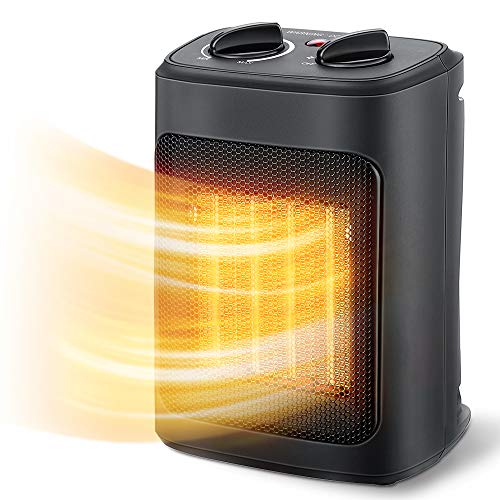
The Aikoper unit uses PTC ceramic technology and an adjustable thermostat to target comfort while avoiding unnecessary power use. It highlights three heat settings and a fan-only mode; users seeking minimal audible disruption can favor lower heat levels and avoid high-speed fan settings.
The design aims to warm small spaces quickly and evenly. Built-in thermostat control enables cycling behavior that often results in gentler, less obtrusive sound compared with continuous high-speed blower operation.
Buying Guide — Choosing A Low-Noise Or Fanless Space Heater
This guide covers practical considerations when selecting a heater that minimizes noise or avoids an exposed fan. Use multiple perspectives—acoustics, heat transfer, safety, and controls—to match the unit to your space and needs.
Tips for Getting the Best HVAC Prices
- Prioritize Quality Over Cost
The most critical factor in any HVAC project is the quality of the installation. Don’t compromise on contractor expertise just to save money. - Check for Rebates
Always research current rebates and incentives — they can significantly reduce your overall cost. - Compare Multiple Quotes
Request at least three estimates before making your choice. You can click here to get three free quotes from local professionals. These quotes include available rebates and tax credits and automatically exclude unqualified contractors. - Negotiate Smartly
Once you've chosen a contractor, use the proven strategies from our guide — How Homeowners Can Negotiate with HVAC Dealers — to get the best possible final price.
Heating Technology
- PTC Ceramic Elements heat quickly and stabilize; many use internal blowers but can remain relatively quiet at lower settings.
- Convection And Radiant Styles without fans rely on natural air movement; these are typically quieter but may heat slower or unevenly.
- Check whether manufacturers describe “fanless” or emphasize “quiet” dB ratings when silence is a priority.
Noise And Acoustic Performance
- Look for reported decibel (dB) figures—around 30–40 dB is comparable to a quiet library.
- Units with variable power levels allow operation at lower, quieter settings.
- Oscillation features can improve perceived evenness of heat without raising noise, depending on mechanism.
Control And Thermostat Precision
- A precise thermostat (1°F increments) helps keep cycling minimal and reduces blower runtime, lowering noise.
- Remote controls and timers reduce the need to interact physically with the unit, preserving quiet operation.
- Eco modes and programmable schedules improve efficiency and often reduce continuous fan use.
Safety Features
- Tip-over protection and overheat shutoff are essential for unattended use, especially in bedrooms.
- Look for flame-retardant materials and certifications such as ETL or UL listings.
- Avoid using extension cords unless the heater and cord are explicitly rated for that use.
Room Size And Placement
- Estimate required coverage—many 1500W models are rated for ~150–200 sq ft; adjust expectations for well-insulated spaces.
- Fanless convection or low-noise ceramic heaters are best near seating or bedside; place on stable, flat surfaces.
- Oscillation or directional designs help reach corners without boosting motor speed.
Energy Use And Operating Cost
- Higher wattage heats faster but may raise running costs. Use thermostatic control to minimize runtime.
- Multi-stage power settings (e.g., 700/1000/1500W) allow targeted heating and lower consumption when full power is unnecessary.
- Eco modes and timers reduce energy waste when continuous heating isn’t needed.
Durability And Maintenance
- Choose models with accessible filters (if present) and a design that prevents dust accumulation on heating elements.
- Regular dusting and keeping intake/exhaust areas clear helps maintain low-noise operation over time.
- Check warranty and user reviews for long-term reliability signals when noise or mechanical issues arise.
Comparison Perspectives
- Quietest Operation: Fanless convection or PTC heaters with low RPM internal motors typically register the lowest noise.
- Fastest Heat: PTC ceramic elements provide rapid surface warmth; pairing with oscillation improves perceived coverage.
- Best For Bedrooms: Prioritize tip-over protection, low dB ratings, and timers for overnight use.
- Best For Open Areas: Choose oscillation or higher-wattage units while monitoring noise at higher settings.