
Find reliable space heaters with precise thermostats, safety features, and versatile modes. This guide compares five top-rated models suited for bedrooms, offices, and larger rooms, highlighting thermostat accuracy, safety protections, and coverage so you can choose the right heater for your needs.
| Product | Brand | Key Features |
|---|---|---|
| Dreo 2025 Portable Heater | Dreo | 1500W PTC, 1°F thermostat increments, tilt sensor, ETL |
| GiveBest Portable Electric Heater | GiveBest | 2 heat levels, adjustable thermostat 0–158°F, tip-over protection |
| Dreo Oscillating PTC Heater | Dreo | 1500W PTC, 70° oscillation, 8 safety protections |
| Aikoper PTC Ceramic Heater | Aikoper | PTC ceramic, 3 heat settings, adjustable thermostat |
| Amazon Basics Oscillating Heater | Amazon Basics | 1500W, 45° oscillation, thermostat, compact |
Content Navigation
Dreo 2025 Portable Heater

Overview: This Dreo model uses a 1500W advanced PTC system with a heat funnel design to deliver instant warm air and extended circulation. The manufacturer states heat reaches up to 200% farther than some traditional heaters.
Thermostat & Controls: The unit features an enhanced NTC chipset offering thermostat control from 41°F to 95°F in 1°F increments, enabling precise temperature maintenance and potential energy savings through tighter cycling.
Safety & Certifications: Includes a tilt-detection sensor, overheat protection, V0 flame-retardant materials, and an ETL certification. The design aims to improve tip-over response and overall electrical safety.
Use Cases: Suited for bedrooms, offices, and medium rooms where precise temperature control and rapid warm-up are priorities. Remote control and timer functions increase convenience for scheduled operation.
Call 888-896-7031 for Free Local HVAC Quotes – Compare and Save Today!
GiveBest Portable Electric Heater

Overview: The GiveBest heater is a compact ceramic unit offering two heat levels (1500W and 750W) plus a cool-fan mode. It targets small rooms, desks, and offices where localized heating is needed.
Thermostat & Cycling: The adjustable thermostat is designed to turn off at the preset temperature and resume when the room drops, cycling to maintain comfort. The thermostat range is listed up to 158°F, providing a broad setpoint range.
Safety Features: Flame-retardant materials, automatic overheat shutoff, and tip-over protection are included. The heater is described to automatically shut off if tipped and resume if uprighted.
Portability & Efficiency: A built-in handle and a small footprint make this model portable. Its dual power levels allow lower energy use when full power is unnecessary.
Dreo Oscillating PTC Heater

Call 888-896-7031 for Free Local HVAC Quotes – Compare and Save Today!
Overview: This Dreo model combines 1500W PTC ceramic heating with 70° oscillation, a 12-hour timer, and multiple modes designed for larger coverage and quieter operation.
Thermostat & Modes: The unit offers several heating modes and remote operation, enabling setpoint adjustments and timer scheduling to maintain desired temperatures without manual intervention.
Safety & Noise: ETL-certified safety features include tip-over protection, overheat protection, a V0 flame-retardant plug, and a 6ft flat power cord. The manufacturer cites noise levels around 34 dB, intended for quiet settings like bedrooms or offices.
Coverage: Rated for coverage up to about 200 sq. ft. per the product details, which is common for 1500W ceramic heaters aimed at single-room heating.
Aikoper PTC Ceramic Heater
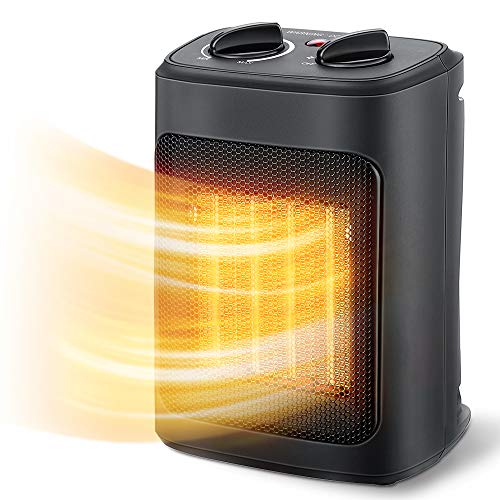
Overview: The Aikoper PTC ceramic heater focuses on rapid warm-up and energy-efficient localized heating. It offers three heat settings plus a fan-only mode for year-round use.
Thermostat & Settings: Equipped with an adjustable thermostat and a simple control dial, the heater monitors ambient temperature and cycles to maintain the selected setting, reducing continuous full-power operation.
Efficiency & Placement: The combination of PTC ceramic elements and an efficient fan aims to warm spaces quickly, suitable for small to medium rooms and for supplementing central heating.
Practical Notes: The dial-style thermostat simplifies adjustments but may offer less fine-grained setpoint control than digital units that list 1°F increments.
Amazon Basics Oscillating Heater

Overview: A compact oscillating ceramic heater with safety protections and multiple heat settings intended for portability and even heat distribution across a small room or workspace.
Thermostat & Options: The heater provides three settings—High (1500W), Low (900W), and Fan Only—and a thermostat to moderate output. The 45° oscillation enhances distribution across a wider area than a stationary unit.
Safety & Portability: Listed features include overheat and tip-over protection. Its lightweight design makes it easy to move between rooms where supplemental heat is needed.
Use Cases: Best suited for personal spaces, small bedrooms, and office desks where compact size and oscillation aid comfort without occupying much floor space.
Buying Guide: Choosing A Space Heater With A Thermostat
Thermostat Type And Accuracy
Digital thermostats with narrow increments (for example, 1°F) deliver finer temperature control and fewer overshoots compared with simple dial thermostats. If precise room temperature is important—sleeping, workshops, or energy savings—prefer digital thermostats or units that state specific increment accuracy.
Power Rating And Coverage
Most portable electric space heaters use up to 1500W. Coverage depends on insulation, ceiling height, and room layout. As a rough guide, a 1500W ceramic heater can adequately heat a well-insulated room up to about 200–250 sq. ft. Always compare manufacturer coverage claims with your room conditions.
Control Features: Modes, Timer, And Remote
Heaters with multiple modes (fan-only, low, high), programmable timers, and a remote provide flexibility. Timers and programmable setpoints can reduce runtime and lower energy consumption by avoiding unnecessary heating when rooms are unoccupied.
Safety Features And Certifications
Look for tip-over protection, overheat shutoff, flame-retardant materials, and ETL/UL listing. Tilt sensors that cut power instantly and auto shutoff timers enhance safety, especially in homes with pets and children. Avoid using heaters on unstable surfaces or with extension cords unless explicitly approved by the manufacturer.
Noise Level
If the heater will operate in a bedroom, nursery, or office, consider noise ratings or product descriptions citing dB levels. PTC ceramic units and those with optimized airflow can run in the low 30s dB—comparable to a quiet library—making them better for sleeping or focused work.
Oscillation And Airflow
Oscillating heaters spread warm air across a wider area. A heater with 45° to 70° oscillation improves even distribution and reduces hot/cold spots. For larger rooms, choose a unit that combines oscillation with higher airflow speeds.
Portability And Footprint
Consider size, weight, and handles for moving the heater between rooms. Compact models are convenient for desks and small spaces, while tower or larger ceramic units provide greater coverage for living areas.
Energy Efficiency And Cycling Behavior
A precise thermostat that cycles power on and off to maintain setpoints often uses less energy than a heater that runs continuously at full power. Models that allow lower watt settings (750W/900W) can reduce consumption when full heat is unnecessary.
Durability And Material Quality
V0 flame-retardant plastics and reinforced plugs increase long-term safety. Check for stable base designs and cord quality to reduce wear. Manufacturer-provided safety features often indicate attention to component quality.
Placement And Usage Recommendations
- Place heaters on flat, level surfaces away from water and flammable materials.
- Maintain clear space (manufacturer-recommended) around the heater to ensure circulation and prevent heat buildup.
- Avoid powering high-draw heaters through extension cords or power strips unless rated for the heater’s current.
Noise, Sleep, And Occupant Comfort
If you or household members are sensitive to noise, choose models that explicitly list low dB operation or advertise whisper-quiet fans. Oscillating and high airflow designs can increase perceived noise, so review noise specs when available.
Warranty And Support
Review manufacturer warranties and support options. Warranties offer protection against defects, and accessible customer support can be important for troubleshooting thermostat or electronic control issues.
Comparison Perspectives
- Precision vs Simplicity: Digital thermostat models offer tighter control; dial thermostats are simpler and often less costly.
- Coverage vs Portability: Tower and larger ceramic units heat bigger areas but are less compact than small desktop heaters.
- Safety Emphasis: Models with multiple ETL-listed safety features (tilt sensors, overheat shutoff, flame-retardant materials) are preferred for households with children or pets.
- Noise vs Airflow: Higher airflow and oscillation support faster warming and distribution but may increase noise—balance based on intended placement.
Final Selection Tips
Match the heater’s thermostat precision, power, and safety features to your room size and intended use. For sleeping areas, prioritize low noise and precise thermostatic control. For occasional localized warmth, a compact dual-power unit with a basic thermostat may suffice. Always follow manufacturer placement and safety guidelines to ensure reliable operation.
Tips for Getting the Best HVAC Prices
- Prioritize Quality Over Cost
The most critical factor in any HVAC project is the quality of the installation. Don’t compromise on contractor expertise just to save money. - Check for Rebates
Always research current rebates and incentives — they can significantly reduce your overall cost. - Compare Multiple Quotes
Request at least three estimates before making your choice. You can click here to get three free quotes from local professionals. These quotes include available rebates and tax credits and automatically exclude unqualified contractors. - Negotiate Smartly
Once you've chosen a contractor, use the proven strategies from our guide — How Homeowners Can Negotiate with HVAC Dealers — to get the best possible final price.