
Finding the right heating solution for a travel trailer requires balancing efficiency, installation type, and power source. The table below summarizes five well-suited products that cover forced-air furnaces, rooftop heat-pump units, 12V options, and insulation accessories to improve HVAC performance.
| Product | Type | Key Feature |
|---|---|---|
| FOGATTI 35,000 BTU Quiet RV Furnace | Propane Furnace | High BTU, 4 Power Levels, Fault Monitor |
| Udekoo 12V RV Air Conditioner 15000 BTU | 12V Rooftop Heat Pump | 12V Scroll Compressor, Cooling & Heating |
| RecPro RV Air Conditioner 13.5K BTU | Rooftop Heat Pump (110–120V) | Low Amp Draw, Ultra-Quiet |
| Vanrste 12V RV Air Conditioner (7,900 BTU Cooling) | 12V Rooftop Heat Pump | Fits Skylight Openings, All-Season |
| Camco Camper/RV Vent Insulator (14″) | Insulation Accessory | 3-Layer Reflective Insulation, Increases A/C Efficiency |
Content Navigation
- FOGATTI 35,000 BTU Quiet RV Furnace
- 12V RV Air Conditioner 15000 BTU Ultra-Quiet AC
- RecPro RV Air Conditioner 13.5K BTU | Low Profile
- 12V RV Air Conditioner Ultra-Quiet AC (Vanrste)
- Camco Camper/RV Vent Insulator And Skylight Cover
- Buying Guide: Choosing The Right Heating Solution For Your Travel Trailer
- 1. Heating Type And Performance
- 2. Power Source And Energy Use
- 3. Climate And BTU Sizing
- 4. Installation And Compatibility
- 5. Noise, Comfort Modes, And Controls
- 6. Efficiency And Operating Costs
- 7. Durability And Weather Resistance
- 8. Maintenance And Serviceability
- 9. Safety Considerations
- 10. Combining Solutions
FOGATTI 35,000 BTU Quiet RV Furnace
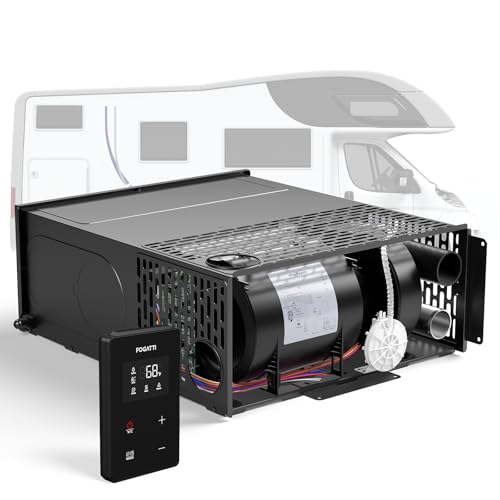
This propane furnace is designed for rapid heating in campers, motorhomes, and travel trailers. The unit offers a maximum output of 35,000 BTU with four adjustable power levels down to 17,000 BTU, delivering up to 260 CFM airflow for faster warm-up times.
Key technical highlights listed include a 3-mode control (quick heat/standard/sleep), a built-in fault monitor for troubleshooting, and an upgraded high-efficiency heat exchanger that maximizes gas usage and sustains output up to 176°F. These features make it a strong option when continuous, high-output heating is needed during very cold nights.
Installation considerations: this type of furnace typically requires a dedicated furnace cavity, proper venting for combustion gases, and a compatible thermostat. Its high-BTU output suits larger trailers or cold-climate use where fast heat recovery and sustained warmth are priorities.
12V RV Air Conditioner 15000 BTU Ultra-Quiet AC

Call 888-896-7031 for Free Local HVAC Quotes – Compare and Save Today!
This rooftop unit uses a 12V DC scroll compressor, enabling operation from a battery bank without engine idling. The manufacturer highlights energy efficiency suitable for off-grid or extended boondocking, and it combines both cooling and heating capability via a heat pump function.
Product features emphasize durability with an ABS housing resistant to UV and deformation and a high protection rating of IPX6K, indicating strong weather protection for driving in varied conditions. The listing notes reduced reliance on gasoline and potential fuel savings when using battery-based power.
Practical use: 12V heat-pump systems perform best in milder cold conditions and are optimal where silent, battery-powered heating is preferred. Consider battery capacity, inverter/charger setup, and whether the heat-pump capacity meets your trailer’s heating load in sub-freezing temperatures.
RecPro RV Air Conditioner 13.5K BTU | Low Profile

The RecPro rooftop unit is a 13.5K BTU heat pump designed for quiet, energy-efficient operation on standard 110–120V shore power. Noted features include a low amp draw for simultaneous use with other RV appliances and an aerodynamic, UV-resistant housing for durability.
The listing specifies 47 dB operation, which is marketed as ultra-quiet and beneficial for sleeping or working inside the trailer. The RecPro emphasizes rugged construction and fit compatibility with most RV rooftops, making it suitable for owners seeking a balance between power and efficiency on grid power.
Call 888-896-7031 for Free Local HVAC Quotes – Compare and Save Today!
Considerations: this model is best where reliable shore power or generator capacity is available. Its combination of quieter operation and low electrical draw makes it a candidate for owners prioritizing indoor noise levels and modest energy consumption.
12V RV Air Conditioner Ultra-Quiet AC (Vanrste)
This 12V rooftop unit provides all-season comfort with 7,900 BTU cooling3,000 BTU heating
The product notes emphasize high efficiency
Practical notes: as with other 12V heat-pump units, performance in very cold temperatures will be limited compared to propane furnaces. Assess battery bank size, charging strategy (solar or DC charging), and roof opening compatibility before selection.
Camco Camper/RV Vent Insulator And Skylight Cover

This accessory is a 3-layer vent insulator designed to reduce heat transfer through a standard 14″ RV roof vent. It reflects solar heat and provides additional insulation to help keep interiors cooler in summer and warmer in winter.
Camco’s listing highlights improved A/C efficiency and compatibility with most motorhomes, travel trailers, and fifth wheels. Using vent insulation reduces HVAC load, which can translate to shorter run times for both heat pumps and furnaces, and can be particularly effective when combined with other insulation strategies.
Installation is straightforward for standard vents and is a low-cost, low-complexity approach to improving overall thermal performance of a travel trailer without modifying the HVAC system itself.
Buying Guide: Choosing The Right Heating Solution For Your Travel Trailer
Selecting the best heating option depends on trailer size, climate, power availability, and travel habits. Below are critical considerations and comparison perspectives to help guide a purchase.
Tips for Getting the Best HVAC Prices
- Prioritize Quality Over Cost
The most critical factor in any HVAC project is the quality of the installation. Don’t compromise on contractor expertise just to save money. - Check for Rebates
Always research current rebates and incentives — they can significantly reduce your overall cost. - Compare Multiple Quotes
Request at least three estimates before making your choice. You can click here to get three free quotes from local professionals. These quotes include available rebates and tax credits and automatically exclude unqualified contractors. - Negotiate Smartly
Once you've chosen a contractor, use the proven strategies from our guide — How Homeowners Can Negotiate with HVAC Dealers — to get the best possible final price.
1. Heating Type And Performance
- Propane Furnaces (e.g., FOGATTI): Provide high-BTU output and fast warm-up, effective in sub-zero conditions and large interiors. Require ventilation for combustion and a propane supply.
- Electric Heat Pumps / Rooftop Units (RecPro, rooftop heat pumps): Offer combined heating and cooling with no combustion. Best when shore power or generator power is readily available. Heat pump performance drops as outdoor temperatures fall.
- 12V DC Heat Pumps (Udekoo, Vanrste): Allow silent, battery-powered operation for off-grid use. Ideal for mild-to-moderate cold; not as effective for extreme cold without auxiliary heat or large battery/solar systems.
2. Power Source And Energy Use
- Match the unit to the available power: 110–120V rooftop units suit campsites with shore power. 12V units require a robust battery system and often a solar or alternator charging plan.
- Consider low amp draw ratings if you plan to run other appliances. Low-amp designs are better for limited electrical systems.
- Propane furnaces reduce electrical load but require safe propane storage, regular venting, and combustion air.
3. Climate And BTU Sizing
- Estimate heating load based on trailer volume, insulation quality, and expected low temperatures. Manufacturers list BTU outputs—higher BTU is necessary for large trailers or cold climates.
- Heat pumps yield better efficiency in mild climates; propane furnaces maintain output in sub-freezing conditions.
4. Installation And Compatibility
- Check roof opening sizes and duct/vent layouts. Rooftop units require correct mounting and roof reinforcement. 12V skylight-type units require compatible openings.
- Furnaces require a dedicated cavity, flue/venting, and thermostat wiring. Verify that the trailer has sufficient space and clearances.
5. Noise, Comfort Modes, And Controls
- Noise levels vary—recall listings that specify dB values (e.g., RecPro at ~47 dB). If sleeping comfort is a priority, choose models marketed as ultra-quiet.
- Look for multiple modes (quick heat/standard/sleep) and diagnostics or fault monitors that simplify maintenance and troubleshooting.
6. Efficiency And Operating Costs
- Consider long-term operating costs: propane usage for furnaces vs. electricity or battery draw for heat pumps. 12V systems may reduce fuel use but shift demand to battery capacity and charging systems.
- Insulation accessories (Camco vent insulator, window shade rolls) can lower HVAC run time and effectively reduce operating costs regardless of heat source.
7. Durability And Weather Resistance
- Choose units with UV-resistant housings and rated protection for rooftop exposure. IP ratings and material construction indicate resilience to weather and road vibration.
- Accessories like vent insulators and stainless-steel vent screens help protect HVAC openings from pests and heat transfer issues.
8. Maintenance And Serviceability
- Confirm local service availability for complex systems (propane furnace maintenance or rooftop unit repairs). Check for replaceable filters, accessible panels, and manufacturer support.
- Regularly inspect vent screens and insulators to maintain airflow and efficiency.
9. Safety Considerations
- For combustion heaters, ensure correct venting, carbon-monoxide detection, and adherence to manufacturer installation instructions.
- For electric and 12V systems, verify proper wiring, fusing, and battery management to avoid overloads.
10. Combining Solutions
- Many RV owners use a hybrid approach: a propane furnace for cold-weather reliability plus rooftop heat pumps or A/C for mild heating and cooling. Adding insulation accessories improves overall system performance.
- Evaluate how accessories like vent insulators and window shades reduce total heat loss and may allow a smaller primary heater to meet comfort goals.