
Finding the right under sink heater means balancing size, power, and installation needs. The table below summarizes five top point-of-use options selected for compact kitchens, RVs, and bathroom sinks.
| Product | Type | Capacity / Power | Key Feature |
|---|---|---|---|
| ECOTINYMACH 110V Tankless Water Heater | Tankless | 3000W (110V) | Compact, Fahrenheit/Celsius switch |
| Nessxa 1.8 Gallon Mini Tank Water Heater | Mini Tank | 1500W, 1.8 gallon | Adjustable thermostat, compact storage |
| LECLOC 3kW 120V Mini Instant Hot Water Heater | Tankless | 3000W (120V) | LED display, multi-protection |
| BISELONG 2.5 Gallon Small Under Sink Tank | Mini Tank | 1440–1500W, 2.5 gallon | Thick 304 stainless steel, rapid recovery |
| ThermoMate 1.32 Gallon Mini Tank Water Heater ES150 | Mini Tank | 120V, 1.3 gallon | Compact size, UL listed, plug-in |
Content Navigation
- ECOTINYMACH 110V Tankless Water Heater Electric
- 1.8 Gallon Electric Mini Tank Water Heater (Nessxa)
- LECLOC 3kW 120V Mini Instant Hot Water Heater
- BISELONG 2.5 Gallon Small Under Sink Water Heater (BI-2.5)
- ThermoMate Mini Tank Water Heater ES150
- Buying Guide: Choosing The Right Under Sink Heater
- Type: Tankless Versus Mini Tank
- Power And Electrical Requirements
- Flow Rate And Temperature Rise
- Installation And Space Constraints
- Materials, Build Quality, And Safety Features
- Energy Efficiency And Operating Costs
- Use Cases And Matching Products
- Installation Complexity And Maintenance
- Comparison Perspectives
ECOTINYMACH 110V Tankless Water Heater Electric

This tankless point-of-use heater targets users who need a compact, wall-mounted solution. The unit advertises a 3000W heating element on 110V which is intended for low-flow fixtures. The design emphasizes a compact footprint for under-sink installation and space-limited cabinets.
Features listed include a convertible temperature scale allowing Fahrenheit or Celsius display, and an easy installation approach. As with other tankless 110V models, output temperature depends on inlet water temp and flow rate; it works best for a single sink or low-flow tap. The product is suitable where continuous on-demand hot water at small flow rates is needed without a storage tank.
1.8 Gallon Electric Mini Tank Water Heater (Nessxa)

The Nessxa model is a mini tank storage heater sized at 1.8 gallons with a 1500W heating element for standard 120V circuits. It supplies near-instant hot water by holding a small reservoir of heated water close to the faucet.
Call 888-896-7031 for Free Local HVAC Quotes – Compare and Save Today!
Key product features include a wide temperature adjustment range (25°C–80°C) and an adjustable thermostat accessible from the panel. The mini tank design is intended to reduce water waste and wait times compared with distant central heaters. Construction notes cite an ABS exterior and stainless steel internal tank to support separation of water and electrical components. The unit can be wall- or floor-mounted under cabinets and is positioned for sink or small bathroom point-of-use needs.
LECLOC 3kW 120V Mini Instant Hot Water Heater

LECLOC’s 3kW tankless unit offers a digital LED display and a user-friendly knob for temperature and power control. It’s designed for low-flow point-of-use applications and explicitly notes it is not suitable for showers or multiple simultaneous outlets at typical household flows.
The listing highlights multiple safety protections including leakage protection, overheat and dry-run protection, IPX4 splash resistance, automatic fault diagnosis, and constant temperature memory. The product aims to be smart and safe for kitchen or single-sink installations where a visual temperature display and straightforward control are priorities.
BISELONG 2.5 Gallon Small Under Sink Water Heater (BI-2.5)
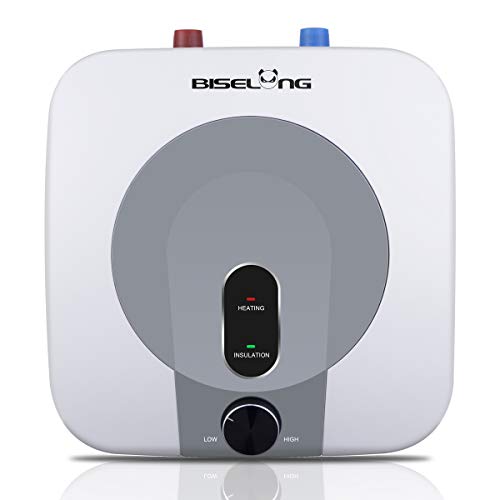
The BISELONG model is a 2.5-gallon mini storage tank with a 1440–1500W heating element and a stainless steel tank body. Its thicker 304 stainless construction and laser welding are emphasized to resist rust and pressure.
Call 888-896-7031 for Free Local HVAC Quotes – Compare and Save Today!
This unit focuses on rapid temperature recovery, claiming 8–15 minute heat-up for the stated capacity and the ability to service two sinks in some use cases. It includes a smart inverter function to maintain set temperature and reduce energy use, plus compact dimensions intended for under-sink cabinets, RVs, or food trucks.
ThermoMate Mini Tank Water Heater ES150

ThermoMate’s ES150 is a 1.32-gallon point-of-use tank with plug-in convenience for standard 120V outlets. It emphasizes no-wait hot water at the sink and compact sizing for tight installations.
Key features include a three-level thermostat with a freeze mode and UL listing. The unit advertises fast recovery and high thermal efficiency, designed for single-sink locations and spaces where a simple plug-in mini tank is preferred over hard-wired tankless systems.
Buying Guide: Choosing The Right Under Sink Heater
Selecting an under sink heater requires matching capacity, power, installation, and intended use. Below are primary considerations and comparison perspectives to help narrow choices.
Type: Tankless Versus Mini Tank
- Tankless (On-Demand): Heats water as it flows. Pros: continuous hot water at low flow, compact wall-mounted options, reduced standby heat loss. Cons: performance depends on inlet temperature and flow rate, may require higher amperage or 240V for greater output.
- Mini Tank (Storage): Holds a small reservoir of hot water. Pros: simple installation, plug-in models available, consistent immediate hot water until tank depletes. Cons: limited capacity requiring recovery time and potential standby heat loss.
Power And Electrical Requirements
- Check voltage and amperage: many tankless units require 3000W or more and can be 120V/110V limited in flow performance; larger outputs may need 240V and dedicated circuits.
- Mini tanks commonly run on 120V at 1500W and may plug into a standard outlet, simplifying installation.
- For RVs or mobile setups, confirm vehicle electrical compatibility and breaker sizing.
Flow Rate And Temperature Rise
- Flow Rate: Measured in gallons per minute (GPM). Tankless 3kW on 120V typically supports low GPMs suitable for a single faucet, not showers.
- Temperature Rise: The achievable increase depends on inlet temperature and heating power. Lower inlet temps (winter) reduce outlet temperature at a given flow.
Installation And Space Constraints
- Measure cabinet space for under-sink placement; tankless models are often slimmer, while mini tanks require floor or wall clearance for plumbing and safety valves.
- Consider whether you need a plug-in model or will hard-wire the unit. Hard-wiring may increase cost and require an electrician but may allow higher-wattage models.
- Look for included mounting hardware, T&P valves, and diverter fittings if you plan to serve multiple outlets.
Materials, Build Quality, And Safety Features
- Stainless steel tanks and robust heating elements can extend life and resist corrosion.
- Safety features to compare: overheat protection, dry-fire protection, leakage detection, T&P relief valve (for tanks), waterproof ratings (IPX) for tankless electronics.
- Certifications such as UL listing can indicate third-party safety testing.
Energy Efficiency And Operating Costs
- Tankless systems avoid standby losses but may draw higher peak power when heating. Mini tanks keep a small volume hot, which can be efficient for frequent short uses at a single point.
- Smart controls, insulation, and thermostatic settings reduce wasted energy. Consider recover time and standby losses relative to your household use patterns.
Use Cases And Matching Products
- Single Kitchen Sink In Home: A 1.3–2.5 gallon mini tank or a 3kW low-flow tankless on 120V often suffices.
- Wet Bar / Small Bathroom: Compact tankless or 1–1.8 gallon tanks offer rapid hot water without large footprint.
- RV / Food Truck: Stainless steel mini tanks and low-voltage tankless models designed for mobile use handle vibration and limited space.
- Multiple Fixtures Or Shower Use: Consider higher-wattage tankless requiring 240V or larger storage systems designed for multiple outlets.
Installation Complexity And Maintenance
- Tankless units may need dedicated breakers and professional installation for higher-wattage models; confirm wiring and code requirements.
- Mini tanks often include accessible thermostats and replaceable elements; periodic flushing reduces scale buildup in hard water areas.
- Check warranty terms and available replacement parts for heating elements, valves, and sensors.
Comparison Perspectives
- Performance vs. Simplicity: Tankless models provide continuous hot water at low flows but can be sensitive to inlet temperature. Mini tanks provide immediate hot water at simple plug-and-play convenience.
- Upfront Cost vs. Operating Efficiency: Higher-wattage tankless units or 240V installs increase upfront cost but may reduce long-term water waste. Mini tanks can be less expensive to install but may use energy maintaining stored heat.
- Durability vs. Portability: Stainless steel tanks and heavy-duty elements favor durability for mobile or high-use environments. Lightweight ABS-bodied units are easier to move and install but may have different longevity characteristics.
Use the above criteria to match the chosen model to your specific fixtures, electrical setup, and usage patterns. Inspect product specs for flow performance claims, installation requirements, and safety certifications before purchasing.
Tips for Getting the Best HVAC Prices
- Prioritize Quality Over Cost
The most critical factor in any HVAC project is the quality of the installation. Don’t compromise on contractor expertise just to save money. - Check for Rebates
Always research current rebates and incentives — they can significantly reduce your overall cost. - Compare Multiple Quotes
Request at least three estimates before making your choice. You can click here to get three free quotes from local professionals. These quotes include available rebates and tax credits and automatically exclude unqualified contractors. - Negotiate Smartly
Once you've chosen a contractor, use the proven strategies from our guide — How Homeowners Can Negotiate with HVAC Dealers — to get the best possible final price.