
Choosing a wall mounted gas heater with a thermostat helps maintain steady, efficient warmth in targeted rooms. Below is a quick comparison table of five relevant wall-mounted gas heaters, selected for their mounting style, thermostat control, fuel type, and heating capacity.
| Product | Fuel Type | Thermostat | BTU / Coverage |
|---|---|---|---|
| Comfort Glow 25,000 BTU Direct Vent Natural Gas | Natural Gas (Direct Vent) | Not Listed | 25,000 BTU — Up To 825 Sq. Ft. |
| ProCom MN100TBA-B Ventless Natural Gas Blue Flame | Natural Gas (Ventless) | Built-In Thermostat Control | 10,000 BTU — Up To 500 Sq. Ft. |
| Comfort Glow 17,000 BTU Direct Vent Natural Gas | Natural Gas (Direct Vent) | Not Listed | 17,000 BTU — Up To 570 Sq. Ft. |
| Mr. Heater MHVFBF30NGT 30,000 BTU Vent Free Blue Flame | Natural Gas (Vent Free) | Built-In Thermostat | 30,000 BTU — Up To 1,000 Sq. Ft. |
| Dyna-Glo BFSS20NGT-2N 20,000 BTU Vent Free Blue Flame | Natural Gas (Vent Free) | Thermostatic Control (Listed) | 10,000–20,000 BTU — Up To 700 Sq. Ft. |
Content Navigation
- Comfort Glow 25,000 BTU Natural Gas Wall Heater
- ProCom MN100TBA-B Ventless Natural Gas Heater
- Comfort Glow 17,000 BTU Natural Gas Wall Heater
- Mr. Heater 30,000 BTU Vent Free Blue Flame Heater
- Dyna-Glo 20,000 BTU Natural Gas Blue Flame Heater
- Buying Guide: Choosing A Wall Mounted Gas Heater With Thermostat
Comfort Glow 25,000 BTU Natural Gas Wall Heater

This direct vent natural gas wall heater delivers 25,000 BTU and is specified to heat up to 825 sq. ft. The sealed burn system and Matchless Piezo Ignition are designed to isolate combustion from the room air, and a safety pilot with a pressure regulator shuts off gas flow if the pilot is extinguished. The product emphasizes a space-saving mounted design with dimensions of 26.5 H x 32.25 W x 8.75 D. While thermostat functionality is not specified in the listed features, the model is relevant where a vented wall-mounted solution and sealed combustion are preferred for air quality and safety.
ProCom MN100TBA-B Ventless Natural Gas Heater

The ProCom MN100TBA-B is a ventless blue flame space heater rated at 10,000 BTU and sized for areas up to 500 sq. ft. Its listed features include a built-in thermostat control with High/Medium/Low settings, and the unit offers both wall mount and floor placement with included hardware and base feet. The slim, modern profile is highlighted along with versatility for offices, bedrooms, or living rooms. As a ventless model, combustion products are released into the room, which is an important consideration for ventilation and local codes.
Comfort Glow 17,000 BTU Natural Gas Wall Heater

Call 888-896-7031 for Free Local HVAC Quotes – Compare and Save Today!
This Comfort Glow direct vent model provides 17,000 BTU and is rated to heat up to 570 sq. ft. Like other Comfort Glow vented units it uses a sealed burn system, Matchless Piezo Ignition, and a safety pilot with a pressure regulator to stop gas flow if the pilot goes out. The unit is noted for a compact wall-mounted footprint with dimensions of 20 H x 27.3 W x 6.5 D. Thermostat presence is not specified in the provided features; this is a vented option for homes prioritizing isolated combustion and air quality.
Mr. Heater 30,000 BTU Vent Free Blue Flame Heater
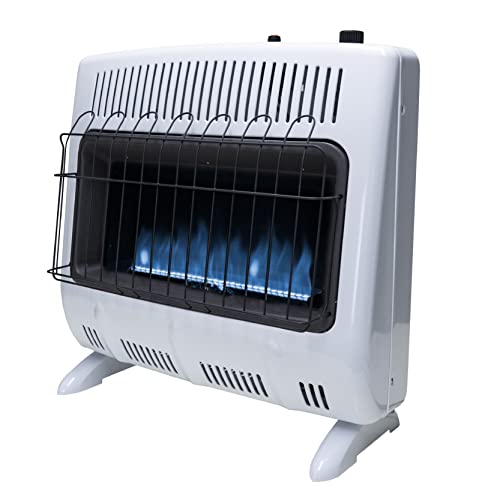
The Mr. Heater MHVFBF30NGT is a vent-free blue flame wall heater delivering up to 30,000 BTU, suitable for spaces up to 1,000 sq. ft. It explicitly lists a precise thermostat for temperature adjustment and includes a battery for the electric ignition. The blue flame burner is described as fuel-efficient and provides convective, even heat. As a vent-free heater, it vents combustion byproducts to the living space, which impacts placement, local code compliance, and required ventilation considerations.
Dyna-Glo 20,000 BTU Natural Gas Blue Flame Heater

The Dyna-Glo BFSS20NGT-2N is a vent-free blue flame thermostatic wall heater that specifies adjustable output between 10,000 and 20,000 BTU and coverage up to 700 sq. ft. The blue flame design uses convective heating similar to central systems. The listed features note thermostatic control and that it is ready for natural gas. Being vent-free, this model requires attention to room ventilation, occupant sensitivity, and compliance with local codes and safety recommendations.
Buying Guide: Choosing A Wall Mounted Gas Heater With Thermostat
When selecting a wall mounted gas heater with thermostat functionality, evaluate these key factors to match the heater to your space and priorities.
Call 888-896-7031 for Free Local HVAC Quotes – Compare and Save Today!
Fuel Type And Venting
- Natural Gas vs Propane: Confirm local fuel availability and whether lines or tanks are needed.
- Vented (Direct Vent) vs Vent-Free: Direct vent models isolate combustion air and exhaust outdoors, improving indoor air quality. Vent-free models are more efficient at delivering heat to the room but release combustion byproducts into indoor air.
Thermostat And Control Features
- Built-In Thermostats: Provide automatic temperature regulation; check whether the thermostat is mechanical or electronic for accuracy.
- Temperature Range And Settings: Look for adjustable ranges and multiple heat levels (High/Medium/Low) for finer control.
- Integration: Some units offer simple onboard thermostats only; others may allow remote thermostats or integration with home controls—verify compatibility if networked control is needed.
BTU Output And Coverage
- Match BTU To Room Size: Use manufacturer coverage estimates as a guideline and factor in ceiling height, insulation, window area, and climate.
- Adjustability: Units with variable BTU ranges or multiple settings provide better comfort tuning.
Safety And Certifications
- Sealed Combustion And Safety Pilot: Direct vent models often include sealed burn systems and safety pilots with pressure regulators; these reduce indoor combustion exposure.
- Oxygen Depletion Sensor (ODS): Common in vent-free appliances—shuts off the unit if oxygen falls below safe levels.
- Local Codes And Installation Requirements: Verify local building codes and whether a professional gas fitter is required for installation.
Ventilation, Indoor Air Quality, And Occupant Health
- Vent-Free Considerations: These models can increase indoor moisture and combustion byproducts. They are often not recommended for small, poorly ventilated, or allergy-sensitive spaces.
- Direct Vent Advantages: Preferred in occupied spaces where combustion isolation is a priority (e.g., bedrooms, continuous occupancy).
Mounting, Size, And Installation
- Wall Space And Clearance: Verify product dimensions and clearance requirements in the manual.
- Mounting Hardware: Many units include wall-mount brackets and base feet for flexible placement—confirm what’s included.
- Professional Installation: Gas connections and venting typically require licensed professionals to ensure safety and code compliance.
Efficiency, Fuel Usage, And Operating Costs
- Heat Distribution: Blue flame burners and infrared elements distribute heat differently—consider convection vs radiant needs.
- Thermostat Accuracy: More accurate controls can reduce cycling and fuel waste by holding target temperatures with fewer swings.
Comparison Perspectives
- Safety-Focused Buyers: Prefer direct vent sealed-combustion units for isolated combustion and reduced indoor emissions.
- Max-Heat Coverage Seekers: Higher BTU vent-free or high-BTU direct vent models can handle larger rooms; check thermostat control to avoid overshoot.
- Cost And Installation-Conscious Users: Vent-free units often avoid complex venting installations, but evaluate long-term indoor air impacts.
Use the table and the feature-focused reviews above to weigh trade-offs between venting, thermostat control, heating capacity, and safety before final selection. Ensure any installation meets local codes and consider professional installation for gas and venting work.
Tips for Getting the Best HVAC Prices
- Prioritize Quality Over Cost
The most critical factor in any HVAC project is the quality of the installation. Don’t compromise on contractor expertise just to save money. - Check for Rebates
Always research current rebates and incentives — they can significantly reduce your overall cost. - Compare Multiple Quotes
Request at least three estimates before making your choice. You can click here to get three free quotes from local professionals. These quotes include available rebates and tax credits and automatically exclude unqualified contractors. - Negotiate Smartly
Once you've chosen a contractor, use the proven strategies from our guide — How Homeowners Can Negotiate with HVAC Dealers — to get the best possible final price.